Exploring the Wonders of Messier 22: A Historical and Astronomical Perspective
Messier 22, the first globular cluster discovered in history, offers fascinating insights into stellar formation and galactic dynamics. Explore its discovery, characteristics, and significance in astronomy.
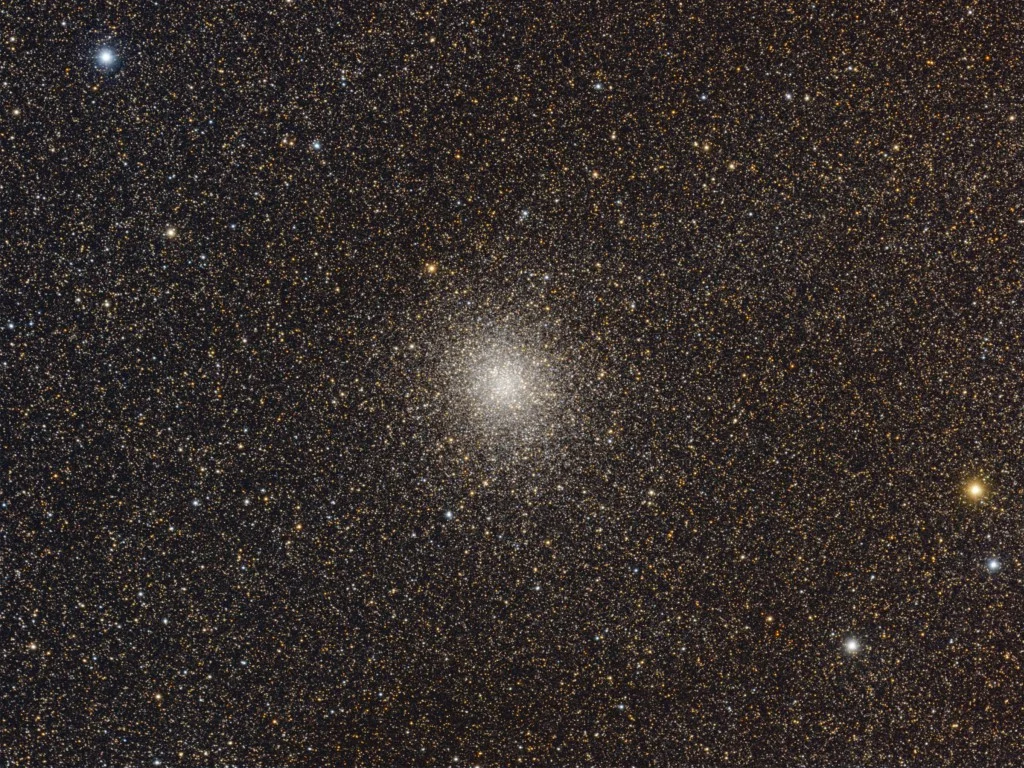
Messier 22 (NGC 6656), located in the southern constellation Sagittarius, holds a significant place in astronomical history. Discovered on August 26, 1665, by the German amateur astronomer Johann Abraham Ihle, it was the first globular cluster ever identified. Ihle made this observation while studying the planet Saturn through a 2-inch telescope, perceiving the cluster merely as a round nebula. There is speculation that it may have been observed prior to 1665 by astronomers such as Hevelius and cataloged by notable figures including Jean-Philippe de Chéseaux and John Bevis. Sir Edmund Halley also included it in his list of six objects published in 1715. In 1747, Guillaume Le Gentil described it as “very irregular, hairy, and scattering light rays in all directions.” Nicolas Louis de Lacaille compared Messier 22 to the core of a comet in 1752.
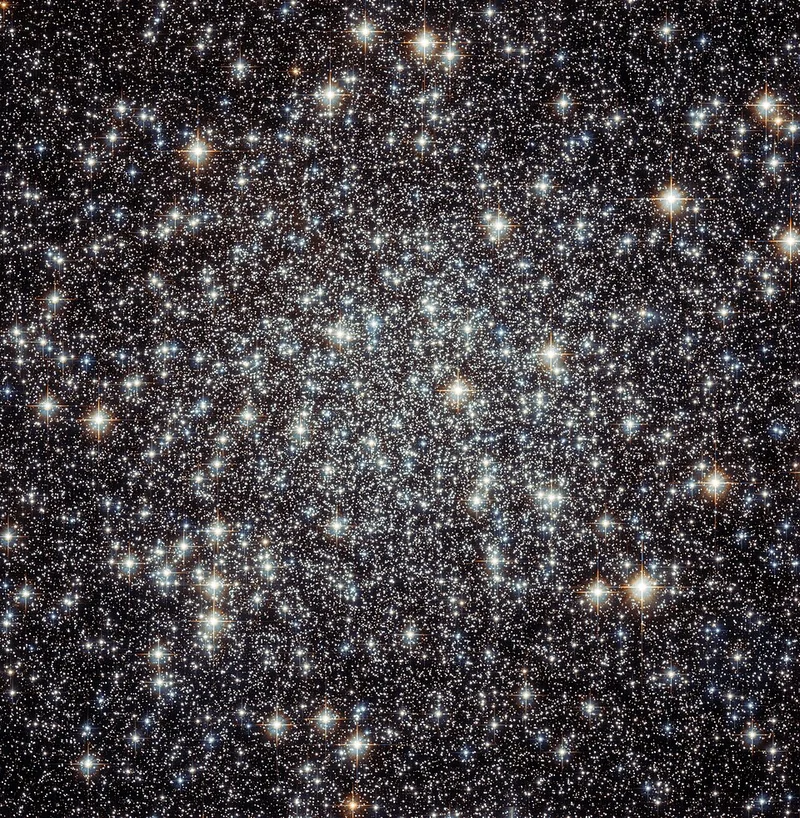
The French astronomer Charles Messier observed the cluster on the night of June 5-6, 1764, and included it in his famous catalog of comet-like objects 99 years after its initial discovery. He noted, however, that he could not resolve it into individual stars, describing it as a “nebula, below the ecliptic, between the head and bow of the archer, near a star of 7th magnitude, 25 Sagittarii, according to Flamsteed; this nebula is round, contains no star, and can be seen very well with a common telescope.” It wasn't until July 4, 1783, that the German-British astronomer Friedrich Wilhelm Herschel managed to resolve the cluster into hundreds of individual stars, describing it as a dense heap of faint stars. His son, John Herschel, later characterized M 22 as “a remarkable globular cluster, very bright, very rich, and very dense, with stars ranging from magnitudes 11 to 15.” A photograph of M 22 was captured by American astronomer Heber Doust Curtis and published in 1918 in the book Descriptions of 762 Nebulae and Clusters Photographed with the Crossley Reflector. In 1930, Harlow Shapley also described the cluster, estimating it to contain around 70,000 stars and noting its dense core.
The Brightest Globular Cluster in the Messier Catalog
Messier 22 is one of approximately 150 globular clusters in our Milky Way and stands out as the brightest globular cluster in Charles Messier's renowned catalog. However, from a Central European perspective, it never rises very high above the horizon, lying less than one degree from the ecliptic. Its low position often leads to it being overlooked amidst the many open clusters and nebulae in the constellation Sagittarius. With an apparent magnitude of 5.1 and an angular diameter of 32 arc minutes—comparable to the apparent size of the full moon—this slightly elliptical globular cluster rivals the Hercules cluster (Messier 13) and Messier 5 in Serpens in terms of brightness and size. Along its longer axis, it has approximately 30% more stars than along its shorter axis, with the stars in the cluster being so closely packed that the central region is nearly 500 times denser than the area surrounding our Sun. It is the brightest globular cluster visible from mid-latitudes and one of the easiest to resolve into individual stars. The brightest stars within the cluster reach a magnitude of 10.7, making Messier 22 one of the globular clusters with the most luminous member stars. Unfortunately, its proximity to the center of our Milky Way means that it is never very high above the horizon when viewed from Germany. Only the southern sky objects Omega Centauri (NGC 5139, 5.3 mag) in Centaurus and 47 Tucanae (NGC 104, 4.1 mag) in Tucana are brighter than M 22, but they are not visible from Central Europe.
The impressive appearance of the globular cluster can be attributed to its proximity to us. In terms of mass, Messier 22 is relatively average for a globular cluster, located 10,600 light-years away, just in front of the galactic bulge of our home galaxy. Compared to other globular clusters in the Milky Way, M 22 is thus relatively close. Only Messier 4 in Scorpius is significantly nearer. M 22 orbits the center of our Milky Way, completing a revolution approximately every 200 million years, never straying more than about 30,000 light-years from the galactic center. Currently, it is about 16,000 light-years from the center and 9° south of the galactic plane. In 100 million years, it will have moved far enough away that it may appear as a less remarkable globular cluster.
With a diameter of 97 light-years and a mass exceeding half a billion solar masses, M 22 is comparable to M 13 in terms of size and mass. The cluster exhibits two distinct stellar populations with varying amounts of heavy elements, though their origins remain uncertain. They could either represent two generations of stars, which is typical for most globular clusters, or M 22 might have an extragalactic origin, which would be more unusual. The cluster contains 78 variable stars, with 32 of them being RR Lyrae type variables, a number similar to its more famous northern counterpart. Some Mira stars have also been identified in M 22, but these are all foreground stars and not true members of the cluster. Unfortunately, interstellar dust in the plane of our Milky Way dims the light of the globular cluster by 1.8 magnitudes. If M 22 were positioned where M 13 is, it would vastly outshine it in size and brightness. M 22 is receding from us at a velocity of 144 km/s.
A Planetary Nebula, Lonely Planets, and Black Holes
Messier 22 is one of only four globular clusters known to contain a planetary nebula. GJJC-1 (PK 9−7.1) is the optical counterpart of the infrared source IRAS 18333–2357, first discovered in 1986 by the IRAS infrared satellite. It is located about one arc minute south of the cluster's center at coordinates RA 08h 36m 22.82s, Declination -23° 55′ 18.3″. This remnant of a sun-like star is no older than 6,000 years and contains a white dwarf at its center with an apparent magnitude of 14.3. Its size is measured at 10 x 7 arc seconds. Another globular cluster in the Messier catalog known to contain a planetary nebula is Pease 1, found in Messier 15 in the constellation Pegasus. Other globular clusters with planetary nebulae include NGC 6441 and Palomar 6.
Due to its position in front of the densest part of our galaxy, M 22 is a regular candidate for microlensing events. The Hubble Space Telescope captured a field of 3.3 light-years that revealed around 83,000 stars! In 1999, Hubble recorded microlensing events caused by objects with masses of eighty Earth masses within the globular cluster. Approximately six of these planet-sized objects are known not to orbit a star. A microlensing effect occurs when the light from a background star is briefly focused by the gravitational field of a foreground object passing by, making the star appear brighter. In 2001, a flash of light was observed, possibly linked to a dwarf nova or the microlensing effect of a passing star.
In 2012, the Very Large Array in New Mexico unexpectedly discovered two stellar black holes in M 22, which were later confirmed by the Chandra Space Telescope. These black holes have masses between 10 and 20 times that of our Sun. It is estimated that there may be between 5 to 100 of these stellar black holes within the globular cluster. Their interactions with cluster stars could also explain the unusually large core of the cluster. Previously, their existence had been considered nearly impossible based on celestial mechanics. The two black holes, M22-VLA1 and M22-VLA2, are part of binary star systems, each drawing material from a companion star. The accreted material forms an accretion disk around each black hole, with emissions detected. Recently, there has been speculation about the existence of a more massive central black hole in M 22, but this remains a subject of ongoing research. In 2019, remnants of a nova were observed in Messier 22, which had been recorded in China as far back as 48 B.C. This is one of the oldest confirmed records of an observation of an event outside our solar system. The MUSE instrument of the Very Large Telescope detected a reddish nebula at the site of the nova, extending 8,000 AU.
Observation
Messier 22 can be seen with the naked eye as a star-like point under a dark sky. It appears just as magnificent as Messier 13, especially when viewed from southern latitudes. From Namibia, M 22 even passes through the zenith. However, from Central Europe, this globular cluster does not impress as much due to its southern position at -24° declination. The dimming from the denser layers of the Earth's atmosphere and light pollution near the horizon significantly weakens the cluster's light. In a standard 7x50 binocular, the cluster appears as a uniform, bright nebula. With a 10x70 Fujinon binocular, M 22 is slightly brighter, with a more luminous central region, resembling a round comet. A 3-inch refractor at medium magnification begins to show the edges of the cluster as granular, with a moderate increase in brightness towards the center. At higher magnification with a 4-inch telescope, the edges resolve into several dozen individual stars, surrounded by an oval glow of unresolved stars. Subtle brightness variations can be observed in the center.