Astronomy Enthusiasts: A Celestial Gathering of Moon, Jupiter, Pleiades, and Aldebaran
A captivating astronomical event visible to the naked eye, featuring a conjunction of the Moon, Jupiter, Pleiades, and Aldebaran on February 6-7, 2025.
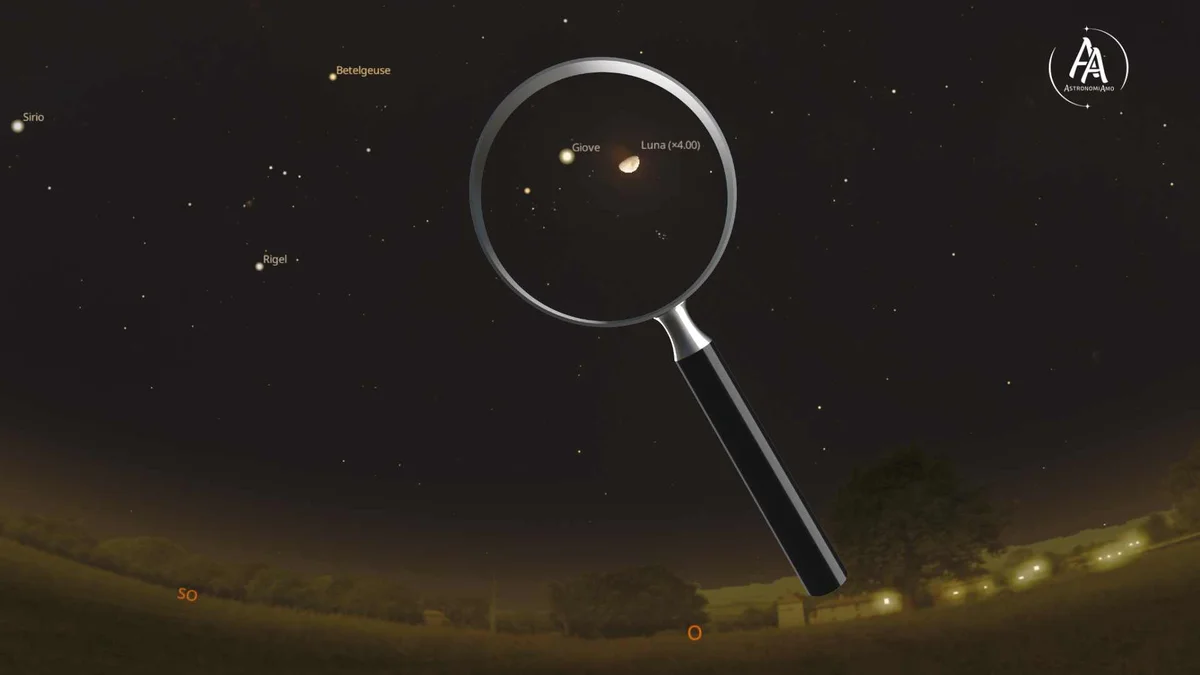
A phenomenon easily visible to the naked eye, even from urban skies: a conjunction within everyone's reach.
On the night between February 6 and 7, 2025, starting from sunset on the 6th, the sky presents an interesting astronomical display. This event features a conjunction involving the Moon, Jupiter, the Pleiades (formally known as the 45th object in Charles Messier's catalog, or M45), and Aldebaran, the brightest star in the constellation Taurus. Such an occurrence is easily observable, weather permitting.
What to Expect and How to Observe
Shortly after sunset on the 6th (set for 17:31), around early evening at 19:06, the Moon, illuminated at approximately 66%, will be positioned near Jupiter, the second-brightest object in the night sky after Venus. Nearby, the Pleiades, one of the most famous and captivating star clusters, will be visible alongside Aldebaran, which is notable for its warm orange hue.
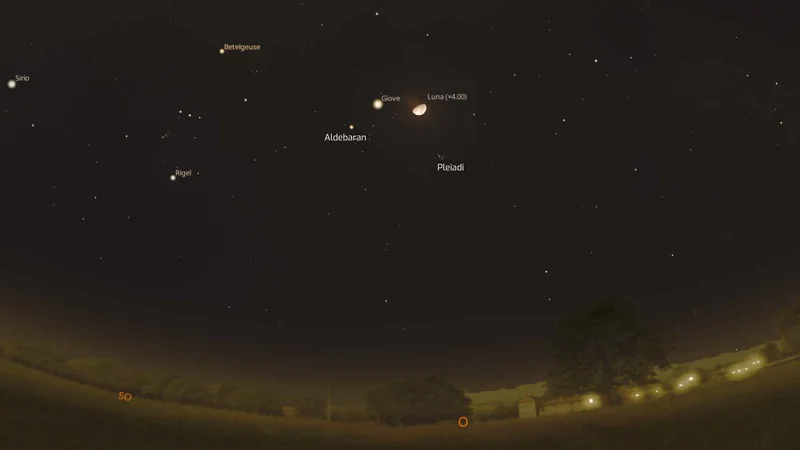 Rappresentazione della congiunzione Luna-Giove-M45-Aldebaran della notte tra il 6 e il 7 febbraio 2025. Software Stellarium
For the most favorable viewing conditions, the closest conjunction between the Moon and the Pleiades (0.8° apart) will occur at 02:10 on February 7, while the closest alignment between the Moon and Aldebaran will happen at 23:17 on the evening of the 6th (approximately 7° apart). The conjunction between the Moon and Jupiter will take place at 03:19 on February 7 (5° apart). Observing on the evening of February 6 is an excellent compromise, as the Moon sets at 03:24 on the 7th, marking the latest opportunity to view this event.
For those interested in specific timings for their observation locations, the portal offers a localization feature to set coordinates via a map. Once the observatory is set up, you can find times and information on the celestial bodies by visiting the pages for:
- Luna
- Giove
- Pleiadi (M45)
- Aldebaran
- Costellazione del Toro
The observation does not require special equipment; the apparent proximity of these celestial objects is clearly visible to the naked eye. However, a telescope or a small binocular can enhance the experience, allowing for a better distinction of lunar surface details, especially during this phase, and appreciating the characteristic blue color of the Pleiades, which is due to the power and youth of the stars that compose it.
Astronomical Significance and Context
Conjunctions (not kisses, please, just conjunctions!) are frequent phenomena, yet they remain captivating. These events are simply visual alignments resulting from the Earth’s position relative to other celestial bodies. In this instance, the apparent closeness of the Moon, Jupiter, the Pleiades, and Aldebaran provides a chance to admire a variety of celestial objects: a planet, a young star cluster, a red giant star, and our Moon.
Why You Should Observe
While alignments like this do not have scientific implications, they are visually striking events that encourage us to pause and appreciate the sky. Furthermore, they present an opportunity to deepen our understanding of the involved celestial bodies and, why not, to attempt to photograph the phenomenon. With a camera equipped with a good lens or even a smartphone supported by a tripod, capturing the celestial gathering is possible. However, the simplicity of the observation can be misleading, as the proximity of a 66% illuminated Moon to a much dimmer object like the Pleiades requires careful exposure settings in photographs.
If the weather cooperates, simply look up and allow yourself to be mesmerized by this natural spectacle, which brings together some of the brightest and most intriguing objects in the night sky.