Gliese 48 b: A Super-Earth Discovered by the "Palidoro" Team
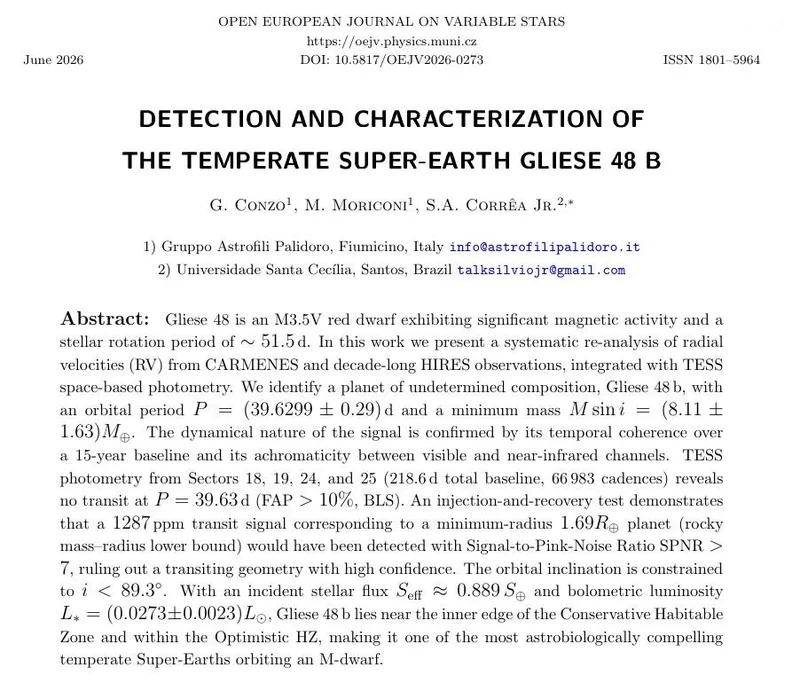
The discovery is the result of the work of an international team of astronomers led by the Palidoro Astrophile Group, which includes Giuseppe Conzo, Mara Moriconi, and Silvio Antonio Corrêa Jr., and was published in the Open European Journal on Variable Stars (OEJV).
The discovery is the result of the work of an international team of astronomers led by the Palidoro Astrophile Group, which includes Giuseppe Conzo, Mara Moriconi, and Silvio Antonio Corrêa Jr., and was published in the Open European Journal on Variable Stars (OEJV).
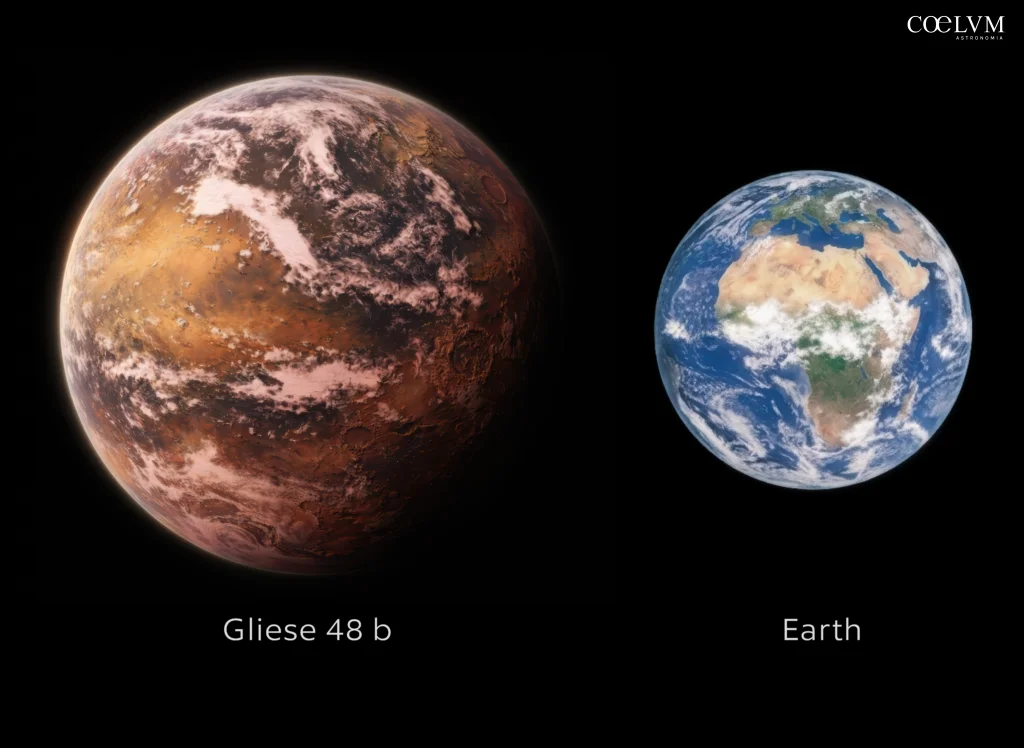
Gliese 48 b is not just any planet; it is a Super-Earth: a rocky exoplanet more massive than Earth, belonging to a category that today represents one of the main targets of astronomical research. This new world completes an orbit around its star, a red dwarf, in about 39.6 days. The system is located just 28 light-years from the Solar System, a relatively short distance on a cosmic scale that makes it an ideal candidate for future observations. Its proximity will allow astronomers to study its physical characteristics and surrounding environment with great precision, contributing to clarifying how rocky planets form and evolve outside our Solar System.
Fifteen Years of Observations to Distinguish the Planet from Its Star
The confirmation of Gliese 48 b did not come quickly. Over fifteen years of observations, analyses, and verifications were necessary to demonstrate that the detected signal was indeed due to the presence of a planet.
Red dwarfs, in fact, are particularly active stars. Stellar spots, magnetic flares, and surface oscillations can alter spectroscopic measurements, producing signals that mimic those generated by an orbiting planet. Distinguishing a genuine gravitational effect from these phenomena represents one of the most complex challenges in observational astrophysics.
To overcome this obstacle, the team adopted a multidisciplinary approach, combining radial velocity measurements obtained with the CARMENES spectrograph, installed at the Calar Alto Observatory in Spain, and HIRES, operational at the Keck Telescope in Hawaii, with photometric data collected by NASA's TESS (Transiting Exoplanet Survey Satellite).
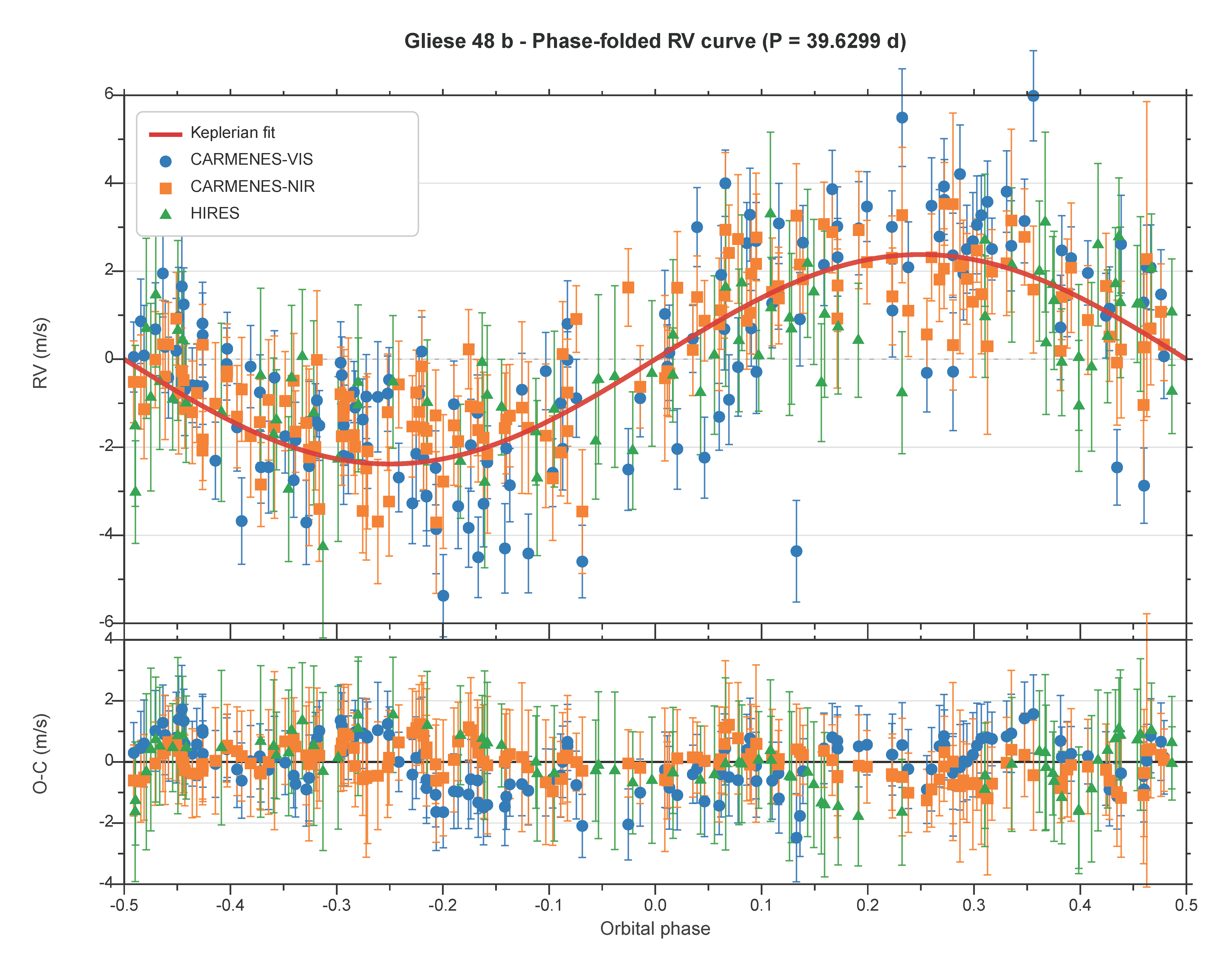
The joint analysis of these observations allowed the team to separate the weak gravitational signal produced by Gliese 48 b from the "noise" generated by the star's activity, providing an extremely solid confirmation of its existence.
The planet has a minimum mass of about eight times that of Earth, a characteristic that places it in the Super-Earth category, a class of exoplanets that is very common in the Galaxy but absent in our Solar System.
It is important to remember that the term "Super-Earth" describes only the planet's mass and not its nature. Some Super-Earths may be predominantly rocky, others rich in water, while others may be enveloped in dense hydrogen and helium atmospheres. Establishing the true composition of Gliese 48 b will require even more in-depth observations with the next generation of telescopes.
A Planet in the Habitable Zone, but Not Necessarily Habitable
One of the aspects that makes Gliese 48 b particularly interesting is its position within the optimistic habitable zone of its star. This is the region around a star where, at least in theory, conditions could exist for water to remain in a liquid state on the surface of a planet. However, being in the habitable zone does not automatically mean that a world can host life. Many other factors come into play: the presence and composition of the atmosphere, surface pressure, the existence of a magnetic field, rotation speed, geological activity of the planet, and, above all, the behavior of the host star.
Red dwarfs can emit powerful flares and intense ultraviolet and X-ray radiation that, over millions or billions of years, can profoundly alter the atmospheres of orbiting planets. For this reason, astronomers prefer to speak of potential habitability, avoiding hasty conclusions until more detailed observations are available.
An Example of How Astronomy Can Still Be Pursued by Enthusiasts in Modern Times
Giuseppe Conzo, Mara Moriconi, and Silvio Antonio Corrêa Jr. have used well-known research techniques such as patience and scientific rigor but have added the indispensable factor of international cooperation, which is now essential for achieving results of great value.
The scientific article is available on the OEJV journal website: https://oejv.physics.muni.cz/issues/oejv_0273.pdf.