Isotope Analysis Raises Questions About Planet Formation
The young planetary system of the 23 million year old star Beta Pictoris has become a prime example of circumstellar dust disks, hosting at least three giant gas planets. Recent studies using the GRAVITY+ instrument have shed light on the planet's origins and atmospheric variability.
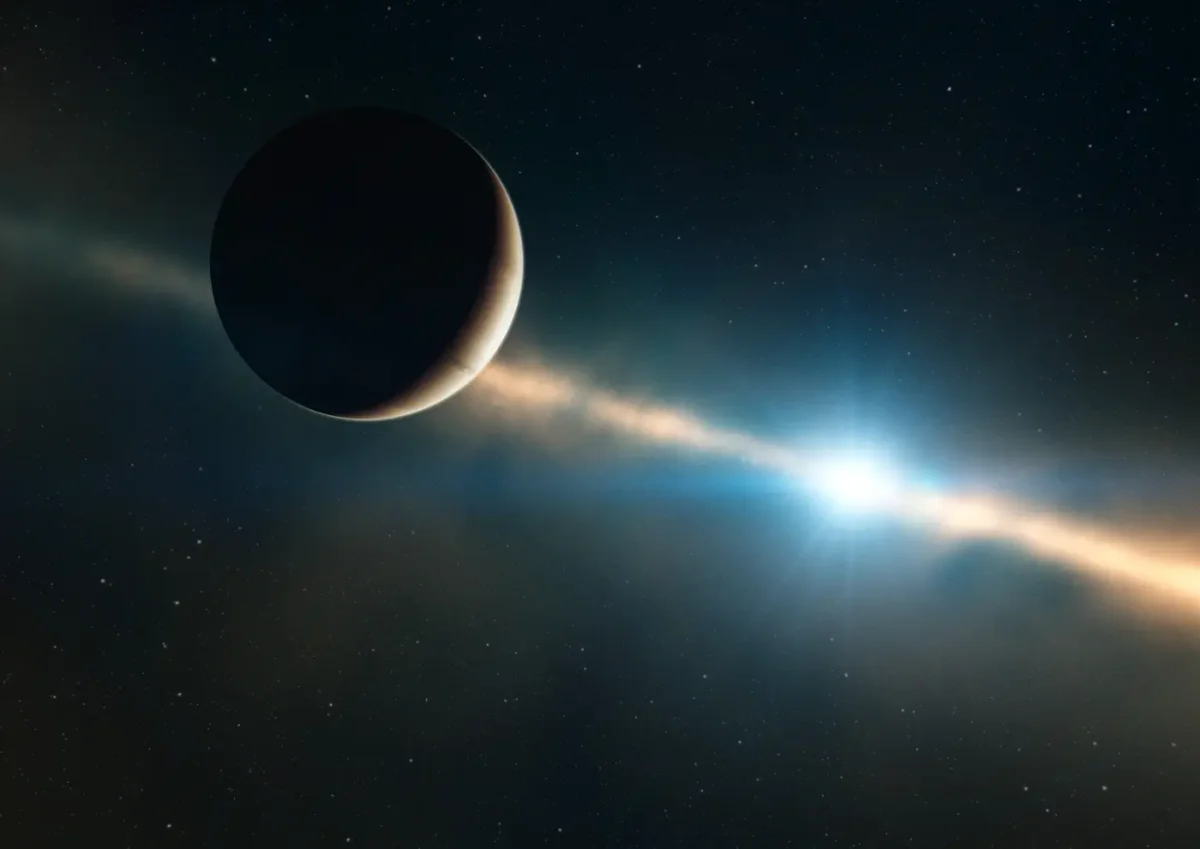
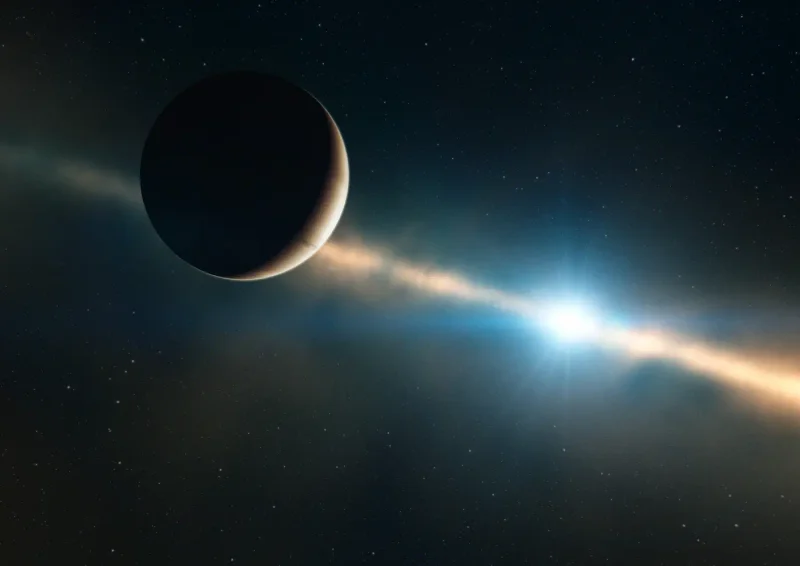
The young and incomplete planetary system surrounding the 23-million-year-old star Beta Pictoris has emerged as a prime example of circumstellar dust disks, hosting at least three giant gas planets. Among these, Beta Pictoris b, discovered in 2008 through direct imaging, is the most massive, weighing in at approximately 11 Jupiter masses. It orbits its central star on a wide path, taking about 23 years to complete a single revolution.
Researchers from the Max Planck Institute for Astronomy (MPIA) in Heidelberg, Germany, and the Observatoire de la Côte d’Azur (OCA) in Nice, France, among other partners, have conducted observations of Beta Pictoris b. Utilizing the recently modernized GRAVITY+ instrument, they explored the planet's origins and potential atmospheric variability. This instrument is connected to the Very Large Telescope Interferometer (VLTI), operated by the European Southern Observatory (ESO) at the Paranal Observatory in Chile. Antonia von Stauffenberg, a doctoral candidate at MPIA, is the lead author of the study published as a Letter in the journal Astronomy & Astrophysics.
"The interferometric instrument GRAVITY+ is extremely stable […] making it unique for determining the properties of directly imaged exoplanets with high accuracy," states co-author and MPIA scientist Jonas Sauter. GRAVITY+ is an extension of the original GRAVITY instrument and features enhanced adaptive optics.
Insights into the Atmosphere and Origin of Beta Pictoris b
The research team employed a method proposed a few years ago to determine the birthplace of planets within planet-forming disks. By measuring the relative abundance ratio between two different carbon isotopes found in the carbon monoxide gas of Beta Pictoris b's atmosphere, they aimed to ascertain whether the planet formed inside or outside a region of the disk where carbon monoxide existed as ice. Considering the radiation from the central star that heats the disk from within, this could be translated directly into the distance from the star at which the planet formed.
The radius at which temperatures are low enough for gas to freeze into ice is generally referred to as the snow line. The term for the variants of an atom, such as carbon, is isotope. Isotopes have the same number of positively charged protons in the atomic nucleus but differ in the number of neutral neutrons—like the two carbon isotopes 12C and 13C. Consequently, they have slightly different masses but exhibit similar chemical properties. In space, carbon frequently bonds with oxygen, forming 12CO and 13CO molecules.
An Intriguing Preliminary Scenario
Interestingly, MPIA scientist Matthieu Ravet, during an earlier attempt to determine the diagnostic ratio between 12CO and the slightly heavier 13CO using the original GRAVITY instrument prior to its upgrade, found a relatively low ratio. The researchers suspected that GRAVITY might have been insufficient to resolve the crucial signals in that dataset clearly, and they cautioned against overinterpreting the results.
Nevertheless, following the logic of the above scenario, this value suggests that Beta Pictoris b may have grown in the outer disk beyond the snow line, accumulating more CO ice than CO gas. Currently, at a distance of about 10 AU (Astronomical Units = the average distance between the Sun and Earth; 1 AU = 149.6 million kilometers) from its central star, Beta Pictoris b clearly orbits further inward, between the star and the snow line, where CO should predominantly exist as gas. Assuming this result is correct, it would imply that Beta Pictoris b could have migrated through the disk (planetary migration).
New and Improved Results with GRAVITY+
Using GRAVITY+, von Stauffenberg and her colleagues derived an updated and more precise 12CO/13CO abundance ratio in the atmosphere of Beta Pictoris b, which is significantly higher than the previous value. While 12CO was clearly detected and its proportion relatively easy to determine, measuring 13CO necessitated a considerably more complex approach.
Interestingly, the ratio aligns with the value reported in a companion article by González Picos et al. (2026), which utilized a different instrument, underscoring the improved data quality that GRAVITY+ provides compared to its original design. The earlier GRAVITY result was clearly affected by systematic uncertainties.

Moreover, the astronomers found subtle indications that the radiation received by the planet fluctuates over time. Despite the low statistical significance, the observed changes seem to correlate with the planet's rotational period of about 8.7 hours. Should this be confirmed, it could indicate clouds or chemical processes in the atmosphere of Beta Pictoris b. However, further sensitive observations are needed to validate this finding.
Antonia von Stauffenberg comments: "The ability to precisely constrain both isotopologue and potential rotation-related variability using ground-based observations of a planet like Beta Pictoris b demonstrates the extraordinary data quality achieved with the upgraded GRAVITY+ instrument."
Doubts About the Significance of Abundance Ratios
In the proposed model for determining the birthplace, the new, more precise 12CO/13CO abundance ratio now clearly places Beta Pictoris b in the warmer, inner region of the original protoplanetary disk, consistent with the planet's current location. Furthermore, this ratio largely aligns with values typically found in the solar system and the interstellar medium (ISM), which fills the space between stars in the Milky Way. The overwhelming majority of about a dozen young giant gas planets studied regarding their CO ratios exhibit similar values.
However, this alignment could spell bad news, as the carbon isotope ratio loses its hoped-for significance for determining a planet's birthplace. The most likely explanation is that any differences during planet formation are simply too minor to be captured by this method. Consequently, the 12CO/13CO ratio currently lacks sufficient significance to draw specific conclusions about the respective formation environment of a planet.
"It remains challenging to use 13CO as an indicator for the formation of giant planets, as uncertainties persist in both models and measurements," says Antonia von Stauffenberg.
It is quite probable that the current theory does not fully account for the chemical processes in CO ice within such dust disks. Thus, the 12CO/13CO ratio may not reflect a measurable difference between the warmer gas environment and the icy outer regions. For now, giant planets with extended orbits continue to keep the secrets of their formation hidden. To clearly differentiate between the various formation scenarios in the future, astronomy will require new analytical methods—and GRAVITY+ is likely to play a key role in their development and validation.
Background Information
The findings are based on data obtained during the GRAVITY+ Guaranteed Time Observing (GTO) program 114.27JS (PI: Laura Kreidberg). The GRAVITY+ consortium includes the following institutes: MPE, INSU/CNRS, University of Cologne, MPIA, CENTRA, University of Southampton, as well as associated partners KU Leuven, University College Dublin, and Universidad Autónoma de México, in close collaboration with the ESO and supported by the Max Planck Foundation.