Webb Telescope Sheds Light on Exoplanet WD 1856 b Orbiting a White Dwarf
An international team of astronomers has observed the exoplanet WD 1856 b with the James Webb Space Telescope, revealing its mass, temperature, and atmosphere. This research provides insights into the future of planets like Jupiter after the sun's demise.
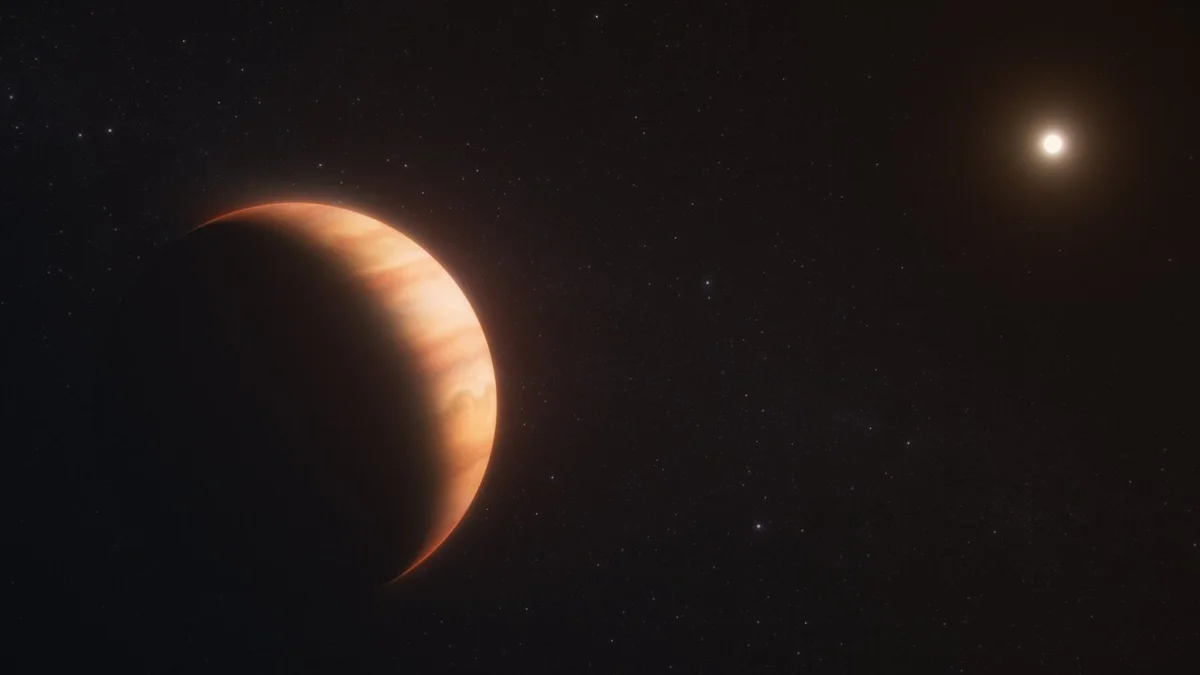
An international team of astronomers has utilized the James Webb Space Telescope, a collaborative effort by NASA, ESA, and CSA, to observe the Jupiter-sized exoplanet WD 1856 b as it transited in front of its host star, a white dwarf. This observation allowed researchers to measure the planet's mass and temperature while also confirming the presence of its atmosphere. The findings revealed that WD 1856 b is significantly warmer than previously anticipated, providing insights into how this planet likely achieved its extremely close orbit around its star. These results offer a glimpse into the future of planets like Jupiter after the sun's demise, which is billions of years away.
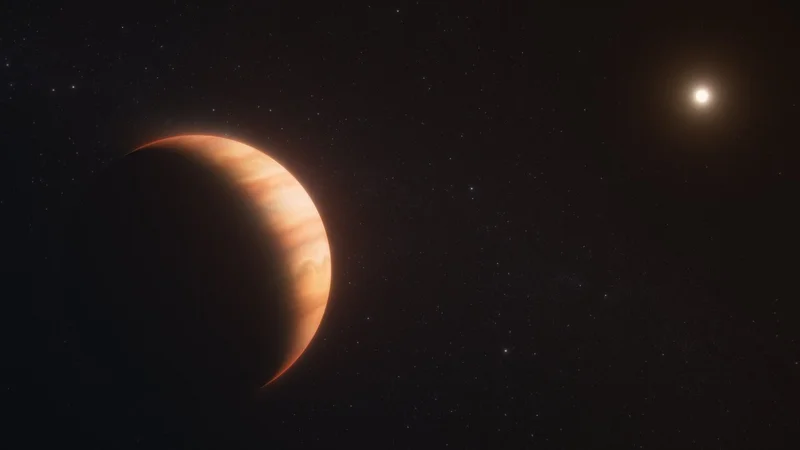
The Webb telescope is providing new insights into the distant future of solar systems similar to our own. Billions of years ago, a sun-like star expanded dramatically at the end of its life, becoming a red giant before shedding its outer layers and leaving behind a hot core, known as a white dwarf. It would be expected that this red giant would consume and destroy all nearby planets. However, astronomers have discovered a Jupiter-sized exoplanet orbiting the white dwarf every 34 hours at a distance of less than 3 million kilometers.
The results of this study were published on July 1, 2026, in the journal Nature.
WD 1856 b was initially discovered in 2020 using the NASA space telescope TESS (Transiting Exoplanet Survey Satellite) and the Spitzer Space Telescope. The planet orbits the white dwarf WD 1856+534, located approximately 80 light-years from Earth. "The planet is about the size of Jupiter, but the white dwarf it orbits is the size of Earth. Therefore, the planet is seven times larger than its star,” explained lead author Ryan MacDonald from the University of St. Andrews in the UK.
WD 1856 b orbits its host star at an extremely close distance, approximately 50 times closer than the Earth is to the Sun. If WD 1856 b had originally orbited at this distance, it would have been destroyed when the star was still a red giant. This raises the question: how did it survive the death of its host star and end up in its current position?
Size and Temperature Measurements
The new study employed the Webb telescope to observe the planet during its transit in front of its star. This transit [1] provided unique data regarding the planet's mass, which is estimated to be between four and eleven times that of Jupiter.
The team also determined the temperature of the planet. During the transit, the star's light was partially obscured, but the infrared light was less diminished than other wavelengths. This difference was attributed to the infrared radiation emitted by the planet due to its own heat. The data suggested that the planet has a temperature of about 126 degrees Celsius—significantly hotter than expected if its only heat source were the light from the white dwarf. This intriguing discovery was the critical clue that indicated how the planet must have reached its current orbit.
Christopher O’Connor from Northwestern University in Illinois, a co-author of the study, was responsible for tracing the planet's temperature evolution. O’Connor noted, "The central question is how WD 1856 b ended up in its current location. There are two theories. One suggests that the planet was swallowed by its dying host star and survived inside. The other theory posits that migration was caused by the gravitational influence of other objects in the system. The white dwarf is part of a triple star system, and the outer companion stars may have affected the orbit of WD 1856 b."
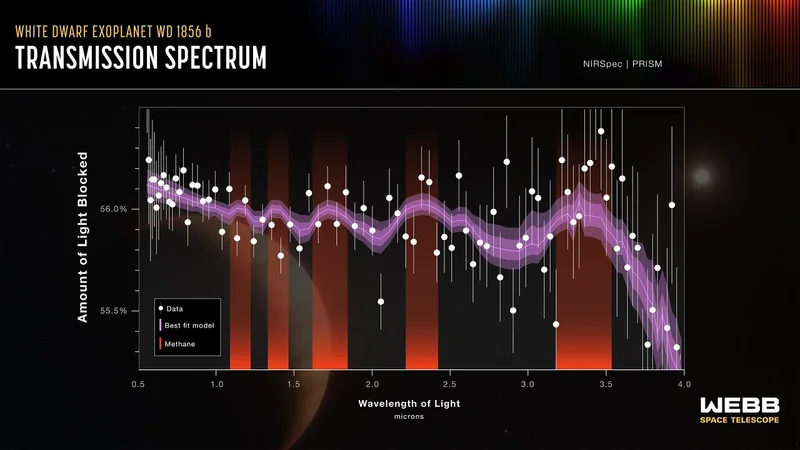
The researchers concluded that there is currently no energy source capable of generating this heat, indicating it must originate from residual energy from an earlier time when the planet was still heated. By using cooling models for substellar objects like WD 1856 b over time, combined with the new Webb telescope data on the planet's mass and current temperature, the team could extrapolate its temperature back in time and estimate how long the heating must have occurred. This timing is crucial for determining whether the heating was caused by being swallowed by the red giant or during an inward migration.
They concluded that the heating likely occurred between 3 and 5.5 billion years after the star transitioned to a white dwarf. In this scenario, the planet was on a wide orbit that protected it from the destructive phase of the red giant and only later migrated to its current position. "As the planet moved inward, its interactions with the strong gravity of the white dwarf led to significant heating, and it has been cooling ever since,” O’Connor explained.
The light from the star that penetrated the planet's atmosphere also provided information about its chemical composition. "We detected telltale traces of small cloud particles and hydrocarbons, most likely methane. This is the first time we have observed an atmosphere on a planet transiting in front of a dead star,” remarked co-author Victoria Boehm from Cornell University in the USA. "We have recently observed four additional transits of WD 1856 b with the Webb telescope to study its atmospheric chemistry in more detail, and we look forward to the results."
Potential Future of the Solar System
In approximately five billion years, the hydrogen supply in the sun's core will be exhausted, causing it to expand to over 100 times its current size as a red giant. Subsequently, it will shed its outer layers and conclude its life as a white dwarf. Mercury, Venus, and possibly Earth will be destroyed by the red giant. However, the fate of the more distant planets, particularly the gas giants, remains uncertain. The exploration of planets that orbit the remnants of sun-like stars after their death could provide insights into what may happen in our own solar system in the distant future.
"We are used to looking back in time with telescopes, but this is the first time we can look ahead to see what might happen to the outer planets around the remnant of a sun-like star,” said MacDonald. “It’s like we’re using a time machine to glimpse the distant future of our solar system."
Notes
[1] A transit occurs when a planet passes in front of the star it orbits from our perspective, obscuring a portion of the star's light. Many exoplanets have been discovered by looking for the slight dimming of a star caused by a transiting planet. Comparing the light from the star with the light that passes through the atmosphere of the transiting planet also provides information about the atmosphere's composition.
Background Information
The Webb telescope is the largest and most powerful telescope ever launched into space. As part of an international cooperation agreement, ESA provided the launch service for the telescope using the Ariane 5 rocket. In collaboration with its partners, ESA was responsible for the development and qualification of the modifications to the Ariane 5 for the Webb mission, as well as the procurement of the launch service through Arianespace. ESA also provided the main spectrograph NIRSpec and 50% of the mid-infrared instrument MIRI, developed and built by a consortium of publicly funded European institutes (the MIRI European Consortium) in collaboration with JPL and the University of Arizona.
Webb is an international partnership between NASA, ESA, and the Canadian Space Agency (CSA).
Image credit: NASA, ESA, CSA, R. Crawford (STScI)