K2-18 b: A Potentially Habitable Exoplanet Captivating Astronomers
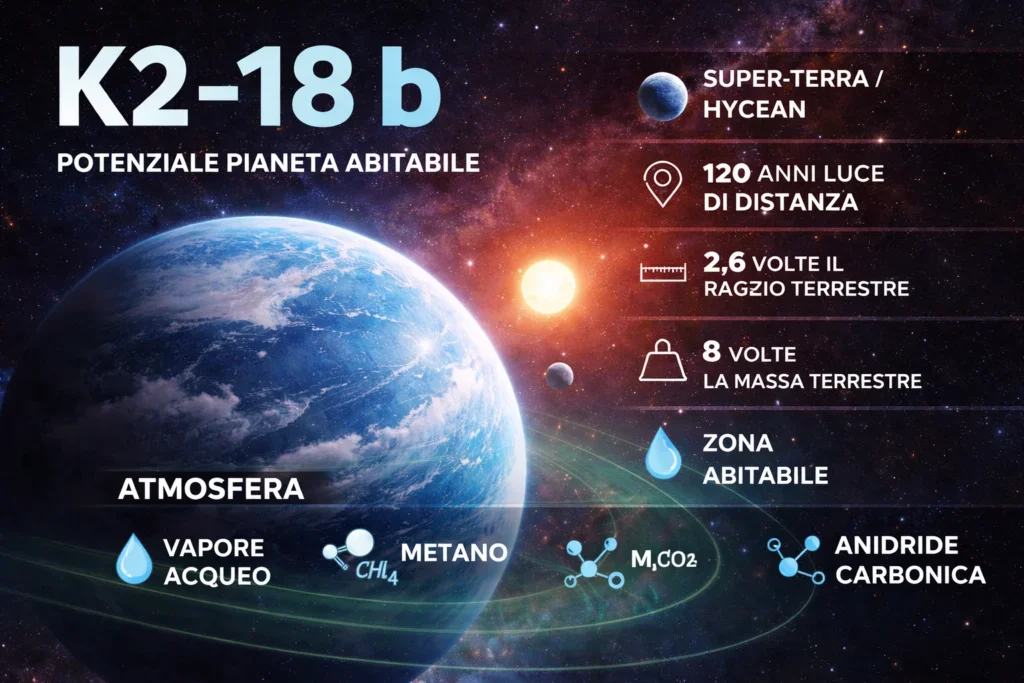
K2-18 b, an intriguing exoplanet located 120 light-years away, has gained attention for its atmospheric composition, which may suggest conditions suitable for life.
🌌 K2-18 b: A Potentially Habitable Exoplanet Captivating Astronomers
In recent years, K2-18 b has emerged as one of the most extensively studied exoplanets in the scientific community. Located approximately 120 light-years away from Earth, this intriguing planet has garnered attention due to the presence of atmospheric molecules that may be linked to conditions conducive to life.
Recent observations from the James Webb Space Telescope have yielded unprecedented data, placing K2-18 b at the forefront of international scientific discussions.
But what do we truly know about this distant world?
🔭 Locating K2-18 b
K2-18 b orbits a red dwarf star in the constellation Leo. It was discovered in 2015 as part of the extended Kepler mission (K2).
Its location is particularly noteworthy because it resides within the habitable zone of its star, suggesting that liquid water could potentially exist on its surface or within its atmospheric layers.
However, it is crucial to clarify that K2-18 b should not be considered a “second Earth.”
🪐 What Type of Planet is K2-18 b?
Classified as a super-Earth or, according to some models, a “Hycean” planet, K2-18 b is characterized by:
- A hydrogen-rich atmosphere
- A possible global ocean beneath the atmosphere
- Dimensions larger than Earth
The planet has a radius approximately 2.6 times that of Earth and a mass around eight times greater. Consequently, its gravitational pull is significantly stronger than that of our planet, fundamentally altering environmental conditions.
🧪 Discoveries from the James Webb Space Telescope
Observations made by the James Webb have detected the following in K2-18 b's atmosphere:
- Water vapor
- Methane
- Carbon dioxide
Additionally, some analyses have hinted at the potential presence of dimethyl sulfide (DMS), a molecule primarily produced by marine organisms on Earth. This possibility has sparked considerable media interest.
Nonetheless, scientists are exercising caution, as the presence of DMS has yet to be definitively confirmed. Further observations will be necessary to validate this finding.
🔬 The Significance of K2-18 b
K2-18 b represents a unique case for several reasons. Firstly, it is one of the few planets in the habitable zone where we can analyze the atmosphere in great detail. Furthermore, the quality of the data obtained surpasses that of many previous discoveries.
This planet could enhance our understanding of:
- How hydrogen-rich atmospheres form
- Whether oceans exist beneath thick atmospheric layers
- The commonality of potentially habitable worlds
In essence, K2-18 b serves as a natural laboratory for studying life beyond our Solar System.
🌍 Is K2-18 b Truly Habitable?
The most pressing question is also the most complex. While K2-18 b is located in the habitable zone, its atmosphere may create a strong greenhouse effect. Moreover, surface pressure could be extremely high.
Some models suggest the presence of a global ocean, while others indicate conditions that may be too extreme for life as we know it.
Currently, there is no evidence of life on K2-18 b, only intriguing chemical clues.
🌠 Implications for Future Research
The study of K2-18 b illustrates that we are entering a new era of astronomy. We are no longer limited to discovering planets; we can now analyze their atmospheres in detail.
In the coming years, further observations with the James Webb and next-generation telescopes may:
- Confirm or refute the presence of DMS
- Enhance our understanding of atmospheric structure
- Detect potential seasonal variations
Each new piece of data will help clarify whether K2-18 b is merely an interesting world or something even more extraordinary.
📸 A Planet That Changes Our Perspective
K2-18 b serves as a reminder of the vast diversity of the universe. For decades, we have sought planets identical to Earth. Now, we are beginning to understand that life might develop in vastly different environments.
This realization shifts our perspective. Perhaps we should not be searching for “a second Earth,” but rather expanding our definition of habitability.
✨ Conclusion
K2-18 b stands out as one of the most fascinating exoplanets ever studied. Observations from the James Webb have opened up new questions and possibilities.
While we have yet to find life, we are beginning to identify worlds that could potentially host it. Each step brings us closer to answering one of humanity's most profound questions: are we alone in the universe?