29 Cygni b or How Massive Celestial Bodies Form - Spreewald-Spechtler
Where is the boundary between stars and the most massive planets? Scientists suspect that this depends on their formation method. Did they form through a bottom-up process or a top-down process?
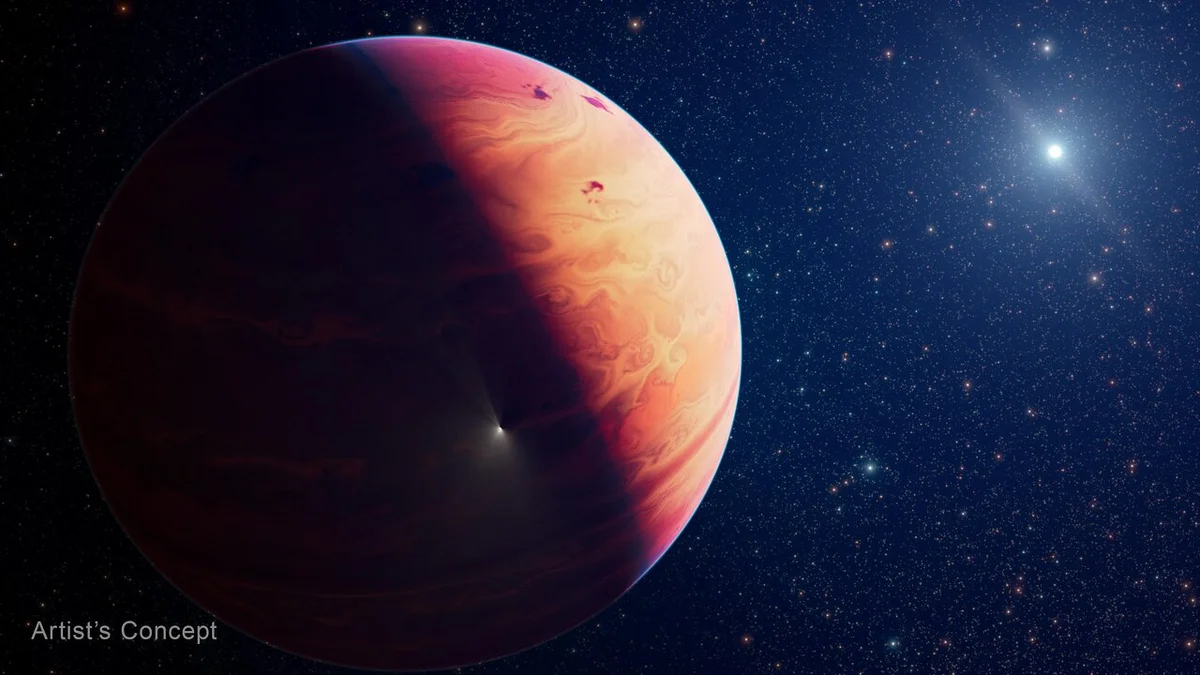
Where is the boundary between stars and the most massive planets? Scientists suspect that this depends on their formation method. Did they form through a "bottom-up" process, where they gradually grew, or through a "top-down" process, where a large accumulation of gas and dust split into smaller, planet-sized fragments? Astronomers used the James Webb Space Telescope from NASA, ESA, and CSA to investigate an object that is about 15 times as massive as Jupiter, placing it precisely at the boundary between the two processes. They found that the object designated 29 Cygni b likely formed more from the bottom up than from the top down. In other words: it formed like a planet, not like a star.
Planets, like those in our solar system, form through a bottom-up process where small rocky and icy particles coalesce and grow over time. However, the more massive the planet, the harder it is to explain its formation in this way.
Astronomers studied 29 Cygni b with the James Webb Space Telescope, an object with about 15 times the mass of Jupiter that orbits a nearby star. They found numerous indications that 29 Cygni b indeed formed through a bottom-up process, providing new insights into how the most massive planets come into being. An article describing these results was published in the Astrophysical Journal Letters.
Planet formation, as is well known, occurs in vast disks of gas and dust around stars through a process called accretion. Dust clumps condense into small particles that collide and grow larger, leading to the formation of protoplanets and eventually planets. The largest of these particles then accumulate gas and develop into gas giants like Jupiter. Since the formation of gas giants takes more time and the disk of planet-forming material eventually evaporates and disappears, planetary systems ultimately contain many more small than large planets.
Stars, on the other hand, form when a massive gas cloud collapses, and each fragment collapses under its own gravity, becoming smaller and denser. A similar collapse process could theoretically also occur in protoplanetary disks. This could explain why some very massive objects are found billions of kilometers away from their parent stars, in regions where the protoplanetary disk would have been too thin for accretion to take place.
29 Cygni b lies at the dividing line between what can be explained by these two different mechanisms. It weighs 15 times as much as Jupiter and orbits its star at an average distance of 2.4 billion kilometers, about as far as Uranus in our solar system. The research team targeted it because it could potentially have originated from both processes.
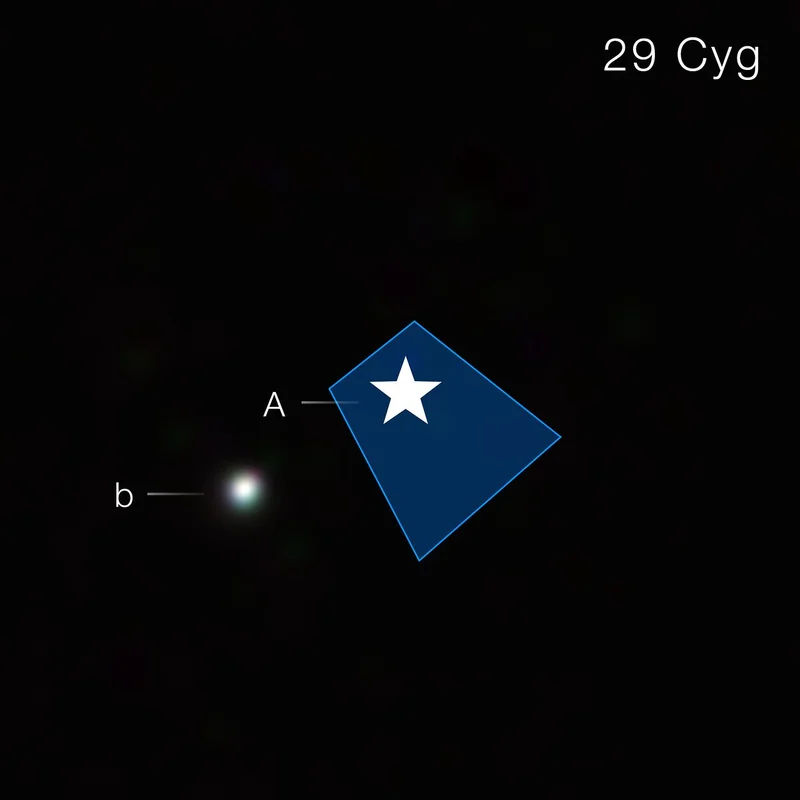
The observation program of the science team utilized Webb's Near Infrared Camera (NIRCam) in coronagraphic mode to directly image 29 Cygni b. This planet was the first of four objects studied under the program. All four objects are known to have masses ranging from 1 to 15 times that of Jupiter. The team also established that the target objects should orbit their stars within a radius of about 15 billion kilometers.
The planets were all young and still hot due to their formation, with temperatures ranging from about 530 to 1,000 degrees Celsius. This ensured that their atmospheric chemistry resembled that of the planets of HR 8799, whose system the team had previously studied.
By choosing suitable filters, the team was able to search for signs of light absorption by carbon dioxide (CO₂) and carbon monoxide (CO), allowing them to determine the amount of these heavier chemical elements, which astronomers collectively refer to as metals.
They found strong evidence that 29 Cygni b is enriched with metals compared to its central star, whose composition resembles that of our Sun. Given the planet's mass, the amount of heavy elements it contains is about 150 Earth masses. This suggests that it has incorporated large amounts of metal-rich solids from a protoplanetary disk.
The team also used a ground-based optical telescope array called CHARA (Center for High Angular Resolution Astronomy) to determine whether the planet's orbit aligns with the rotation of the star. They confirmed this alignment, which would be expected for an object formed from a protoplanetary disk.
Taken together, this evidence strongly suggests that 29 Cygni b formed within a protoplanetary disk through rapid accretion of metal-rich material. While the team collects data on the other three targets of its program, it plans to search for indications of differences in composition between lower and higher mass planets. This is expected to provide additional insights into their formation mechanisms.
Background Information
Webb is the largest and most powerful telescope ever launched into space. Under an international cooperation agreement, ESA provided the launch service for the telescope using the Ariane 5 rocket. In collaboration with its partners, ESA was responsible for the development and qualification of the adaptations of Ariane 5 for the Webb mission, as well as for procuring the launch service through Arianespace. ESA also provided the main spectrograph NIRSpec and 50% of the mid-infrared instrument MIRI, which was developed and built by a consortium of state-funded European institutes (the MIRI European Consortium) in collaboration with JPL and the University of Arizona.
Webb is an international partnership between NASA, ESA, and the Canadian Space Agency (CSA).
Image credit: NASA, ESA, CSA, J. Olmsted (STScI)