Webb Discovers New Details in the Atmosphere of Exoplanet WASP-121 b
Astronomers have discovered significant differences in the atmospheric conditions of the ultra-hot gas planet WASP-121 b, revealing insights into its unique atmospheric dynamics.
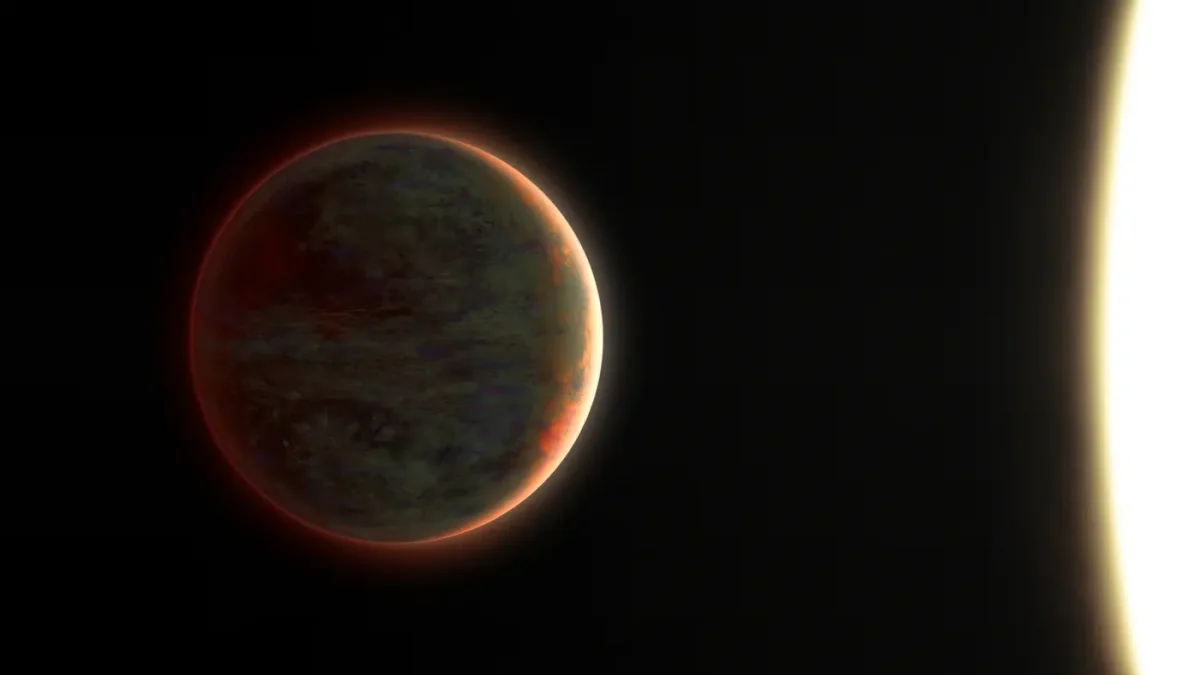
Astronomers have detected significant differences in the atmospheric conditions between the morning and evening transition zones of the ultra-hot gas giant WASP-121 b. These zones separate day and night and are referred to in technical jargon as terminators. This success was only possible thanks to the unparalleled sensitivity of the James Webb Space Telescope (JWST). A team of researchers led by Cyril Gapp, a PhD student at the Max Planck Institute for Astronomy (MPIA) in Heidelberg, demonstrated this phenomenon, which had previously been predicted through theoretical calculations.
Confirmation of Differences Between Evening and Morning Twilight
The discovery is based on an asymmetry in the absorption of infrared light from the central star, which is partially filtered through the planet's atmosphere during the transit. The researchers interpret this as a consequence of uneven temperatures and chemical compositions in the atmosphere of the exoplanet.
"With its unprecedented observational quality, the JWST provides us with the most detailed insights into distant planets to date: By measuring how the absorption of starlight changes during the rotation of WASP-121 b, we probe its atmosphere longitude by longitude," says Cyril Gapp from the Max Planck Institute for Astronomy.
The data suggest that the evening side absorbs more light than the morning side. This aligns with the widely accepted notion of strong winds transporting hot gases from the day side to the night side. The hot winds follow the planet's rotation eastward, thereby heating the evening zone. As temperatures rise, this region inevitably expands, increasing the planet's cross-section and allowing it to absorb stellar radiation more efficiently.
In addition to a general, slight decrease in brightness toward the end of the transit, data from the JWST's NIRSpec instrument (Near-infrared spectrograph) also show an increase in the carbon monoxide (CO) signal. However, this appears to be a temperature effect and is not related to an increase in the number of carbon monoxide molecules.
In contrast, there are indications that the amount of water (H2O) in the atmosphere is decreasing, which astronomers interpret as a real reduction in water molecules. The temperatures in the upper atmosphere are high enough to break down water molecules into their components. This result further supports the existence of hot winds that heat the region of the evening terminator.
Two Extreme Sides of an Ultra-Hot Planet
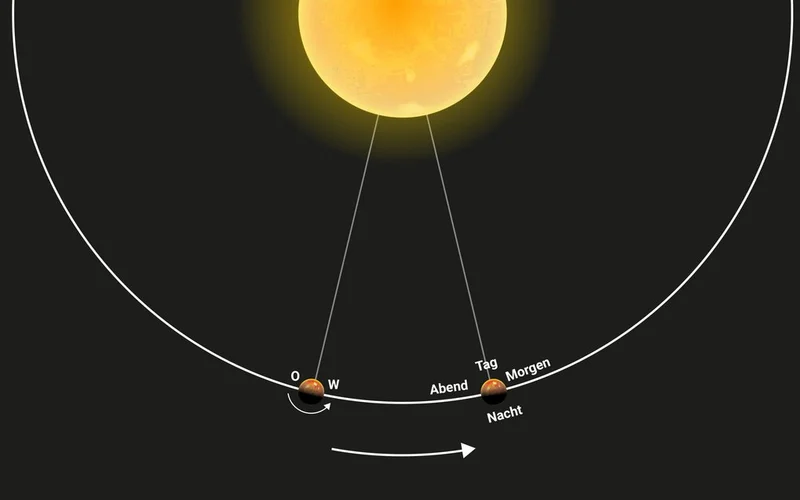
To capture these tiny changes, astronomers took advantage of a particular behavior of hot gas planets. Their proximity to their home stars synchronizes their rotation and orbital motion over time, so that one rotation eventually takes as long as one orbit. Ultimately, these planets exhibit two completely different hemispheres: one hot, constantly facing the star, and the opposite, darker, and cooler side.
"WASP-121 b is particularly extreme: The average temperatures on the day side are around 2,770 Kelvin, while on the night side they are closer to about 1,000 Kelvin," explains co-author Tom Evans-Soma from the University of Newcastle, Australia, who previously determined the temperature range of the planet and is also affiliated with the MPIA. These values correspond to nearly 2,500 degrees Celsius on the day side and about 725 degrees Celsius at night.
During the observation of the transit of such a planet in front of its star, the planet rotates a bit further between the start and end of the passage, revealing different parts of its atmosphere. While the planet mostly shows its night side, our perspective allows us to glimpse beyond the morning and evening twilight toward the bright day side, depending on the progress of the transit. The zone that is in the direction of the planet's motion corresponds to the morning side. The subsequent zone is the evening side.
In addition to recording the measured brightness changes over time, spectrographs break the light into smaller components—what is referred to in physics as a spectrum—similar to how a prism creates a rainbow-like color distribution. Since atmospheric gases absorb light at very specific colors or wavelengths, a detailed analysis reveals their chemical composition.
From Temporal Variation to Longitude
The change along the direction of rotation is thus reflected in a time-dependent change in the filtered signal. In the case of WASP-121 b, the rotation angle during a complete transit is about 30 degrees. This is sufficient to investigate the morning and evening terminators with high precision along different longitudes.
Typically, astronomers average the measurements over the entire transit to obtain a clearer signal. However, to determine how the light changes during the planet's movement in front of the star, Gapp and his colleagues allowed for a temporal variation during the planet's rotation. By employing statistical methods, they found that their approach described the data significantly better. This shows that they have indeed demonstrated a significant variation.
Noticeable Gaps in Atmospheric Models
To confirm the measured temperatures that would cause a local expansion, the researchers applied mathematical models of the physical conditions. These simulated the heat distribution in the upper layers of a gas planet depending on the properties of the planet and the configuration between the planet and its home star. While these atmospheric models confirmed the temperature differences, the data exhibited a greater signal amplitude than the models had predicted.
The astronomers suspected that cooling mechanisms might be at work at the morning terminator that were not accounted for in the models. Previous studies have suggested that there could be clouds, but these are not composed of water droplets but rather of minerals like silicates. Clouds can efficiently shield infrared light from the underlying hot gas layers, thereby creating the illusion of lower temperatures. It is well known that simulating the physics of clouds, condensation, and evaporation in a dynamic environment is extremely challenging. Therefore, the physical models typically applied to exoplanet atmospheres, as in this study, do not account for clouds, which can lead to unrealistic results.
After the simulation was adjusted to approximately mimic the effect of clouds on the infrared radiation from deeper layers, the results aligned better with the observations. Nonetheless, only more complex models will be able to reliably confirm the presence of clouds.
A Concept for Future Studies
Future investigations using this method will benefit from the improved models. The astronomers have already identified additional suitable targets within the required temperature range and with the appropriate rotation speed to successfully study their terminator regions. This will help them build a sample of ultra-hot gas planets, deciphering their structure along the direction of rotation and potentially discovering commonalities and differences among these extreme worlds.