Webb Discovers Water Ice Clouds on Exo-Jupiter
A team of astronomers led by Elisabeth Matthews at the Max Planck Institute for Astronomy (MPIA) has discovered water ice clouds on a distant exoplanet, Epsilon Indi Ab, showcasing the potential for future exoplanet research.
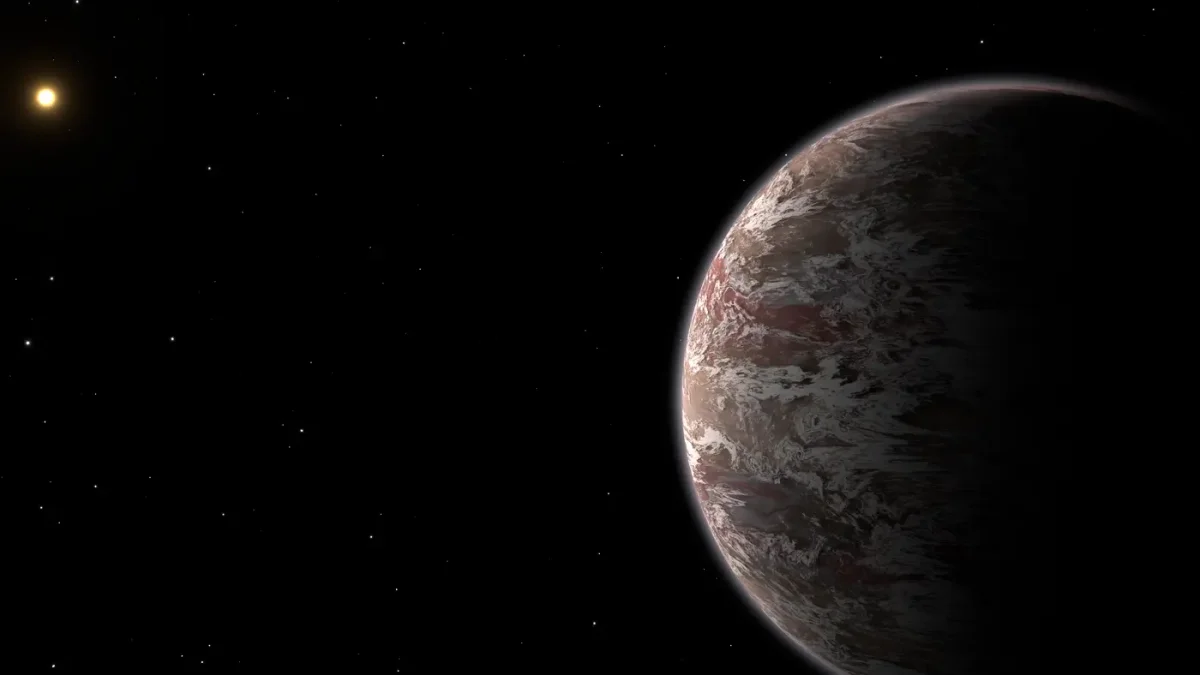
A team of astronomers led by Elisabeth Matthews at the Max Planck Institute for Astronomy (MPIA) has made a discovery that highlights the limitations of many current models of exoplanet atmospheres: water ice clouds on a distant, Jupiter-like exoplanet named Epsilon Indi Ab. How these observations were conducted is an interesting step towards the overarching goal of exoplanet research: the discovery and characterization of an Earth-like exoplanet.
Step by Step to the Second Earth
Exoplanet research has an ambitious long-term goal: astronomers hope to eventually detect signs of life on an exoplanet within the next few decades. Along the way, research has gone through several phases. In the first research phase, from 1995 to around 2022, the focus was on discovering more and more exoplanets: using indirect methods that provided information about the masses of some exoplanets, the diameters of others, and in some cases, information about both mass and diameter.
With the commissioning of the James Webb Space Telescope (JWST) in 2022, the second phase began: from now on, high-quality, detailed information about the atmospheres of a significant number of planets became available, and researchers began to reconstruct the properties of these atmospheres in detail. The realistic search for life on exoplanets is still at least one more step away at this stage and will likely require the next generation of space telescopes.
In the study now published, astronomers are testing some aspects of the investigative methods of that next stage – but not yet for a planet like Earth. Elisabeth Matthews, the lead author of the study, states: "The JWST finally allows us to study planets similar to those in the solar system in detail. If we were extraterrestrials several light-years away and looked towards the Sun, the JWST would be the first telescope with which we could study the planet Jupiter in detail. However, to conduct such studies on Earth, we would still need far more powerful telescopes."
An Exo-Jupiter in Sight
However impressive the JWST's results regarding the atmospheres of exoplanets generally are, exploring true Jupiter analogs has proven difficult. Almost all gas giants studied with the JWST so far are significantly hotter than Jupiter. This is systematic: the most common method for studying exoplanet atmospheres assumes that the planet passes directly in front of its star from the perspective of earthly observers. The likelihood of this configuration is significantly higher when a planet is closer to its star. This, in turn, makes such a planet naturally comparatively hot. The new study by Elisabeth Matthews and her colleagues employs a different method. This allowed the researchers to examine a true Jupiter analog more accurately than ever before – with a surprising result!
Matthews and her colleagues used the Mid-Infrared Instrument (MIRI) of the JWST to directly image the planet Epsilon Indi Ab. According to the usual conventions for exoplanet designations, this is the first planet discovered around the star Epsilon Indi A in the southern constellation Indus. Bhavesh Rajpoot, a PhD student at the Max Planck Institute for Astronomy who contributed to the study, says: "This planet has a significantly larger mass than Jupiter – in our study, we estimate it to be 7.6 Jupiter masses – but its diameter is roughly equivalent to that of its counterpart in the solar system."
A More Massive, Slightly Warmer Jupiter
Epsilon Indi Ab is about four times as far from its central star as Jupiter is from the Sun. The star Epsilon Indi A itself is somewhat less massive and cooler than our Sun. As a result, the surface temperature of Epsilon Indi Ab is relatively low at about 200 to 300 Kelvin (between -70 and +20 degrees Celsius). However, Epsilon Indi Ab is slightly above the surface temperature of Jupiter (140 K). The reason for this is residual heat from the planet's formation phase. Over the next billion years, Epsilon Indi Ab will continue to cool and will eventually be cooler than Jupiter.
The astronomers used the coronagraph of the MIRI instrument to block out the light from the central star. Otherwise, the starlight would overshadow the much weaker light from the planet. They then took an image through a very specific filter, namely at 11.3 μm. This wavelength is just outside the range near 10.6 μm, whose light is characteristic of ammonia molecules NH3. Images at 10.6 μm had already been captured by Matthews and her team in 2024. The comparison allowed the astronomers to estimate the amount of ammonia present. (By the way, both the mechanical filter wheels, the coronagraph, and the filters positioned in front of the MIRI camera were constructed at MPIA – one of the German contributions to the JWST.)
Surprising Evidence of Clouds
In Jupiter, the upper layers of the atmosphere visible in observations are dominated by ammonia gas and ammonia clouds. Due to its properties, it was assumed that Epsilon Indi Ab also contains huge amounts of ammonia gas, albeit no ammonia clouds. Surprisingly, the described comparison of the images indicated a lower amount of ammonia than expected. The best explanation that Matthews and her colleagues found for this deficiency was the presence of dense, albeit patchy water ice clouds, similar to the high-altitude cirrus clouds in Earth's atmosphere – an unexpected complication!
In interpreting such observations, astronomers compare their data with simulations of corresponding planetary atmospheres. However, most published models completely exclude clouds. Including clouds makes the calculations significantly more complicated. The new measurements now suggest that a reasonable comparison without simulated clouds is not possible! James Mang (University of Texas at Austin), a co-author of the study, says: "This kind of problem is immensely exciting and demonstrates the tremendous progress we are making thanks to the JWST. What once seemed out of reach of our observations is now within tangible proximity. We can study the structure of these atmospheres, including the presence of clouds. This opens a new level of complexity that our models are only gradually capturing. And it opens the door to an even more detailed characterization of these cold, distant worlds."
An Opportunity for the Nancy Grace Roman Space Telescope
In an important respect, the astronomers are fortunate. Soon, an opportunity should arise to observe highly reflective water ice clouds based on their reflected light: NASA's Nancy Grace Roman Space Telescope, scheduled for launch in 2026–2027, in which MPIA is also involved as a partner, should be suitable for exactly this type of observation. Until then, Matthews and her colleagues have applied for additional observation time with the JWST to target more cold Jupiter analogs. And while Matthews and other astronomers learn more about cold exo-Jupiters, they are laying the groundwork with their observational techniques for future observers – if all goes well – to target Earth-like planets in the search for life.