Exploring the Open Star Cluster Messier 21
Explore the open star cluster Messier 21 (NGC 6531) in the constellation Sagittarius, discovered by Charles Messier in 1764, and learn about its characteristics, observation tips, and significance in astronomy.
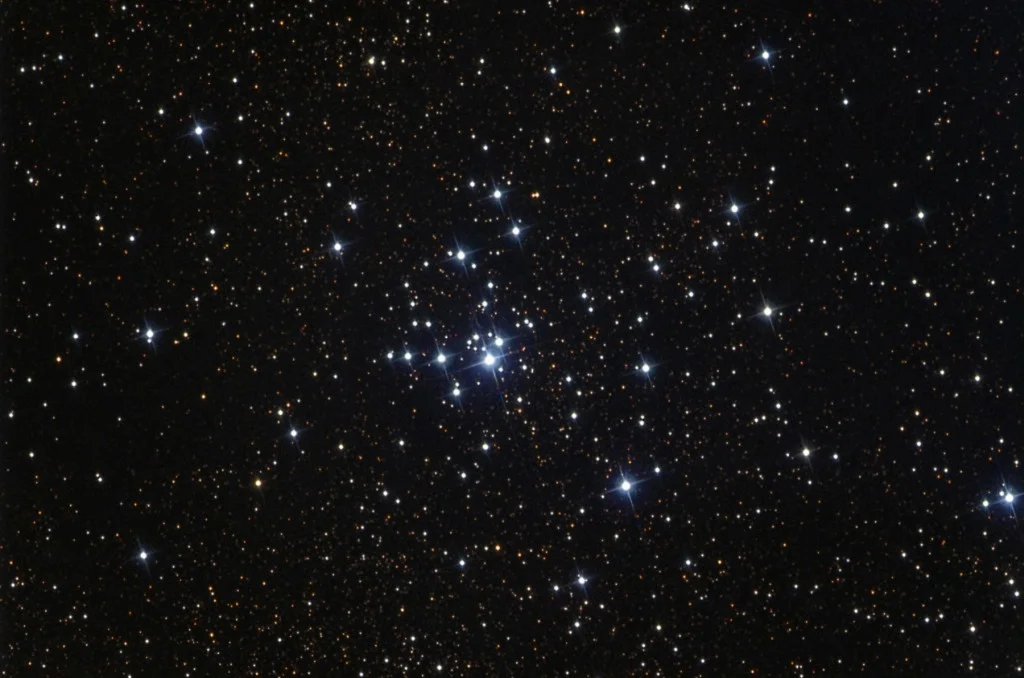
The open star cluster Messier 21 (NGC 6531), located in the southern constellation of Sagittarius, was discovered and cataloged by the French astronomer Charles Messier on June 5, 1764, during his search for comets. He described it simply as a "star cluster near the preceding M 20," noting its position at 11 Sagittarii, although this star is actually situated 2° further southeast of M 21. Messier also believed he observed signs of nebulae within the cluster. The German-British astronomer Friedrich Wilhelm Herschel observed the cluster on May 26, 1786, and his son John Herschel later included it in his catalog as GC 4367. Less commonly known, particularly outside the Anglo-Saxon world, is the designation for Messier 21 along with Messier 20: "Webb’s Cross."
A Young Cluster in a Prominent Setting
Messier 21 is one of many intriguing deep-sky objects within the constellation of Sagittarius. This region lies in the galactic plane, where star clusters, nebulae, star formation areas, and other Messier objects are frequently found. M 21 is a young, compact open star cluster with an apparent diameter of 13 arcminutes—about half the size of the full moon—and an apparent magnitude of 5.9. It belongs to the Trumpler Class I3r, indicating that it is a distinct cluster with a strong central concentration, containing both bright and faint stars with over 100 members. Under excellent conditions, it can even be seen with the naked eye. Nearby are the Lagoon Nebula (Messier 8) and the Trifid Nebula (Messier 20).
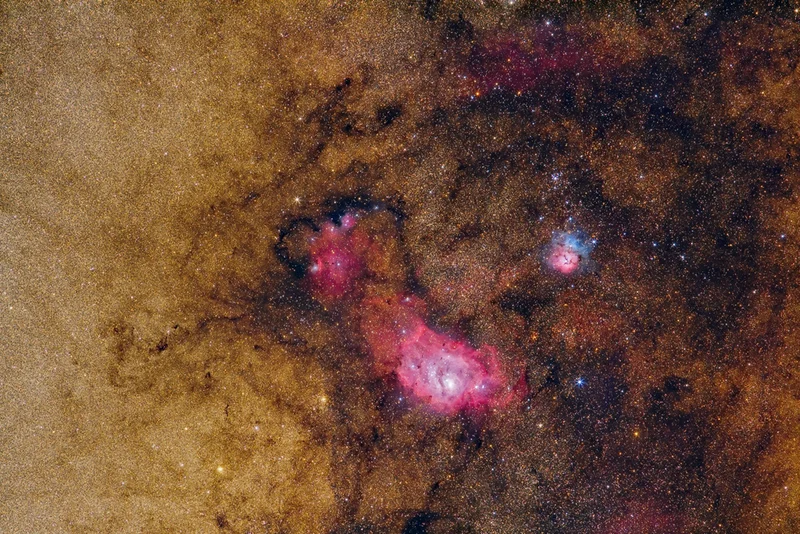
In long-exposure images of the region, these objects are often captured alongside the star cluster. Consequently, M 21 is frequently overlooked by visual observers, despite being detectable with a small telescope. Although the Trifid Nebula lies only ¾ degree northeast of M 21, there is no true physical connection between the two. Depending on the source, M 21 is located between 2,200 and 4,250 light-years from Earth, making it further in the foreground. Recent measurements by the astrometry satellite Gaia place the cluster at a distance of 3,930 light-years. Its diameter spans approximately 17 light-years. The cluster's light is diminished by interstellar absorption by about 0.87 magnitudes. Along with the Lagoon and Trifid Nebulae, Messier 21 is part of the Sagittarius OB1 association in the Sagittarius-Carina spiral arm of our Milky Way. This group consists of massive stars of spectral classes O and B that share a common motion, age, and origin.
At an age of 6.6 million years, the star cluster is significantly older than the Trifid Nebula but ranks among the youngest clusters in our Milky Way. It is merely 10% as old as the Pleiades (Messier 45), the prototype of a young open star cluster, and just 0.1% as old as our Sun. The cluster includes several hot, massive blue giant stars of spectral type B0. These young, hot stars will eventually evolve into red giants and supernovae, enriching the surrounding interstellar medium with heavy elements. The stars within the cluster show no significant age dispersion, indicating that star formation was triggered simultaneously. Additionally, it contains 40 to 60 lower-mass stars, many of which have not yet reached the main sequence in the Hertzsprung-Russell diagram and are still in a contracting phase.
In astronomical literature, the total number of stars in Messier 21 is reported as 57. Approximately 35 stars range between 8 and 12 magnitude, with many of these already visible through a small telescope. The brightest star in the cluster is HD 164863 of spectral class B0, with an apparent magnitude of 7.3. In total, it contains 105 confirmed members up to a magnitude of 15.5. Eight of the ten brightest stars in this cluster are spectroscopic binaries with orbital periods of less than six days. The fainter member stars tend to concentrate more towards the edges, while the brighter stars are predominantly found in the central region. The average stellar density in its center is about nine stars per cubic parsec. The total mass of the cluster is estimated at 783.4 solar masses, with a total luminosity of around 20,000 suns.
Messier 21 is one of the few objects in the Messier catalog that has not yet been photographed by the Hubble Space Telescope. Furthermore, it is among the approximately 1,500 known open star clusters in our galaxy that remain poorly studied.
Observation
The star cluster does not rise very high above the southern horizon in Central Europe. Its light must traverse the denser atmospheric layers near the horizon. In contrast, it is seen at zenith from Namibia. Its stars merge for the naked eye with those of the star cluster embedded in the Trifid Nebula, forming "Webb’s Cross," a beautiful star field with about a dozen stars of the 6th and 7th magnitudes. It appears nebulous and can be resolved with binoculars. With a 10×50 binocular, M 21 appears as a dense knot in a rich star field against the misty veil of unresolved Milky Way stars. With indirect vision, a hint of starlight becomes noticeable. In a 16×70 Fujinon binocular, a dozen member stars can already be resolved against a nebulous background.
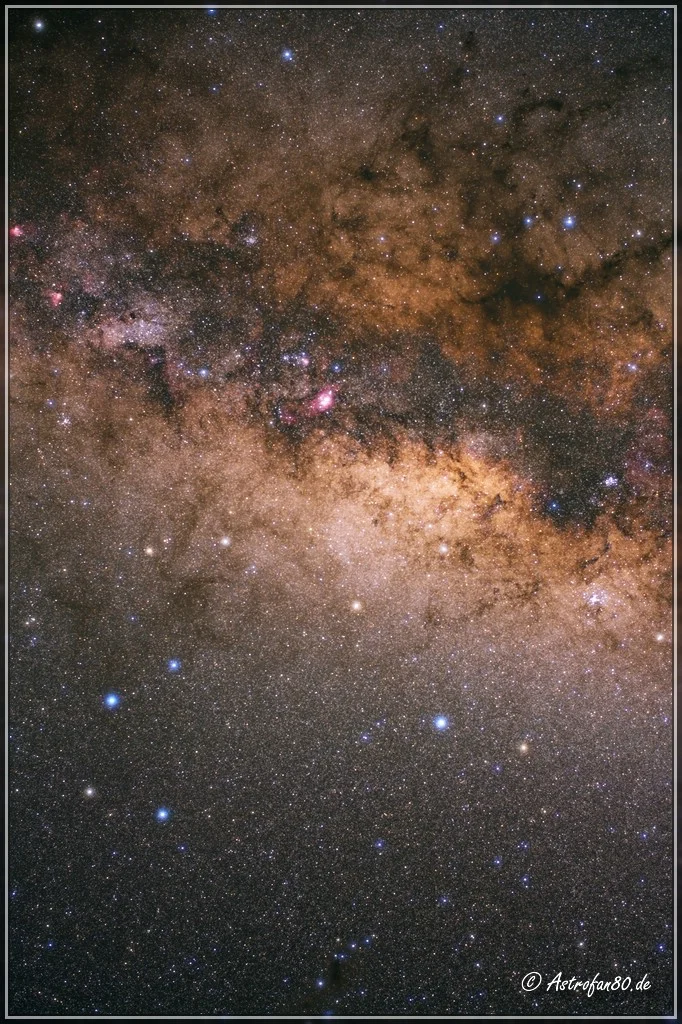
Using a small refractor with a 3 to 4-inch aperture at 30 to 40 magnifications, a compact star cluster with around two dozen delicate, white-blue stars of 7th to 9th magnitudes can be observed. Its members are relatively concentrated towards the center. The Trifid Nebula also occupies the same field of view at low magnifications. A trio of bright stars dominates the central region of the cluster, from which chains of fainter stars extend outward. The brightest star in the cluster is the attractive binary star S 698, featuring components of 7.2 and 8.5 magnitudes separated by 30 arcseconds. Telescopes with 6 to 8-inch apertures and moderate magnifications reveal the star cluster fully resolved. Messier 21 now fills the entire field of view, with around 50 to 60 member stars visible up to the 12th magnitude. The highest concentration is found directly around the bright star. North of this is a small circle of stars, with the brighter stars of the cluster forming a ring or spiral pattern. Southwest of the cluster center, two chains of medium-bright stars can be traced for about half a degree towards the Trifid Nebula.

Messier 21 is located in the northeastern part of the Sagittarius constellation. It is best observed during the summer months when the constellation lies low in the southern sky. The star cluster is relatively easy to locate when starting from the teapot asterism of Sagittarius. The three upper stars of the teapot are Kaus Borealis (Lambda Sgr, 2.8 mag), Kaus Media (Delta Sgr, 2.7 mag), and Theta Sagittarii (3.2 mag). Messier 21 is situated on a line extended one and a half times the distance between Theta Sagittarii and Kaus Borealis. It is already visible in a finder telescope and located just two and a half degrees northwest of the Lagoon Nebula.

Quick Facts for Messier 21
Data and facts about the open star cluster Messier 21 in Sagittarius
- Object Name: Messier 21
- Catalog Designation: NGC 6531, OCL 26, Collinder 363, Melotte 188, Raab 128, ESO 521-SC19
- Type: Open star cluster, I 3 m
- Constellation: Sagittarius
- Right Ascension (J2000.0): 18h 04m 13.3s
- Declination (J2000.0): -22° 29′ 24″
- V Magnitude: 5.9
- Surface Brightness: 11.0 mag
- Angular Size: 16.0′
- Number of Stars: 70
- Brightest Star: 7.3 mag
- Diameter: 17 light-years
- Distance: 3,930 light-years
- Description: Cl,pRi,lC,st9…12; In Sgr OB1; 36 members to 12th mag
- Discoverer: Charles Messier, 1764
- Star Atlases: Cambridge Star Atlas: Chart 12 & 18, Interstellarum Deep Sky Atlas: Chart 66, 67, 78, 79, D6, Millennium Star Atlas: Charts 1391–1392 (Vol III), Pocket Sky Atlas: Chart 67, Sky Atlas 2000: Chart 22, Uranometria 2nd Ed.: Chart 145