Upcoming Notable Pass of the International Space Station on January 31, 2025
The upcoming visible pass of the International Space Station (ISS) on January 31, 2025, will be a notable event for observers across Italy. Learn why the ISS is visible and when to catch the best views.

The visible passes of the International Space Station (ISS) are remarkable events that can be observed with the naked eye from various locations on Earth.
Why is the ISS visible?
The ISS reflects sunlight due to its large surfaces, including solar panels and its external structure. Although it orbits approximately 400 km above the Earth's surface, it becomes visible when illuminated by the Sun while the sky above the observer is dark, typically during twilight or dawn. Occasionally, a shadow from the Earth may obscure the station, causing it to seemingly vanish even when it is high in the sky.
The ISS appears as a bright point moving swiftly across the sky, without blinking (unlike airplanes). It travels at around 28,000 km/h, completing an orbit around the Earth in about 90 minutes. Its brightness can fluctuate based on the angle of sunlight reflection and the observer's location, sometimes reaching a magnitude of -4, comparable to or brighter than Venus.
Visible passes typically last from a few seconds to 5-6 minutes, as the ISS traverses the sky from one horizon to another.
These passes follow a west-to-east trajectory, as the ISS orbits in the same direction as the Earth's rotation. With an orbital inclination of approximately 51.6°, it can fly over many populated areas.
Visibility depends on the observer's geographical location, making it crucial to choose the right observation point. It is unwise to rely on general maps found online, as they may not correspond to your specific location. On our portal, you can:
- Set your observation location;
- Check the visible passes on the dedicated page, updated nightly.
The skies are not solely occupied by the ISS; they are increasingly filled with satellites. You can track any satellite's passage from this page.
When passes occur at higher altitudes, they tend to be more spectacular, as the station appears brighter and the transit is usually longer.
The Pass on January 31, 2025, Around 17:55
The significance of the pass on January 31 can be inferred from the projection map of the station (see the section below in the following image).
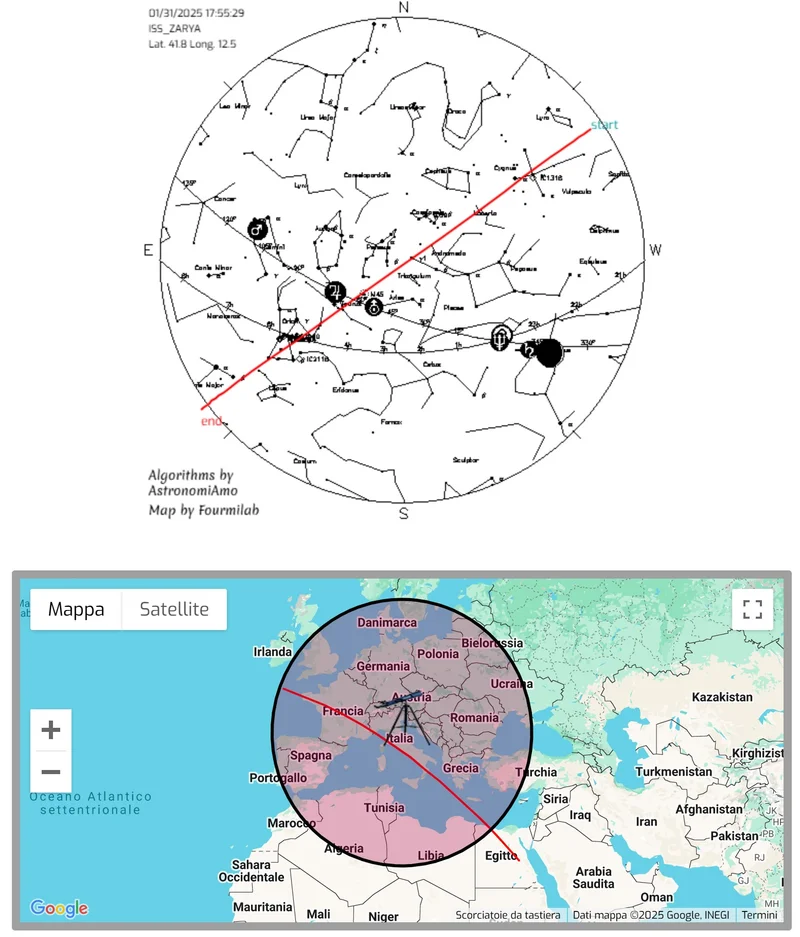
The pass over Italy of the ISS on January 31, 2025, around 18:00. Credits AstronomiAmo
This pass will encompass the entire Italian territory, from North to South, with the station appearing at a high altitude across the country. Typically, passes do not occur at an angle that reflects the shape of the Italian peninsula, so sometimes the North is favored, other times the South or the Center. However, in this case, the height will be approximately equal throughout Italy.
It is important to note that the visibility conditions will vary across Italy: along the red line, observers will see the station at zenith, but as one moves away from this line, the altitude of the ISS will decrease. For example, here are three timings for the North, Center, and South, encouraging readers to set the site to function for their specific observation point. Despite highlighting this pass as an example of "democracy" for all of Italy, each municipality may have even better passes than that of January 31, 2025.
Northern Italy (Turin): begins at 17:54 from the Northwest, peaks at 17:58 at 76° altitude, ends at 18:04 Southeast;
Central Italy (Rome): begins at 17:55 from the Northwest, peaks at 17:59 at 87° altitude, ends at 18:05 Southeast;
Southern Italy (Vibo Valentia): begins at 17:56 from the Northwest, peaks at 18:00 at 80° altitude, ends at 18:06 Southeast.
If you wish to capture the pass, prepare for a long exposure shot, from 5 to 10 seconds depending on the light conditions in the sky: you will obtain a "streak" of the space station's passage above your heads!
Happy observing!