Exploring Messier 24: The Small Sagittarius Star Cloud
Messier 24 is a visible part of the distant Norma spiral arm of our Milky Way in the constellation Sagittarius, offering a unique view of our galaxy's structure.
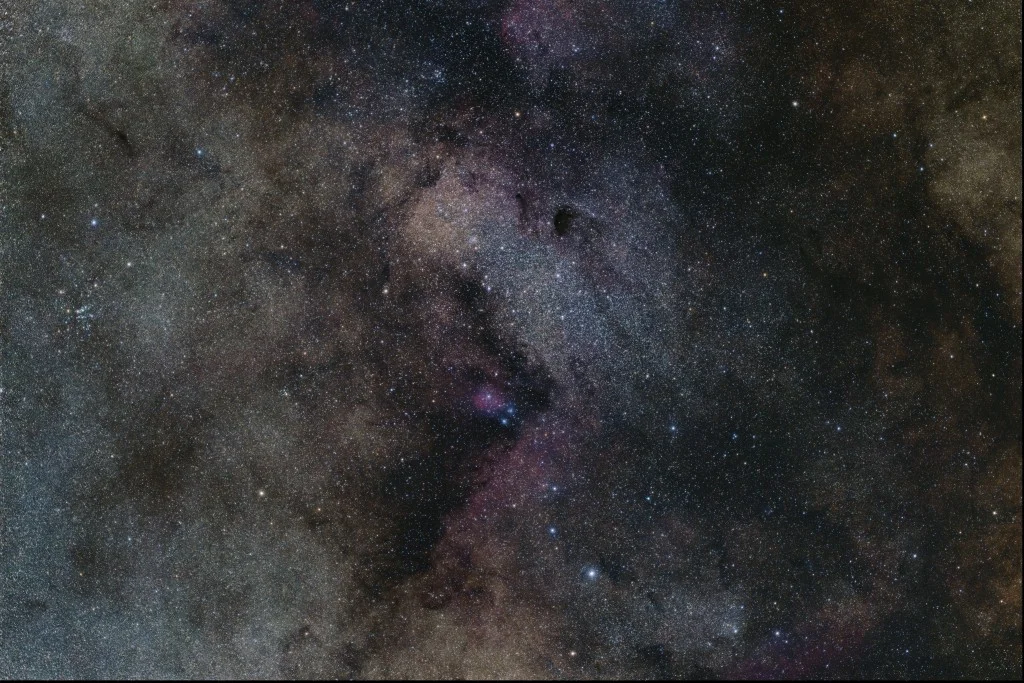
Messier 24 (IC 4715) represents a striking portion of the distant Norma spiral arm of our Milky Way, located within the constellation Sagittarius. This celestial marvel was first documented by the French astronomer Charles Messier on June 20, 1764, who initially perceived it as a star cluster. He later included it in his renowned catalogue of nebulae as the 24th entry, describing it as a "large nebula filled with stars of varying brightness." Interestingly, Messier's catalogue aimed to assist astronomers in distinguishing nebulous objects visible through telescopes from comets. However, the inclusion of Messier 24 raises questions, as it is quite evident that this is an extensive star cloud rather than a traditional nebula.
In 1850, the Italian priest and astronomer Angelo Secchi coined the term "Delle Caustiche" to describe the peculiar arrangement of stars within this region, which manifests in rays, arcs, and intricate spirals.
Today, the star cloud is predominantly referred to as the "Small Sagittarius Star Cloud" to differentiate it from the "Large Sagittarius Star Cloud," which lies north of Gamma and Delta Sagittarii and approximately 10° north of M 24. Unlike the Small Sagittarius Star Cloud, the larger cloud comprises stars located within the galactic bulge of the Milky Way, which are not obscured by interstellar dust. It is common for the open star cluster NGC 6603 to be mistakenly associated with M 24. Messier's measurement of the cloud's diameter at 1.5° clearly indicates that he was observing the significant patch in the Milky Way rather than the much smaller star cluster contained within it.
A Tunnel-Like Window into the Milky Way
Unlike many objects catalogued by Charles Messier, M 24 is not a singular astronomical entity, such as a galaxy, nebula, or star cluster. Instead, it is a dense field of stars with a diameter exceeding 600 light-years, containing thousands of stars visible through telescopes and actually encompassing over a million stars. This tunnel-like "galactic window," situated near the galactic center within a distant spiral arm of the Milky Way, reveals a relatively dust-free section of our galaxy. Remarkably, this "galactic window" provides a view not only of the Sagittarius-Carina spiral arm and the Scutum-Centaurus arm—the main spiral arm between Earth and the galactic center—but also of the underlying Norma spiral arm close to the center.
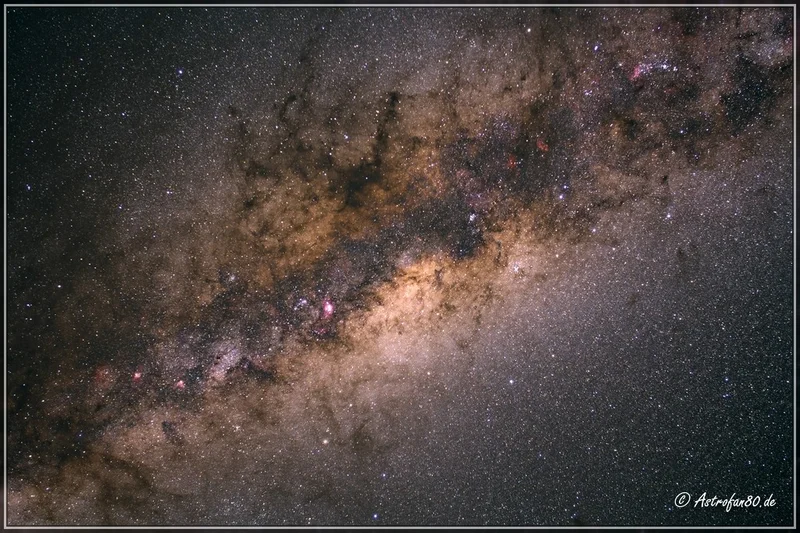
Dense clouds of dust typically obstruct the view of more distant regions of our galaxy along the plane of the Milky Way. This area is referred to as the "Great Rift." Here, we peer through a gap in the Sagittarius-Carina arm, which is located 5,000 to 7,000 light-years away and lies in front of the star cloud. The region surrounding "Delle Caustiche" contains significantly less interstellar material, allowing stars to shine without the 20 to 30 magnitude dimming typically experienced near the galactic center. Normally, our visibility near the galactic plane is limited to just a few thousand light-years; without the obstructive dust and gas, the entire Milky Way would appear as bright as M 24!
Observing Messier 24 grants astronomers an unusual glimpse into the star-rich disk of the Milky Way. These clear windows through the galaxy are crucial for studying its structure, allowing the exploration of otherwise hidden, distant regions as well as the composition of stars within our galaxy. The star-rich region in the summer Milky Way offers a rewarding sight for both amateur astronomers and astrophotographers. While older sources reported the brightness of the star cloud at 4.6 magnitude, more recent estimates suggest a brightness of 2.5 magnitude. Its apparent size spans 2 x 1 degrees in the sky, making the star cloud approximately nine times larger than the full moon. This brightness is not due to individual stars but rather the combined light of thousands of stars closely packed within the star cloud.
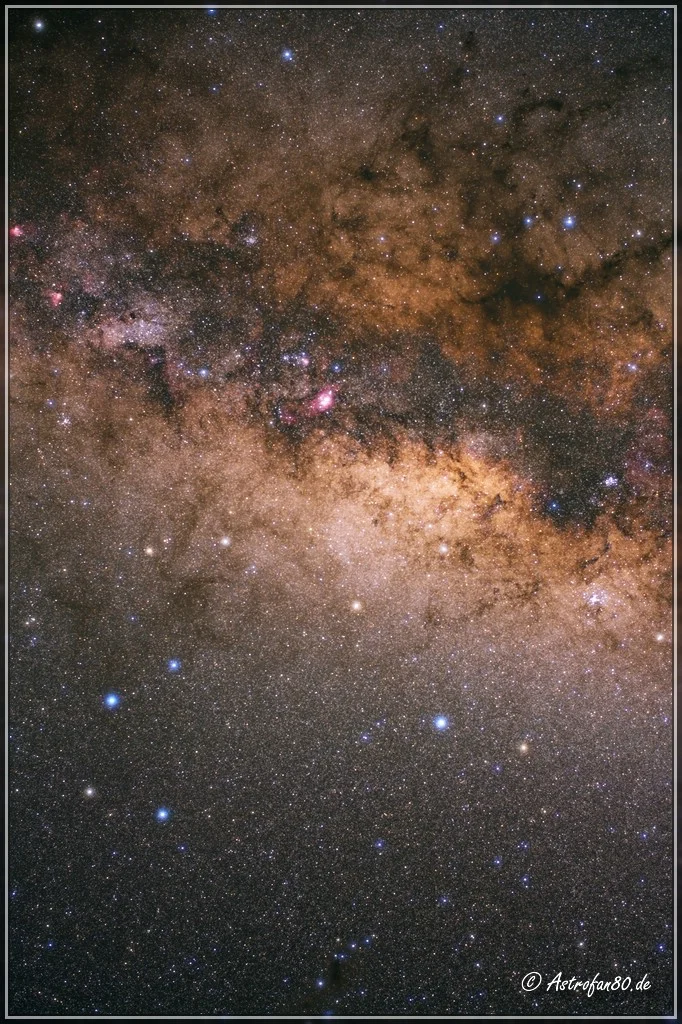
Due to its expansive nature, the best instruments for observing M 24 are binoculars and rich field telescopes. These tools provide a spectacular view of Messier 24, described as "a true tapestry of star jewels" ranging from magnitudes 6 to 10. This includes several dark nebulae that enhance the three-dimensional impression. M 24 is visible to the naked eye whenever the Milky Way can be seen. A more transparent region near the star My Sagittarii is known as the "Bathing Window," offering a view of the galactic bulge—the central area of our Milky Way—at a distance of 30,000 light-years.
Deep-Sky Objects within the "Caustic Cloud"
Messier 24 extends over a considerable volume, reaching depths between 10,000 and 16,000 light-years. It represents the densest concentration of individual stars visible through binoculars. Approximately 1,000 stars can be seen within a single field of view through a standard pair of binoculars. Additionally, it bears similarities to the star cloud NGC 206 in a spiral arm of the Andromeda Galaxy (Messier 31). This field encompasses numerous young, hot stars, as well as several open star clusters, including NGC 6603 (11.4 magnitude) and the two planetary nebulae NGC 6567 (12.0 magnitude) and M 1–43, with NGC 6603 being particularly notable.
This rich star cluster is located in the northern part of M 24, approximately 11,700 light-years from our solar system within the Norma spiral arm of our Milky Way. NGC 6603 was discovered on July 15, 1830, by the English astronomer John Herschel and appears as a nebulous patch even through small telescopes. The star cluster contains over 30 stars within a field of 5 arcminutes in extent, with a linear diameter of about 14 light-years. The hottest stars in the cluster are of spectral type B9, indicating an age of approximately 200 million years. The star cluster resembles Messier 11 in the constellation Scutum but is located 2.5 times farther away. Its light experiences an interstellar extinction of only 1.5 magnitudes.
Other open star clusters include Collinder 469 and Markarian 38 (Biur 5), which are part of the Sagittarius OB4 association. The brightest member of this association, of spectral type O (HD 167771), plays a significant role in ionizing this nebula. Another notably compact star formation region is Sharpless 40. Additionally, two prominent dark clouds are visible, which lie in front of the star cloud and consist of opaque, dense interstellar dust that blocks the light from the stars behind them. To the northwest lies Barnard 92, the darker of the two. In the midst of the star field, this nebula appears as a vast, starless void with an extent of ¼ degree. B 92 was nicknamed "Black Hole" before this term became commonly associated with black holes in its current form. The dark nebula was discovered in 1913 by the American astronomer Edward Emerson Barnard, making it one of the first such objects described by him.
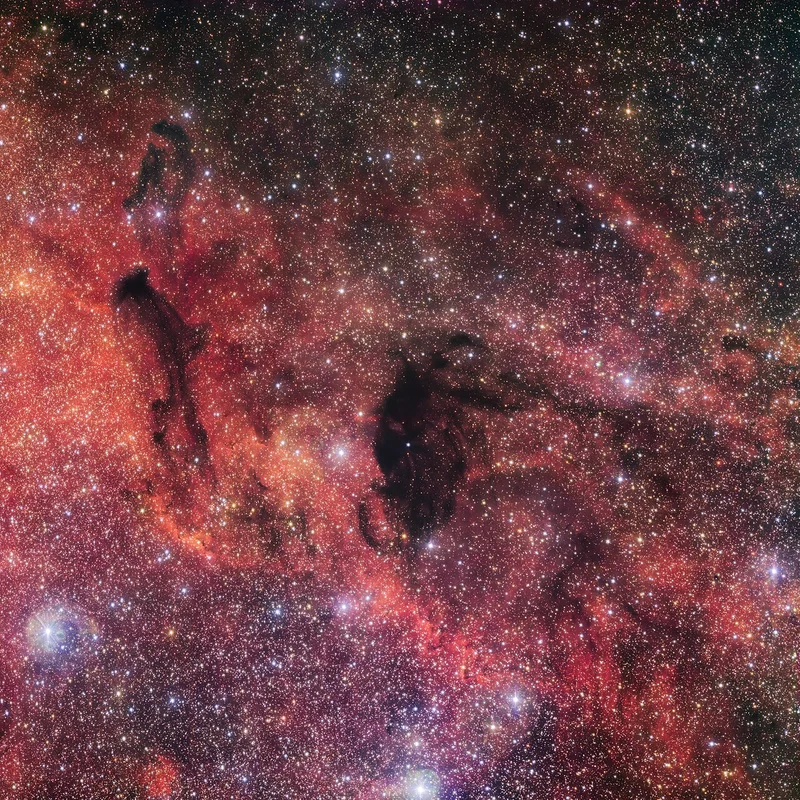
To the northeast is Barnard 93, which is less conspicuous and larger. Additional dark nebulae in M 24 include Barnard 304 and Barnard 307. All these nebulae belong to our local spiral arm and are located just a few hundred light-years from Earth. The dark nebulae LDN 294, LDN 318, and LDN 325 form a dark cloud complex along the southern and eastern edges of M 24. Immediately south of Mrk 38 lies the emission nebula IC 1283/1284, along with the adjacent reflection nebulae NGC 6589/6590. Their energy source is the notable small open star cluster NGC 6595 (7.0 magnitude).
The brightest star in M 24 is HD 167356 (V4387 Sgr), with a brightness of 6.05 magnitude. It is a white supergiant of spectral class A0 and a variable star of the Alpha-2 Canum Venaticorum type. Other variables include the long-period Cepheid WZ Sagittarii and the Alpha-Cygni variable V4384 Sagittarii. M 24 also contains three additional stars with apparent magnitudes between 6.5 and 7.0.

North of the star cloud lies the Omega or Swan Nebula (Messier 17), another famous object from Charles Messier's catalogue. Located 5,900 light-years away, M 17 is only about half the distance of M 24. Furthermore, Messier 24 serves as an excellent starting point for locating and observing other interesting Messier objects within the constellations Sagittarius and Serpens. From this vantage point, deep-sky objects M 18, M 23, M 25, M 21, M 20, M 8, M 17, M 22, and M 28 can be easily found.
Delle Caustiche is one of only three Messier objects that do not represent true deep-sky entities. The other two are the double star Winnecke 4 (WNC 4) in the constellation Ursa Major, catalogued as Messier 40, and the asterism Messier 73, which consists of four non-physically related stars in the constellation Aquarius.
Observing M 24
Messier 24 is visible to the naked eye as a compact brightening among the dark structures of the Milky Way under a dark country sky. However, in Central Europe, urban light pollution typically hampers successful sightings, as M 24 lies 12 degrees deeper than the Shield Cloud, another prominent area of our galaxy. In Namibia, the Small Sagittarius Star Cloud reaches its zenith and appears significantly more prominent and even somewhat brighter than the Shield Cloud. Under less favorable conditions, even a slight optical aid suffices to make it visible. For binocular and small telescope owners, M 24 is a true gem of an object, being the densest collection of individual stars visible through binoculars. However, with medium and large telescopes, some of the allure of the cloud is lost, as it appears too large for the field of view. Nonetheless, thousands of stars can be observed, often in contrasting colors. Using a standard 7×50 binocular, two dark spots (B 92 and B 93) can be discerned at the northern edge, along with an elongated, nearly right-angled dark cloud that adds to the visual spectacle.