January 26: Kemble's Cascade & NGC 1502
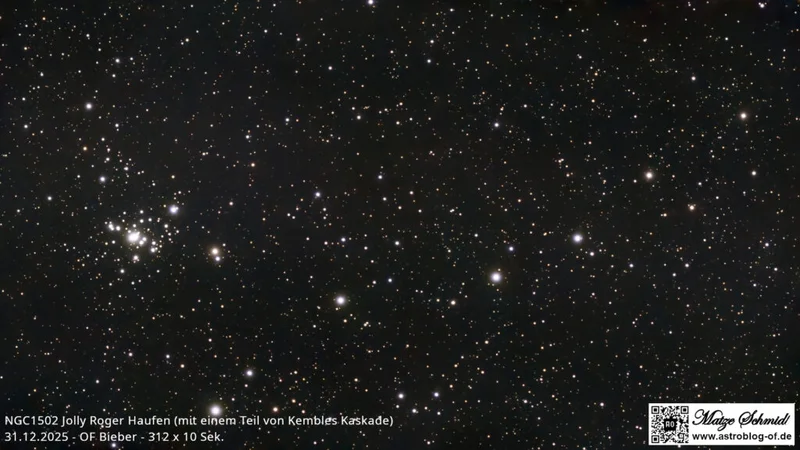
Kemble's Cascade is a striking star chain, leading to the compact star cluster NGC 1502, both located in the constellation Camelopardalis.
Overview
Kemble's Cascade is a striking chain of stars that culminates in the open yet relatively compact star cluster NGC 1502. Both celestial objects are located within the constellation Camelopardalis, commonly known as the Giraffe. This star chain comprises a seemingly random arrangement of bright and dim stars that stretches over more than two degrees in the night sky. Although the stars in the cascade and the star cluster do not share a physical connection, they create a visually harmonious and aesthetically pleasing formation.
Location and Finding
The constellation Camelopardalis is generally faint and lacks particularly prominent stars. Kemble's Cascade is situated northeast of Perseus, in a region that is overall star-poor. However, it stands out distinctly against the background, easily identifiable through a finder scope or binoculars due to its linear arrangement of stars. A useful guide for locating it is to imagine a line connecting Mirfak (α Persei) to the North Star; Kemble's Cascade lies just above this line, approximately one-third of the distance along it.
NGC 1502 marks the endpoint of the cascade. This star cluster can also be observed in smaller telescopes as a slightly condensed grouping of stars.
Observation
Kemble's Cascade is an excellent target for wide-field telescopes and can be seen as a glittering chain of about 20 to 25 stars even through binoculars with an aperture of around 50 mm. When using a telescope, a low magnification is recommended to capture the full length of the cascade.
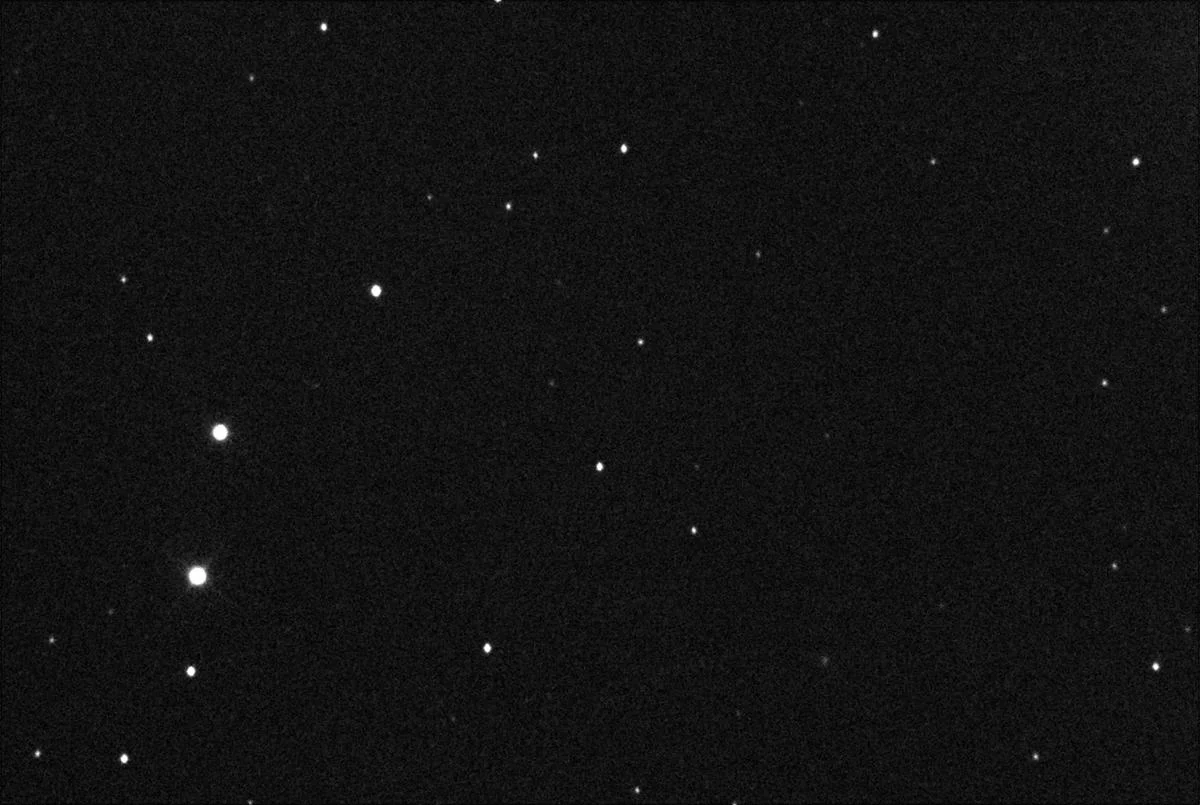
With a slightly higher magnification, observers can resolve the star cluster NGC 1502 at the end of the chain. Notably, two bright star pairs in the center give the cluster its distinctive appearance.
Background and Facts
The stars in Kemble's Cascade are not physically related to each other or to the star cluster. The apparent connection arises solely from our perspective on the spatial arrangement of these stars.
In contrast, NGC 1502 is a genuine open star cluster located approximately 3,000 light-years away. It consists of around 49 stars with magnitudes ranging from about 7 to 11, with the two brightest stars at the center reaching magnitudes of approximately 7 and 8. The star cluster is estimated to be around eleven million years old and spans about six light-years in diameter.
NGC 1502 was discovered on November 3, 1787, by the German-British astronomer Friedrich Wilhelm Herschel.