An Astronomical Night in Weibersbrunn
An evening of stargazing in Weibersbrunn with family and friends, observing various celestial objects despite challenges posed by moonlight.
A Spontaneous Night of Observation
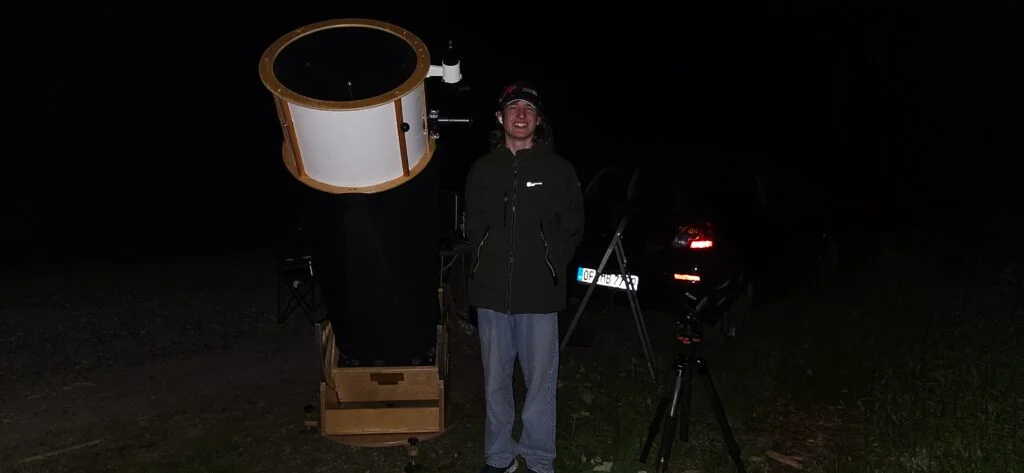
With the weather finally promising clearer skies over the Pfingst weekend, I decided to seize the opportunity for an evening of stargazing alongside my son. Despite the bright half-moon, we were determined to indulge in our shared passion for astronomy. Our plans were slightly delayed due to the Formula 1 qualifying race in Canada, but we set off for Weibersbrunn afterward. To our delight, Mark from our astronomy group joined us, making the night even more special as it had been a while since we last met.
Efficient Setup in Good Company
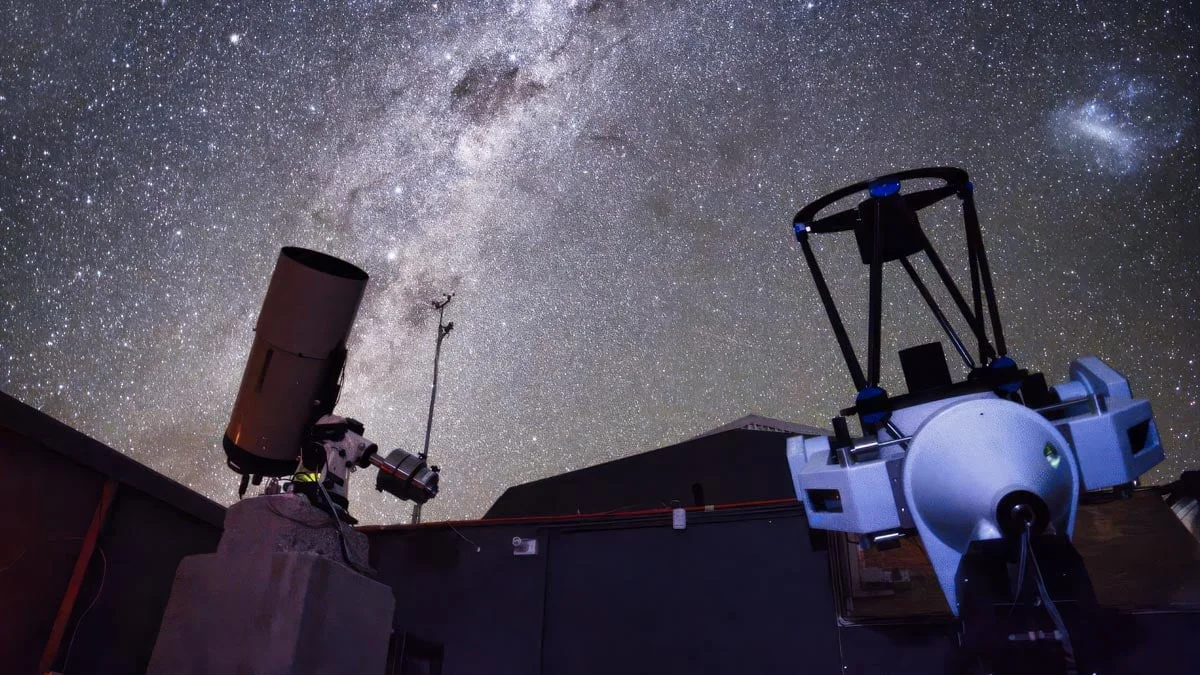
Arriving in Weibersbrunn around midnight, we found Mark had just arrived as well. We quickly set up the Seestar and aligned our target to ensure our eyes adapted to the darkness. Next, we moved on to assembling the 16-inch Dobsonian telescope. Mark brought along his smaller telescope since he couldn’t stay for long.
Frustration with Galaxies, Beauty of Globular Clusters
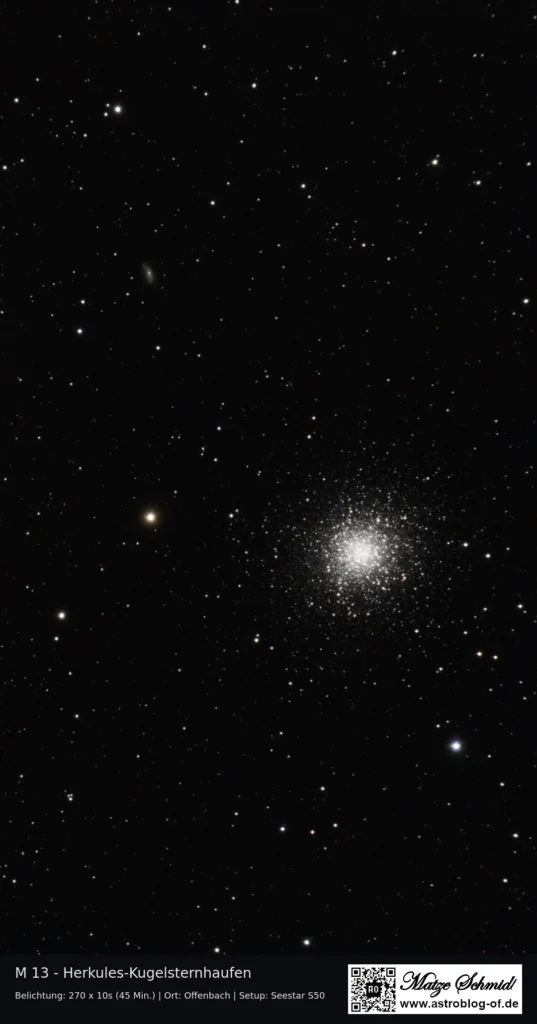
Our first targets were the galaxies M81 and M82 in the Ursa Major constellation. Unfortunately, the bright moonlight hindered our view, leaving these galaxies underwhelming. However, we were thrilled to observe the Hercules cluster M13, which shone brightly despite the lunar glow. It never disappoints! M92, another globular cluster in Hercules, was also a stunning sight. This time, Ben was in charge of locating these objects, and he did an excellent job!
A Mouse’s Face in the Cosmos
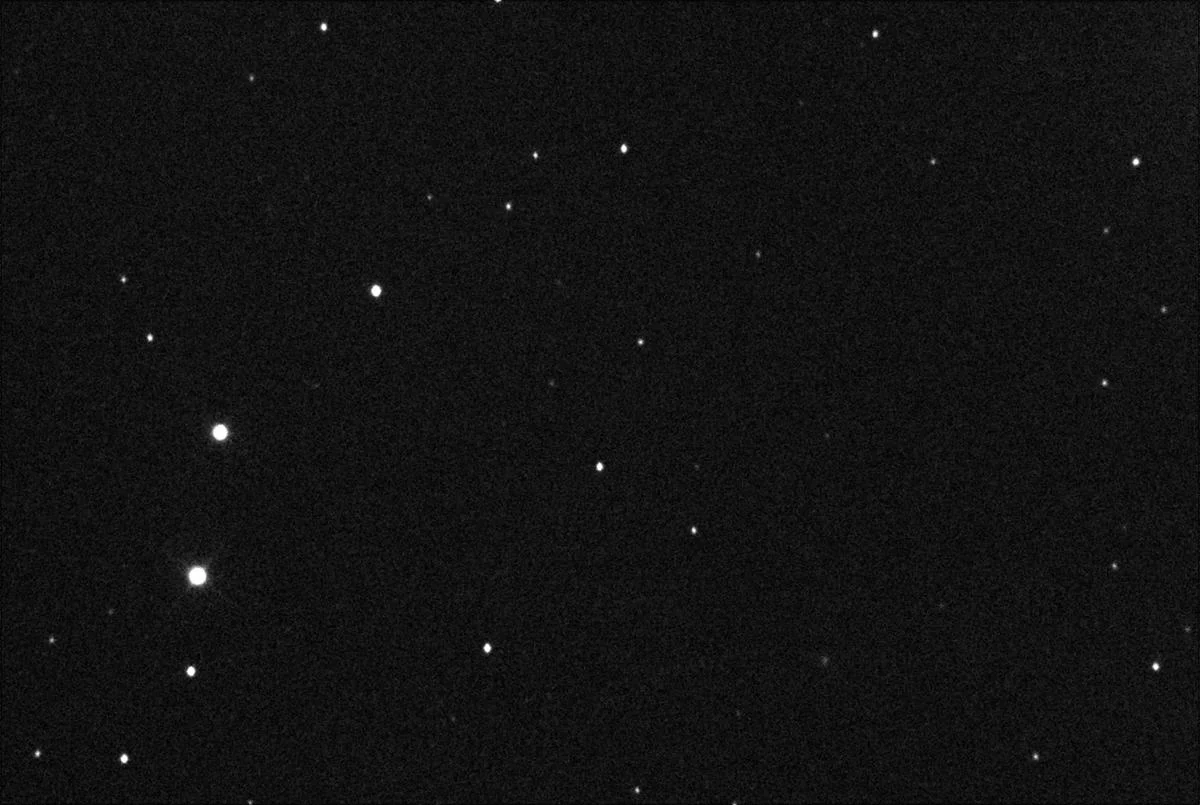
I took over for the next object, which can be tricky to find without knowing what to look for. Still in Hercules, we spotted the globular cluster NGC 6229, which appears much smaller due to its distance of about 100,000 light-years. It formed a distinctive triangle with two nearby stars, resembling a mouse’s face, with NGC 6229 representing the nose.
Classic Summer Sky Objects in Lyra and Cygnus
We then turned our attention to the constellations Lyra and Cygnus. In Lyra, we admired the Ring Nebula M57 and the globular cluster M56. However, M56 pales in comparison to M13 and M92, as it is neither as dense nor as large. In Cygnus, we observed the beautiful double star Albireo, where one star glows a warm yellow-orange, while the other sparkles a deep blue.
From the Coat Hanger to Nebula Frustration
No stargazing outing would be complete without the Coat Hanger cluster Cr399, an asterism best viewed through binoculars. We also explored the Dumbbell Nebula M27, located in the same constellation. Returning to Cygnus, we aimed for the Cooling Tower cluster M29. Finally, we attempted to view the Cirrus Nebula using an OIII filter, but the conditions were poor. The moonlit sky and a fine haze robbed the nebula of its contrast.
A Fitting Conclusion and Continued Imaging
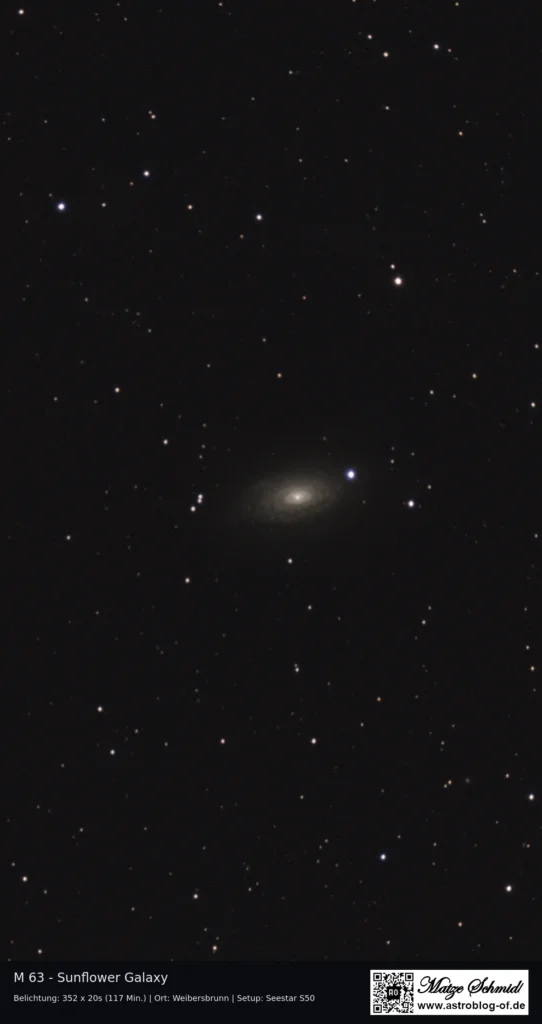
To wrap up our night, we observed the Owl cluster NGC 457 in Cassiopeia and the globular cluster M3 in Canes Venatici. By this time, it was already past 3 AM, and given the conditions, we decided it was best to pack up. Meanwhile, the Seestar continued to capture images. Below, you can see the result of our observation of the Sunflower Galaxy (M63).
Spending the night under the stars with a telescope and in great company was truly delightful. I am already looking forward to our next outing!