May 26 — The Double Star Cluster h & chi Persei
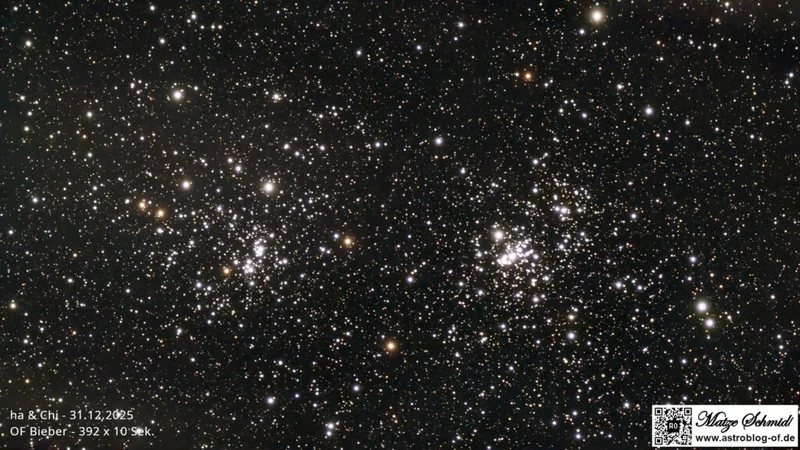
The double star cluster h and chi Persei (NGC 869 and NGC 884) is one of the most magnificent deep-sky objects in the northern sky, located in the constellation Perseus.
Overview
The double star cluster h and chi Persei (also known as NGC 869 and NGC 884) ranks among the most stunning deep-sky objects visible in the northern hemisphere. Located in the constellation Perseus, it lies near the boundary with Cassiopeia. Under a dark sky, it can be spotted with the naked eye as a hazy patch, revealing itself as two closely positioned, brilliant star collections that resemble sparkling diamonds.
Location and Finding
Finding h and chi Persei is straightforward due to its position between two prominent constellations: Cassiopeia, recognizable by its distinct "W" shape, and Perseus. To locate the double star cluster, one can use the constellation Cassiopeia as a guide. By drawing an imaginary line through the two middle stars of the "W" (Gamma Cassiopeiae and Ruchbah) and extending it downwards towards Perseus about twice the distance, one will almost inevitably encounter h and chi. Under favorable rural sky conditions, they can already be discerned without optical aids as an elongated, bright shimmer along the Milky Way. A pair of binoculars will immediately reveal the full beauty of this object.
Observation
The double star cluster h and chi Persei serves as a classic showcase for binoculars and telescopes at low magnifications. Since the pair occupies an area of approximately one degree in the sky (equivalent to two full moon diameters), many telescopes at high magnification may not be able to capture both clusters simultaneously. In a 10x50 binocular, the two clusters appear beautifully embedded in the rich star field of the Milky Way. Observing them through a telescope at low magnification with a wide-angle eyepiece is breathtaking: one gazes upon hundreds of densely packed stars against the black backdrop of space. The color differences add a unique charm; among the many hot, bluish-white stars, some reddish supergiants stand out, creating a stunning color dynamic.
Background and Facts
Unlike asterisms such as the "Hanger Cluster," h and chi Persei are true physical open star clusters. Both clusters are located approximately 8,200 light-years from Earth and are part of the Perseus spiral arm of our Milky Way. Astronomically speaking, these clusters are extremely young, with an estimated age of only about 12 to 14 million years. Due to their immense brightness and size, they have been known since antiquity. The Greek astronomer Hipparch recorded them as a nebular patch in his notes around 130 BC.
Conclusion
The double star cluster is a highlight of the night sky and never fails to impress. It is easy to find, requires no expensive equipment, and offers an unforgettable view even through small optics. Its sparkling star density makes it an ideal demonstration object for beginners, as the "aha experience" when looking through the eyepiece is guaranteed. It is a must-see for every star enthusiast.
Here is a selection of observation reports featuring the double star cluster:
- Orsingen on July 18, 2025
- WHAT 2024 on August 31, 2024, Part 2
- Vogelsberg on October 13, 2018
Image Sources
- 25–12–31_Ha&Ci_392x10sec: Matze Schmidt
- Objekt_des_Monats: Matze Schmidt