Unraveling the Origins of Hyperion and Saturn's Rings
A new study reveals that Hyperion's origins are linked to a collision involving Titan and an ancient moon, providing insights into the formation of Saturn's rings.
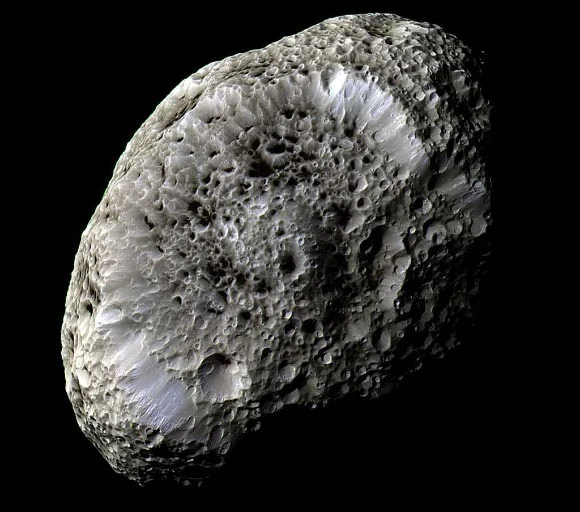
A forthcoming article in Planetary Science Journal presents groundbreaking research suggesting that Hyperion, Saturn's irregular moon, is the result of a dramatic collision between Titan and an ancient moon, triggered by orbital destabilization. This finding sheds light on the origins of Saturn's ring system.
Researchers Matija Ćuk from the SETI Institute and his team employed numerical simulations to model the recent dynamic evolution of Saturn's satellite system. Their study is grounded in several observed phenomena: the apparent youth of Saturn's rings, the dynamic youth of its medium-sized inner moons, the rapid tidal migration of Titan, and the quick damping of Titan's inclination and eccentricity. Additionally, they considered that Saturn recently exited a presumed spin-orbit resonance with other planets.
Ćuk and his colleagues argue that Hyperion is considerably younger than previously thought. The current elongated orbit of Titan indicates a migration outward of approximately 4 to 5% since the two moons entered into a 4:3 orbital resonance, likely formed only 400 to 500 million years ago.
To explain Hyperion's apparent youth, the researchers propose a scenario involving a medium-sized moon, referred to as proto-Hyperion, that once orbited between Titan and Iapetus. As Titan's orbit expanded, the system destabilized, causing proto-Hyperion to follow a chaotic trajectory and ultimately collide with Titan.
This collision would have disrupted the long-standing spin-orbit resonance between Saturn and the other planets, altering the gas giant's axial tilt. Concurrently, debris from the impact could have coalesced to form the current Hyperion, characterized by low density and high porosity, indicative of a rubble pile structure rather than a smoother primordial body.
The team's simulations indicate that collisions between Titan and the hypothetical moon occur frequently under such conditions. In many scenarios, Iapetus acquires orbital inclinations and eccentricities similar to those observed today, consistent with gravitational disturbances during the instability.
The simulations also suggest that Titan's orbit would generally move outward during the collision, allowing its ongoing tidal migration to resume. Ćuk and his team hypothesize that an eccentric Titan, excited during the event, could have destabilized Saturn's inner moons through resonant interactions.
Independent evidence has already hinted at a relatively young age for Saturn's rings, possibly only a few hundred million years old, based on their mass, composition, and interactions with nearby moons. The new model connects this timeframe to the same episode that produced Hyperion and reshaped the external system.
The authors revisit the history of Rhea, whose rapid outward migration implies it has crossed the solar tidal resonance in recent hundreds of millions of years. Such dynamic markers are more compatible with a system that has undergone recent and large-scale rearrangement rather than one that has remained unchanged for billions of years.
In summary, the proposed sequence of events unfolds in three stages:
-
An instability in the external system occurs about 400 million years ago when Titan captures an outer satellite (proto-Hyperion) and enters into a 2:1 resonance, ultimately leading to the collision between proto-Hyperion and Titan. Hyperion then accretes from a small fraction of the debris from this collision, subsequently captured into its current 4:3 resonance with Titan. The pre-collision disturbances from proto-Hyperion altered the eccentricities and inclinations of both Titan and Iapetus.
-
Between 50 to 200 million years ago, the outermost member of the inner moon pair ("Proto-Dione" and "Proto-Rhea") enters into a 4:1 resonance with the eccentric and inclined Titan. The resulting orbital excitation of the inner moons leads to mutual collisions, generating the current inner moons and Saturn's rings.
-
Less than 50 million years ago, Titan and Iapetus pass through their 5:1 resonance, further perturbing Iapetus's orbit and posing a significant risk of ejection.
Although these events occurred hundreds of millions of years ago and are challenging to confirm directly, recent observations have consistently questioned previous models and revealed new dynamics. The hypothesis presented here predicts a dynamically active and relatively young Saturnian system, whose current configuration results from recent and spectacular events.
Future orbital, geophysical, and geological data, particularly from missions targeting Saturn's moons, will be essential in testing this scenario. Such data will include independent determinations of Saturn's axial precession rate and Titan's orbital evolution, as well as tidal and rotational parameters of Titan and the surface ages of Titan and other moons. Whether or not the sequence of events is confirmed, this work contributes to formulating new and relevant hypotheses regarding the evolution of Saturn's satellite system.