The Rings of Saturn: A Journey Through Astronomy
Explore the fascinating history and structure of Saturn's rings, first observed by Galileo in 1610, and learn about their formation and composition.
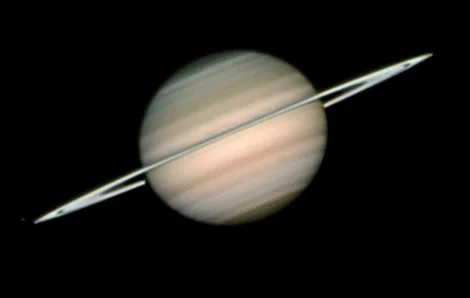
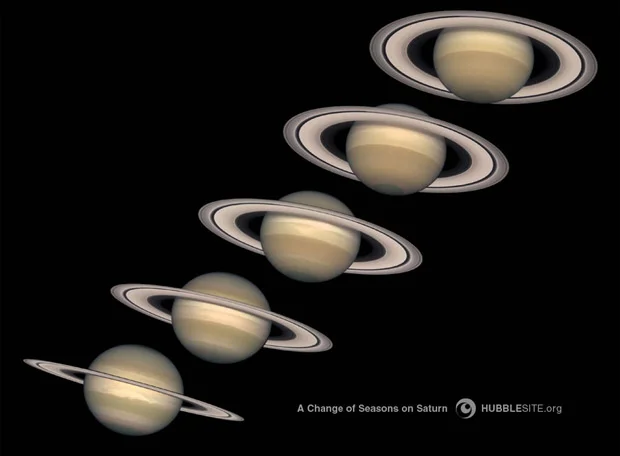
The rings of Saturn are a remarkable planetary ring system encircling the planet, first documented by Galileo Galilei in July 1610. Initially, Galileo misinterpreted the blurry structures he observed as two nearby moons due to his “rudimentary methods.” However, he later revised his view as these "strange appendages" did not change position relative to Saturn night after night, and they vanished from sight in 1612. This disappearance occurred because the rings were aligned edge-on from Earth's perspective, rendering them nearly invisible. A similar phenomenon was noted on September 4, 2009, when they once again faded from view, prompting alerts from amateur astronomers. NASA clarified that the geometry of the rings had created this illusion, leading to various theories about their nature, including the possibility that they were handles attached to Saturn or that they consisted of several moons orbiting only the planet's far side, casting no shadow on it.
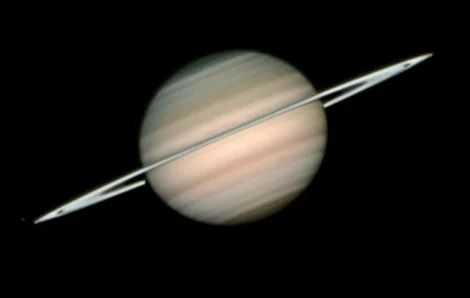
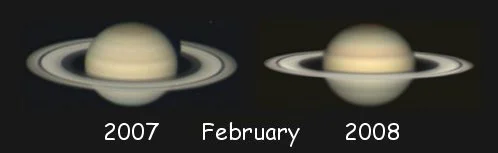
In 1655, Christiaan Huygens proposed that these appendages were indicative of a thin, flat disk of material, distinct from the planet and aligned with its equatorial plane. The appearance of this disk varied depending on the relative positions of Saturn and Earth in their orbits around the Sun, shifting from a thin line to a broad ellipse. Notably, the cycle of the rings mirrored Saturn's own orbit, lasting approximately 30 years.
For the next two centuries, it was assumed that this disk was a continuous layer of matter. However, in 1675, Giovanni Cassini discovered a dark band that divided the disk into two concentric rings, now known as the Cassini Division.
By the late 18th century, Pierre-Simon Laplace demonstrated that the combined gravitational forces of Saturn and the rotation of the disk would tear apart a single layer of material. Each particle in the disk maintained its radial distance from Saturn due to a balance between gravitational pull and centrifugal force, which arises from the disk's rotation. Laplace suggested that Saturn's rings were composed of many thin rings, each capable of withstanding slight imbalances in these forces across their radial width.
The modern understanding of Saturn's rings was solidified in 1857 when James Clerk Maxwell mathematically proved that the thin rings were actually made up of numerous small masses in independent orbits. This hypothesis was experimentally verified in 1895 by American astronomers James E. Keeler and William W. Campbell, who found that the rings rotated around Saturn at different speeds than the planet's atmosphere, with the inner parts of the rings moving faster than the outer ones, consistent with the laws of physics governing independent orbital particles.
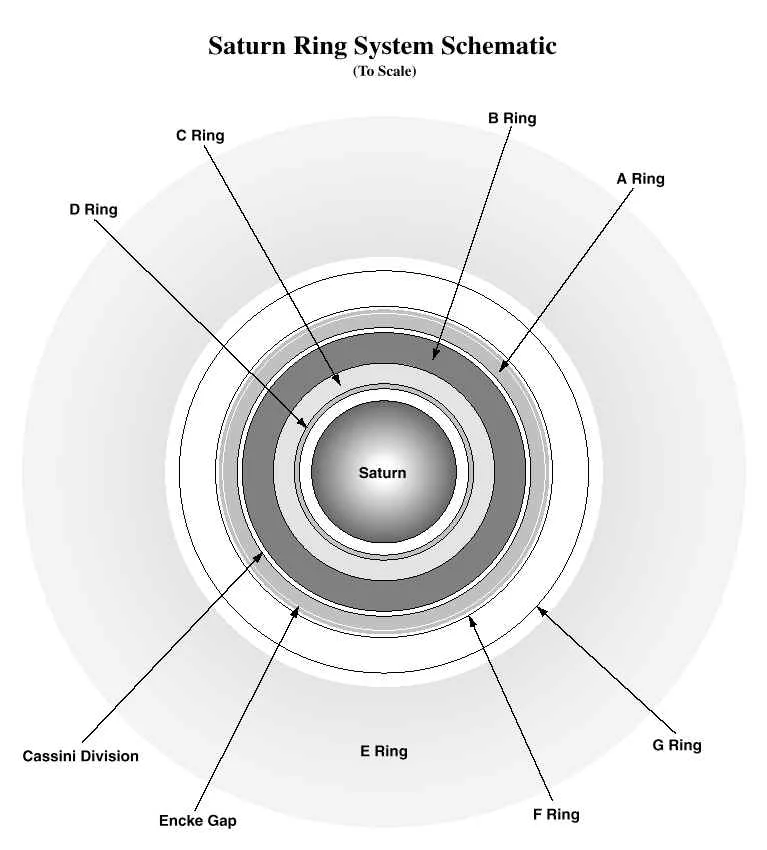
The primary structure of Saturn's ring system includes the bright A and B rings, which are relatively transparent. Between these lies a 5,000-kilometer-wide gap known as the Cassini Division, a region that, while transparent, is not devoid of material. The system also contains the C ring, which is weaker and less opaque, positioned within the inner edge of the B ring, and has a level of opacity similar to that of the Cassini Division. The even fainter D ring lies within the C ring. Prior to the Voyager missions' close encounters with Saturn, the structural configuration of the rings—A, B, C, and D, along with the Cassini and Encke Divisions—was already recognized from Earth. Collectively, the main rings of Saturn (A, B, and C) span about 275,000 kilometers in width, roughly three-quarters of the distance from Earth to the Moon. Notably, the A ring is divided into two sections by the Encke Division.
Additionally, the moons Prometheus and Pandora act as shepherd satellites, shaping the F ring of Saturn, which is 80 kilometers wide. Most gaps found within Saturn's rings are attributed to the influence of these shepherd satellites. For instance, Mimas is responsible for creating the largest gap, the Cassini Division.
In comparison to their vast width, the thickness of Saturn's rings is negligible, with estimates placing their vertical extent at around one kilometer. In relation to their width, the rings are thousands of times thinner than a razor blade.
Recent observations using the Spitzer infrared telescope have revealed the existence of a much fainter and more distant ring, extending asymmetrically between 6 million and 12 million kilometers from Saturn. This ring, inclined at 27 degrees to Saturn's equator, may originate from the moon Phoebe and is referred to as the Phoebe ring.
The study of Saturn's rings continues to captivate astronomers and enthusiasts alike, offering insights into the complex dynamics of planetary systems and the forces that govern them.