The Transformation of WOH G64: From Red Supergiant to Yellow Hypergiant
A recent study in Nature Astronomy reveals WOH G64's stunning transition from red supergiant to yellow hypergiant, indicating a possible impending supernova.
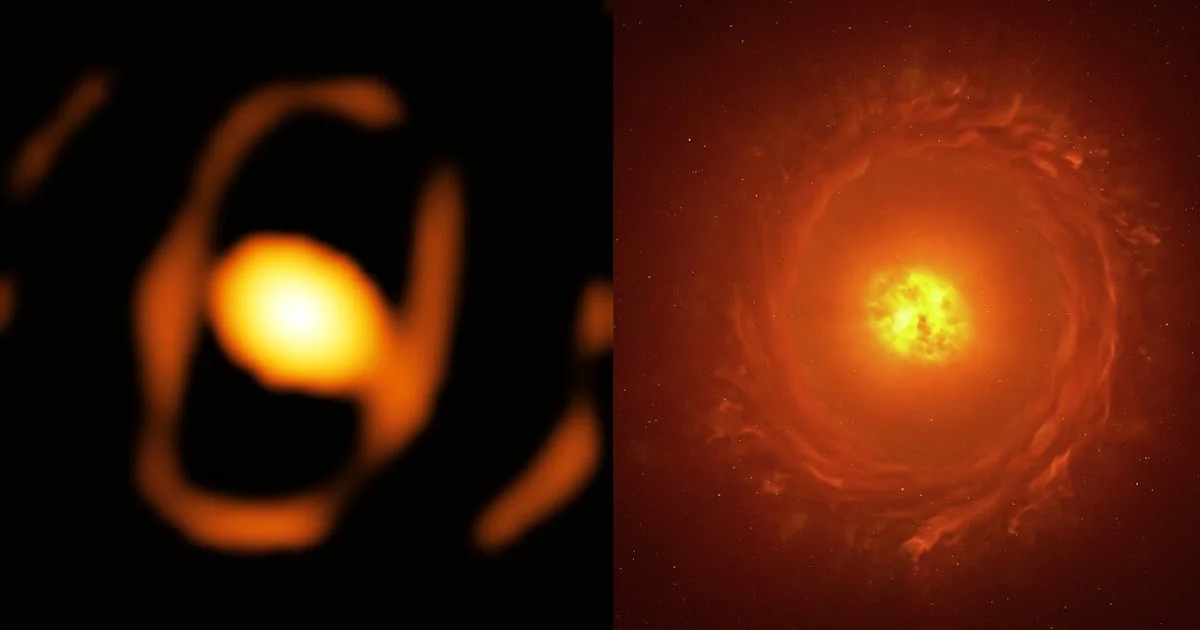
A recent study published in Nature Astronomy reveals a stunning transformation of one of the largest known stars, WOH G64, which transitioned from a red supergiant to a yellow hypergiant in 2014. This abrupt change may indicate an impending supernova.
Discovered in the 1970s within the Large Magellanic Cloud, a satellite galaxy of the Milky Way, WOH G64 is not only incredibly luminous but also one of the largest stars ever identified, boasting a radius 1,540 times that of the Sun. It shines with a luminosity 280,000 times greater than our star and holds the record for mass loss rate, exceeding 10-4 M⊙ per year, equivalent to 30 times the mass of Earth annually.
In 2024, WOH G64 became the first star beyond our galaxy to be captured in detail, thanks to the Very Large Telescope Interferometer. The resulting image displayed a bright dust cocoon surrounding the giant star, confirming its mass loss as it ages.
WOH G64 is relatively young, estimated to be less than 5 million years old. Like a rockstar, this massive star is destined to live fast and die young. Formed from a vast cloud of gas and dust that collapsed until nuclear fusion ignited, it initially burned hydrogen in its core, later expanding and burning helium, evolving into a red supergiant. Red supergiants are massive, cool, and evolved stars with initial masses between 8 to 30 M⊙, marking the final stage of their evolution before ending in a type II supernova explosion.
However, the evolution and fate of the most luminous red supergiants remain uncertain. Their rarity, combined with significant circumstellar material and imprecise distances, complicates the accurate measurement of their stellar properties, hindering assessments of their evolutionary stages and ultimate destinies.
The existence of luminous, hot post-red supergiant objects, along with the apparent absence of bright red supergiants among supernova progenitors, suggests to astronomers a potential "blueward" evolutionary process. Since the 1980s, WOH G64 has been recognized as the most extreme red supergiant in the Large Magellanic Cloud due to its significant obscuration, remarkable size, luminosity, and high mass loss rate.
What transpired with WOH G64 in 2014? Research conducted by Gonzalo Muñoz-Sanchez from the Athens Observatory and his colleagues indicates a sudden yet gradual change in its apparent nature. The optical light curve of WOH G64, spanning from 1992 to the present, clearly reveals two distinct phases separated by the transition in 2014. Prior to this shift, WOH G64 was classified as a Mira variable star due to its semi-regular periodicity of about 850 days. Temporal photometry and subsequent spectroscopy show an extreme transition in its optical spectral characteristics.
A significant drop in brightness occurred in 2011, prior to the transition, displaying a loop in the color-magnitude diagram, suggesting variations in the system's intrinsic properties. Following this decline, the star became noticeably bluer between mid-2013 and mid-2014. An increase in effective temperature of over 1,000 K accounts for the photometric variations observed in the color-magnitude diagram during the transition. Since 2014, WOH G64 has exhibited irregular variability, including a decrease of 2 magnitudes over 10 months in 2025, reaching its lowest observed magnitude.
The researchers ultimately conclude that WOH G64 is a rare and massive symbiotic binary system, where the supergiant component has evolved into a yellow hypergiant. According to astrophysicists, this radical transformation may be explained by either partial ejection of the pseudo-atmosphere during a common envelope phase or a return to a quiescent state following an exceptional eruption lasting over 30 years.
It is important to note that not all supergiants evolve into hypergiants. The theory posits that hypergiants form when very large stars burn rapidly, transitioning from hydrogen to helium combustion. During this process, these stars begin to shed their outer layers while their cores contract inward. Once a star becomes a hypergiant, it is fated to die quickly in a supernova explosion.
What is clear with WOH G64 is that a substantial portion of the original supergiant's surface has been ejected, and the existence of a companion star has been confirmed by observing the light spectrum of WOH G64.
The findings of Muñoz-Sanchez and his team challenge current models of massive star evolution by emphasizing the crucial role of binary interactions and episodic eruptions in the fate of evolved massive stars. WOH G64 provides valuable insights into the late evolutionary stages of the most luminous red supergiants and those that experience significant mass loss, as well as addressing the ongoing issue of the rarity of bright red supergiants. Recent studies of extreme red supergiants such as VY CMa and NML Cyg have highlighted potential signs of companions, yet the mechanisms behind their mass loss episodes remain poorly understood. Determining whether the extreme properties of these supergiants result from intrinsic stellar processes or binary interactions is essential for constraining the evolution of these highly luminous stars. The authors cannot predict the future of WOH G64 due to the poorly defined nature of its physical and orbital parameters and the uncertainty surrounding whether its evolution is driven by simple stellar physics or binary interactions.
In their conclusion, Muñoz-Sanchez and colleagues note that recent observations from 2025 support their interpretation of WOH G64 as a binary system, while also demonstrating that the system is affected by variable reddening due to dust. Moreover, WOH G64 currently exhibits optical characteristics once again consistent with a red supergiant, rather than the yellow hypergiant traits observed between 2016 and 2021. This return to a red supergiant state could be attributed to the resurgence of an optically thick wind and the onset of a new eruption within a single-star physics framework. Predicting the future and recurrence of such eruptions remains uncertain, as the underlying mechanisms are still debated. Concurrently, within a cool envelope, the emergence of new signatures of a cool star could be explained by the formation of a new extended envelope following the ejection of outer layers during the 2013-2014 event. The current orbital configuration will determine whether interactions continue, potentially leading to later phases of mass transfer or recurring cold envelope ejections, as seen in the 2014 episode.
With the advent of modern surveys that continuously monitor the sky, early detection of supernova explosions and the rapid follow-up spectroscopy have revealed the presence of gas cocoons surrounding type II supernova progenitors. One proposed explanation is a major eruption occurring during the last year preceding the explosion, while other authors favor a pre-supernova wind scenario driven by decades of pulsations before the explosion. However, the post-transition behavior of WOH G64 does not follow this periodic pattern, remaining stable from 2014 to 2019, thus excluding pre-SN wind pulsations as the mechanism behind the eruption. It is already known that the upcoming supernova will be of type IIP/L, IIb, or IIn, depending on the remaining mass of the envelope and the density of the circumstellar medium during core collapse.
Instead of an explosion, the star could undergo a direct collapse into a black hole or merge with its companion as a result of ongoing binary interaction. Thus, WOH G64 sheds crucial light on post-red supergiant evolution and the formation of dense circumstellar environments. Continuous spectroscopic and photometric monitoring of WOH G64 will be essential for better constraining its binary properties, elucidating the mechanism behind its spectacular transition, and predicting its ultimate fate.
With a bit of luck, we might witness the death of WOH G64 in our lifetime, offering not only an incredible spectacle but also aiding our understanding of the physical processes associated with supernovae.