Advancements in Stellar Imaging: WOH G64 and the Frontiers of Astronomy
The observation of WOH G64 marks a significant advancement in astronomy, showcasing technological achievements in capturing extragalactic stars with unprecedented detail.
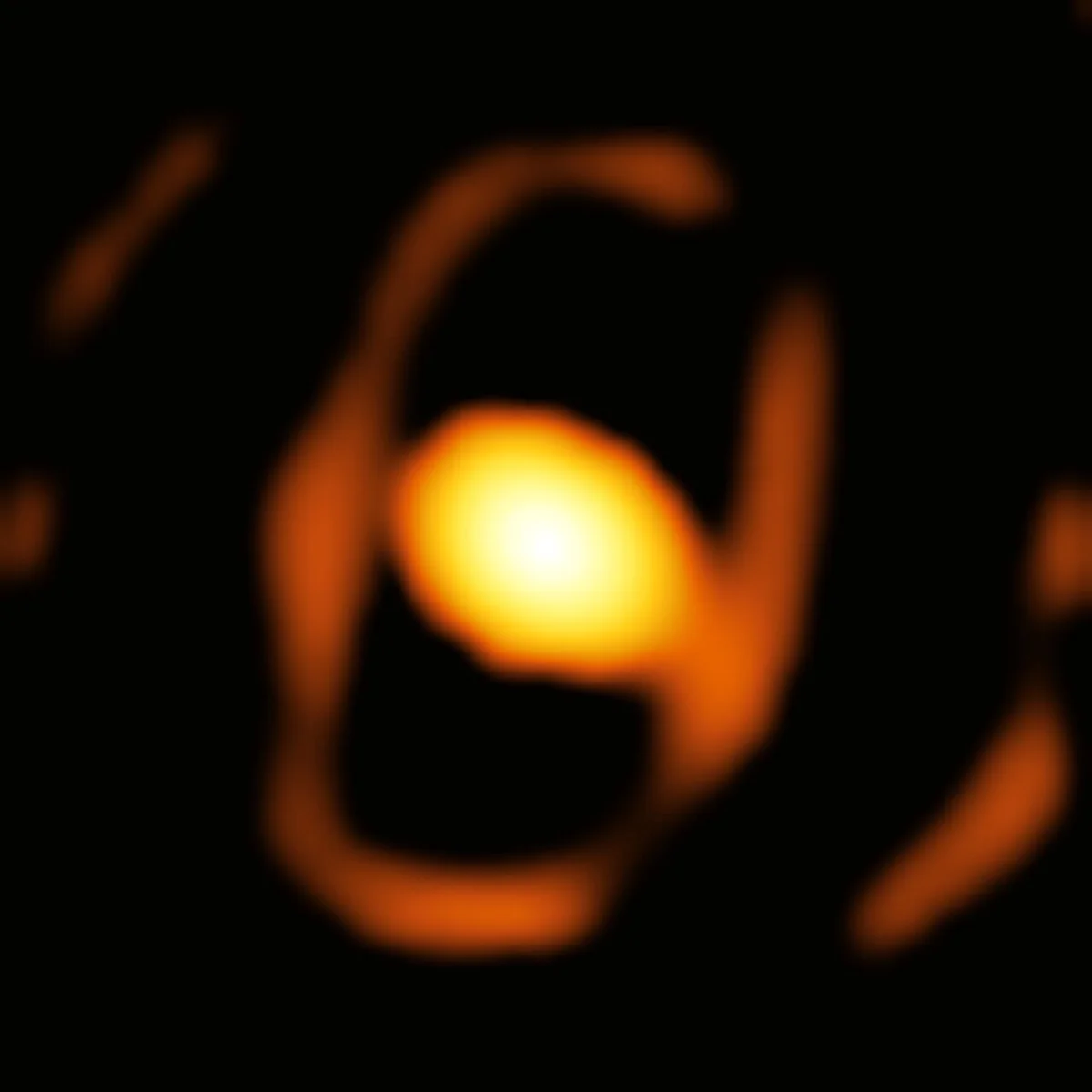
The observation of the star marks a significant advancement in our understanding of celestial bodies, but perhaps more importantly, it represents a fundamental technological achievement.
The star known as WOH G64 is a red supergiant located in the Large Magellanic Cloud (LMC). Notably, it is the first external star to be captured in high detail, made possible through the sensitivity and power of new interferometric techniques.
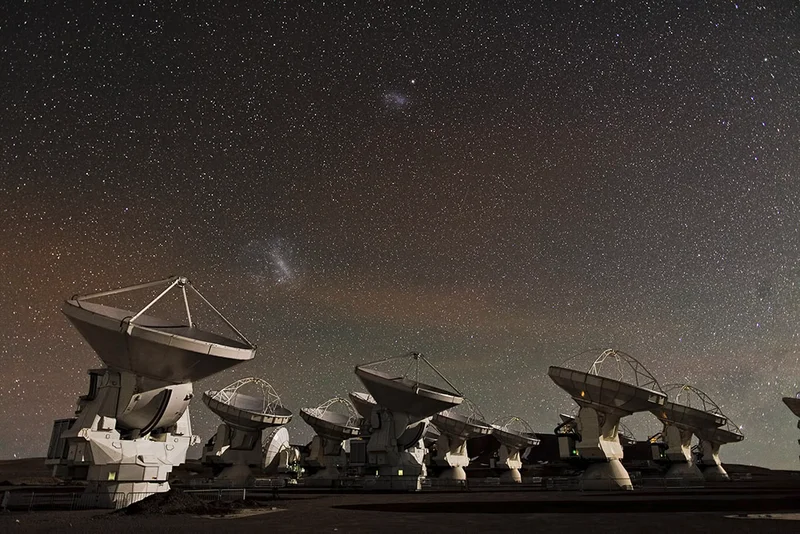
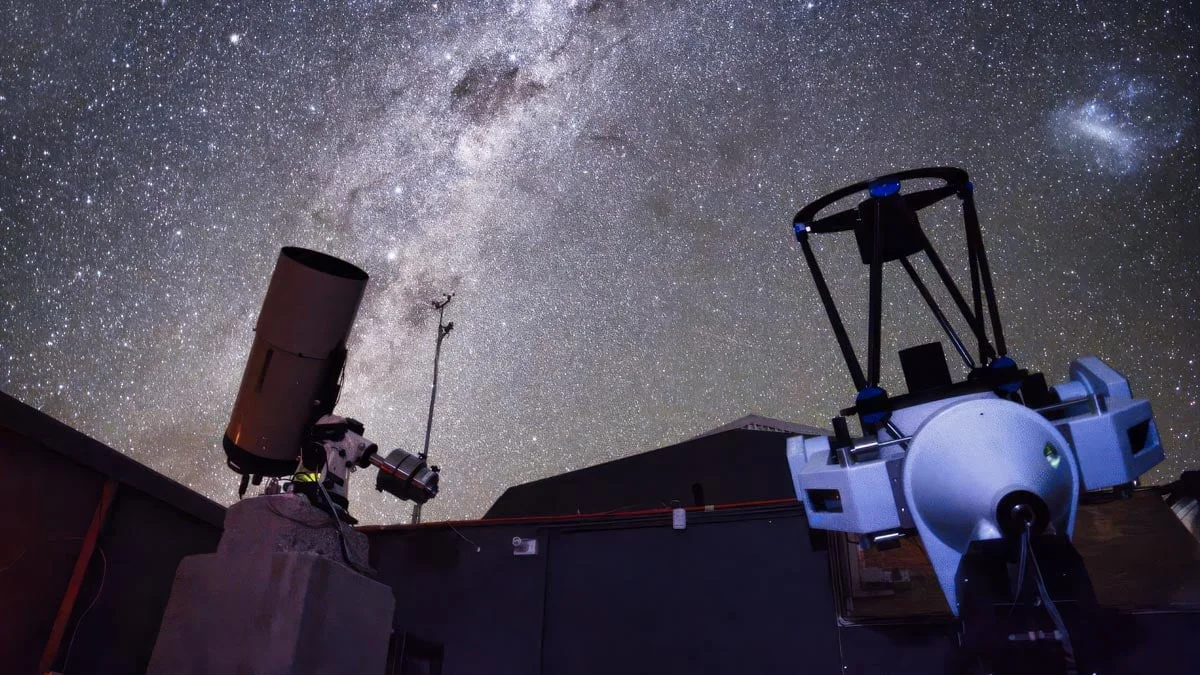
The detailed imaging of WOH G64 was achieved using the advanced instruments of the Very Large Telescope Interferometer (VLTI) operated by the European Southern Observatory (ESO) at the Paranal Observatory in Chile, along with the GRAVITY instrument. The VLTI utilizes the ability to combine signals from multiple antennas, allowing for high-resolution images of the circumstellar environment surrounding WOH G64, revealing unprecedented details of an extragalactic star. GRAVITY (short for GRAVITationalYing interferometer) is a next-generation interferometric tool designed to capture stellar images with unmatched angular resolution, enabling the exploration of extremely distant objects with remarkable clarity, including phenomena in galactic nuclei and extragalactic stars. By employing a long-baseline interferometer, GRAVITY combines signals from four ESO telescopes to achieve very high angular resolutions, simulating a telescope with a diameter of up to 130 meters. This technique gathers light from distant astronomical objects and combines data from each telescope to enhance image quality, surpassing the resolution limits of conventional observatories.
The application of long-baseline interferometry and subsequent image reconstruction through specialized software like IRBis and MiRA has enabled the detailed imaging of the star and the surrounding dust torus.
The significance of this observation lies in the fact that until now, extragalactic star observations at such high resolutions were limited to galactic objects. The distance of WOH G64 from Earth would have made detailed observations challenging without today’s technology.
The ability to observe an extragalactic star in such detail not only enhances our understanding of WOH G64 but also paves the way for studying massive stars in other galaxies. The precision with which we can now examine stars like WOH G64 is a testament to the evolution of astronomical technologies, marking a milestone in cosmic exploration and a crucial step toward better understanding the evolution of massive stars and the formation of stellar winds and dust in extragalactic contexts.
One of the largest known stars, possibly the biggest. A star on the brink of life and supernova.
WOH G64, located in the Large Magellanic Cloud (LMC) approximately 160,000 light-years away, is among the largest known stars. With a radius about 1540 times that of the Sun and a luminosity around 500,000 times that of the Sun, this red supergiant serves as a natural laboratory for studying the final stages of massive stars, which culminate in supernova explosions and the formation of neutron stars or stellar black holes.
WOH G64 is currently in an advanced phase of stellar evolution, during which red supergiants lose substantial amounts of mass through intense stellar winds. These winds are so powerful that they create structures of gas and dust around the star, affecting both its future and its impact on the surrounding environment. The star emits radiation that heats and causes dust grains to glow in the infrared domain, making red supergiants like WOH G64 ideal candidates for study with advanced tools like the VLTI, which can analyze their circumstellar environments in unprecedented detail.
Its relatively low surface temperature of around 3400 K and significant mass loss through stellar winds characterize a crucial phase in its evolution toward a supernova.
Red supergiants like WOH G64 lose mass at extraordinary rates, up to 10−4 solar masses per year, a phenomenon that influences their internal structure and prepares the environment for the final explosion. Recent studies, also based on interferometric observations, have shown that this mass loss is often asymmetric, frequently resulting in highly asymmetric circumstellar environments, shaped by binary interactions or bipolar flows.
A notable example is the system that led to SN1987A, where a ring of dust expelled during the red supergiant phase contributed to shaping the evolution of the supernova (also located in the Magellanic Cloud).
The Dust Torus
WOH G64 is surrounded by an opaque dust torus. Data captured by interferometers have revealed an elongated structure with a major axis of about 13 stellar radii and a minor axis of 9 stellar radii, indicative of a possible bipolar flow or gravitational interaction with an unseen companion. Recently, changes in the infrared spectrum of the star have suggested the formation of new warm dust at a distance of approximately 1.5 stellar radii from the core. This new dust has gradually obscured the central star, making it less visible in the near-infrared band.
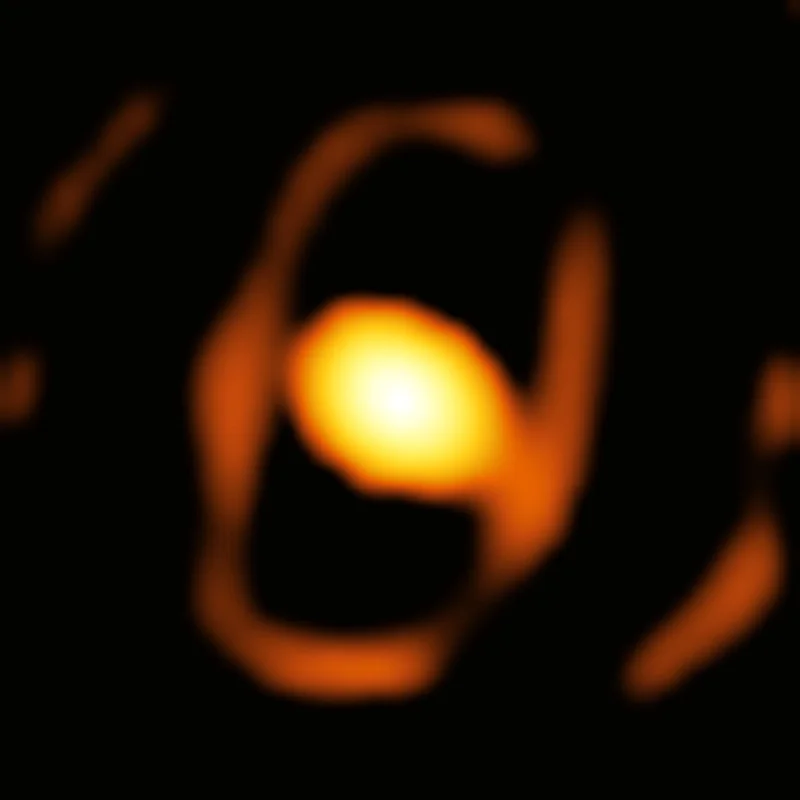
Spectral Variations
One of the most intriguing aspects of WOH G64 is the evolution of its properties over time. Astronomers have observed that the star's spectrum, analyzed in the infrared band between 2009 and 2016, has undergone significant transformation. While strong signs of molecular water absorption (H₂O) were previously noted, recent data show a spectrum dominated by a continuous emission, resulting from the formation of new warm dust very close to the star.
This new dust may have formed due to a recent acceleration in the star's mass loss. This process has rendered the central star less visible, obscured by a denser layer of particles. Detailed studies estimate that WOH G64 loses mass at an impressive rate of 10−4, equivalent to the mass of the Sun expelled over about 10,000 years.
The progressive obscuration of WOH G64 has been confirmed through photometric and spectroscopic observations. By analyzing light collected in the near-infrared (2-2.5 µm) and mid-infrared (8-13 µm), astronomers have noted significant differences. While the spectrum at longer wavelengths (mid-IR) remains unchanged, the near-infrared spectrum reveals an increasing continuum, suggesting that dust is forming near the star, likely at a distance of about 1.5 stellar radii from the core.
The study of stars like WOH G64 suggests that mass loss may accelerate just before the explosion, creating a rich and complex circumstellar environment. When the star eventually explodes, the interaction of the expelled material with the surrounding medium could lead to particularly bright phenomena, as observed in other supernovae.
- Imaging the innermost circumstellar environment of the red supergiant WOH G64 in the Large Magellanic Cloud
- The physical properties of the red supergiant WOH G64: the largest star known?