The Eye of God: Exploring the Helix Nebula
The Helix Nebula, located in the constellation Aquarius, is a planetary nebula with a rich history and unique formation process. This article explores its physical characteristics and the astronomical event that led to its creation.
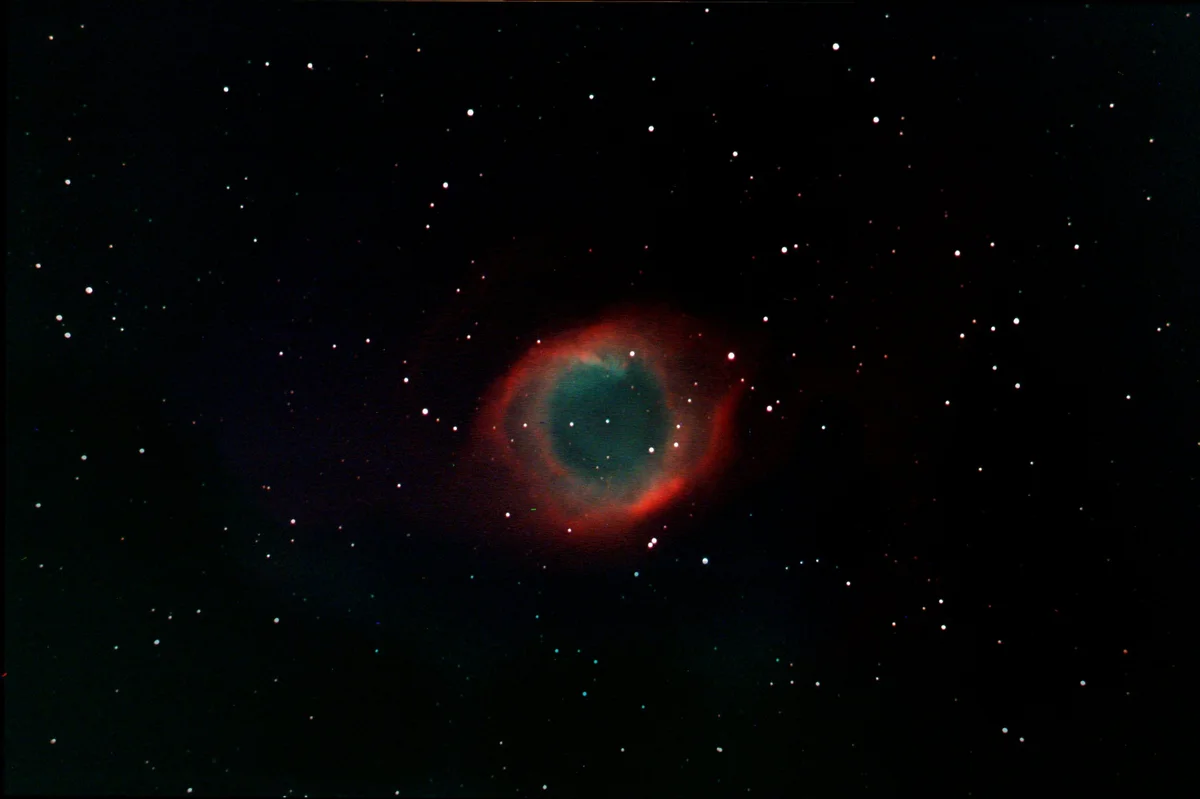
In the realm of celestial wonders, the Helix Nebula, located in the constellation Aquarius, stands out as one of the most iconic and photographed objects in the night sky. Capturing this stunning nebula from our latitudes poses a significant challenge due to its low position on the horizon, which makes it susceptible to atmospheric absorption and the effects of airglow, particularly pronounced near the horizon and exacerbated by pervasive light pollution. Observers in less than ideal dark-sky locations, such as suburban areas, often find that airglow dramatically hampers their imaging efforts, complicating the long hours spent capturing this elusive object. Nevertheless, for astronomy enthusiasts and photographers, obtaining a decent image of the Helix Nebula remains one of the most rewarding experiences, given the inherent challenges it presents.
Helix Nebula, photo by Massimo Dionisi
The image showcased was captured on September 6, 2021, using a 250mm Skywatcher Newtonian reflector telescope with a focal length of 1250mm, yielding an f/5 aperture ratio. A QHY8L CCD camera, cooled to -15°C, was employed, mounted on a Skywatcher EQ6 Pro equatorial mount. To ensure precise tracking during long exposures, a 60mm refractor telescope with a 700mm focal length and a ZWO ASI 120MC CMOS camera were used for guiding, facilitated by the PHD2 software. Each of the twelve images taken had an exposure time of five minutes, with the acquisition managed through the Astro Photography Tool (APT). The following images illustrate two moments captured during the nebula's observation using APT and PHD2.
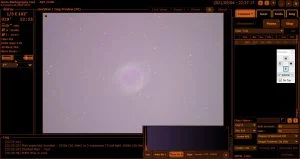
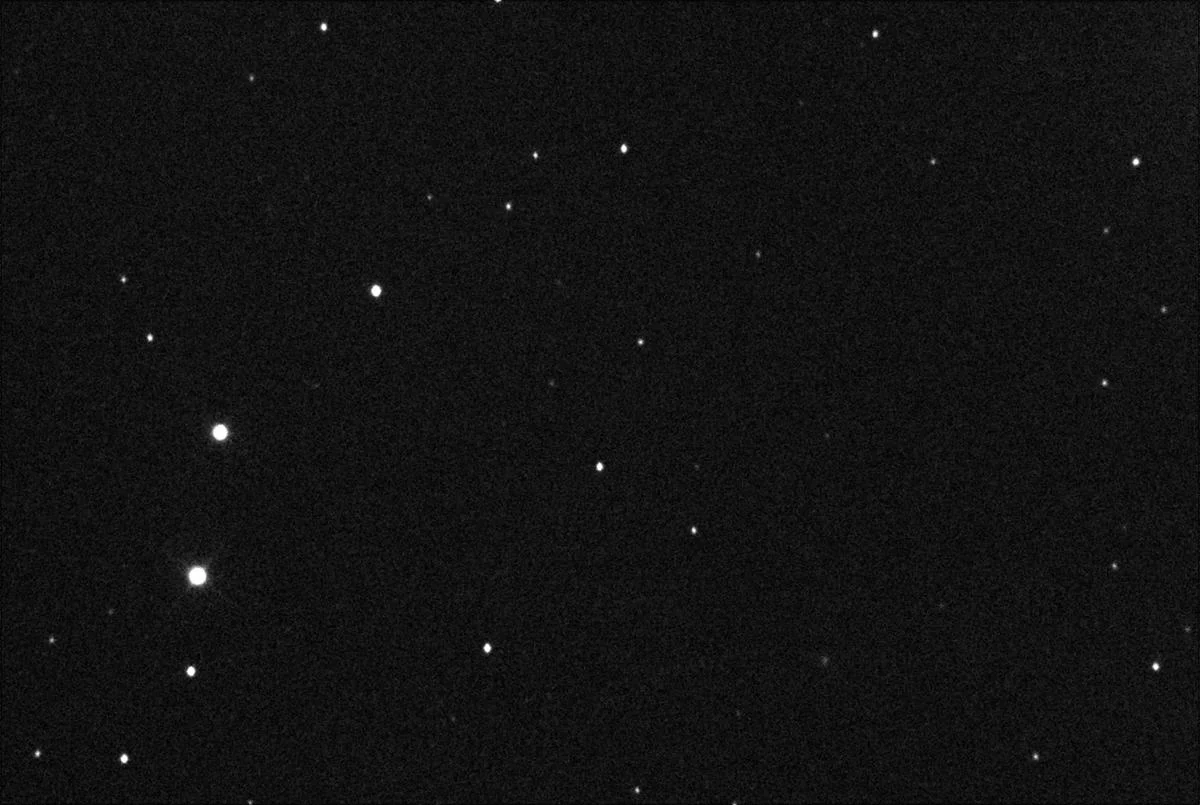
One of the five-minute exposures of the Helix Nebula recorded with APT, the image is still in its raw, unprocessed form.
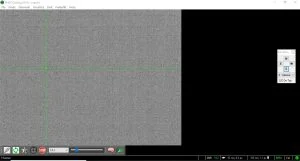
The faint guiding star used to compensate for polar alignment errors of the EQ6Pro mount: even with a good alignment, guiding remains essential, preferably automated with software like PHD2. The star appears as a faint point at the intersection of the two green lines.
To mitigate the effects of light pollution, an Astronomik UHC filter was utilized; however, the resultant image was plagued by significant background noise due to light pollution. To enhance the final output, expert graphic designer Simone Dionisi was enlisted to refine the image using GIMP, transforming it into a more visually appealing representation.
Beyond the technical aspects of capturing and processing this image, it is essential to delve into the historical and physical significance of the Helix Nebula. Imagine a time over ten thousand years ago, as our ancestors began to emerge from the grips of the last Ice Age in Europe. These nomadic hunter-gatherers were learning to harness fire and create rudimentary tools while gradually transitioning towards a more settled lifestyle, laying the groundwork for agriculture—one of humanity's pivotal developments. During this transformative period, it is likely that some of these early tribes began to look to the skies for guidance in their daily lives, perhaps led by women who took on roles as the first observers of celestial phenomena.
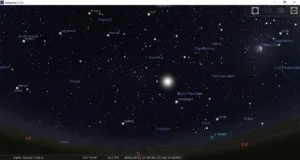
A reconstruction of what the sky might have looked like on a summer night about 10,000 years ago during the Paleolithic era. Above the star Fomalhaut, in the constellation Piscis Australis, a brilliant star ignited in the sky.
Envision that great light in the sky igniting on a cold night in a month later known as August, still marked by the remnants of the Great Ice Age that was slowly retreating northward. While the exact timing of this phenomenon remains a mystery, our historical reconstruction offers a plausible scenario. We may never know the emotions evoked in our ancestors by this dazzling light, which likely shone brighter than Venus and possibly rivaled the Moon’s brightness. Its visibility was so pronounced that it would have been etched into their collective memory, passed down orally through generations in a world that would not see the advent of writing for millennia.
This Great Light was a dying star, transitioning from a stable phase of illuminating the cosmos to a tumultuous end. As this star exhausted its hydrogen fuel, it became unstable, contracting and raising its internal temperature to initiate the fusion of helium into heavier elements like carbon. The outer layers of the star expanded dramatically, transforming it into a red giant that likely consumed any surrounding planets, obliterating them in a fiery embrace.

The process of carbon formation within a star during its final evolutionary stages. The extreme temperatures in the star's core allow helium nuclei to fuse into unstable beryllium, which subsequently fuses with more helium to ultimately produce stable carbon. This entire process is known as the "triple alpha" reaction (image sourced from Wikipedia Creative Commons).
As energy production within the star shifted, it experienced severe internal instabilities that eventually led to irregular pulsations. When energy generation ceased, the core collapsed into an incredibly dense object, roughly the size of Earth but with a mass comparable to that of the Sun. This superdense remnant, with a surface temperature of around 100,000 degrees, emits powerful X-rays and appears as a faint star of thirteenth magnitude, far dimmer than the faintest star visible to the naked eye. This contraction is an ongoing process that will eventually lead to the formation of a white dwarf, which will cool over time.
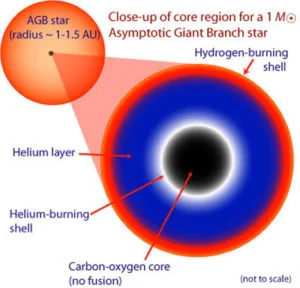
Internal structure of a red giant or supergiant star in its final evolutionary phases.
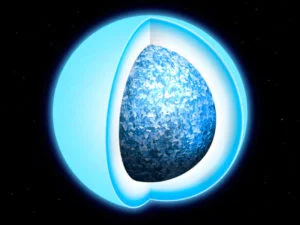
Internal structure of a white dwarf, featuring a hot surface and a core composed of carbon and oxygen in a degenerate state, with electrons densely packed due to intense gravity. The appearance of this core may resemble that of a crystal.
Simultaneously, the outer layers of the star underwent a violent expulsion, resulting in an explosion that propelled its atmosphere into interstellar space at high speeds. The remnants of this explosion, moving outward at approximately 40 kilometers per second, formed what we now recognize as the Helix Nebula, a structure known as a "planetary nebula" due to its resemblance to small planetary disks observed by early astronomers. Spanning 2.5 light-years and located 650 light-years from Earth, the nebula appears as an elliptical ring, roughly half the size of a full moon. Despite its considerable dimensions for an object of its type, its relatively low surface brightness presents further challenges for astronomers attempting to capture its beauty.