Kepler: A Pioneer in Astronomy
Explore the life of Johannes Kepler and his contributions to astronomy, including his laws of planetary motion and his observations of a supernova.
Kepler and the Orbits of the Planets
Introduction:
This article explores the life of Johannes Kepler and his groundbreaking research into planetary orbits. It also examines the evolution of his astronomical knowledge and how his laws contributed to the field.
Biography:
Johannes Kepler (1571-1628) was born in Leonberg, Germany, where he began his education in a Latin school. In 1584, he entered the Protestant seminary in Adelberg, and by 1589, he was studying theology at the Protestant University of Tübingen. There, he was influenced by his mathematics professor, Michael Maestlin, who supported the heliocentric theory of planetary motion initially proposed by the Polish astronomer Nicolaus Copernicus. Kepler immediately embraced the Copernican theory, believing that the simplicity of its planetary arrangement was part of God’s design.
Research and Early Theory In 1594, Kepler moved to Graz, Austria, where he developed a complex geometric hypothesis to explain the distances between planetary orbits, which were mistakenly thought to be circular. He proposed that the Sun exerts a force that decreases inversely with distance, propelling planets in their orbits. His theories were published in a treatise titled Mysterium Cosmographicum in 1596, which is significant for providing the first comprehensive and convincing demonstration of the geometric advantages of the Copernican model. Except for Mercury, Kepler’s system closely matched observational data.
Curiosity: Due to his reputation as a mathematician, Kepler was invited by Tycho Brahe to Prague to assist him in calculating new planetary orbits based on his observations. Following Brahe's death in 1601, Kepler was appointed his successor as the imperial mathematician, a position he held until 1612.
Major Work and First and Second Laws One of Kepler's most significant works during this period was Astronomía nova (1609), which marked the culmination of his meticulous efforts to calculate Mars' orbit. This treatise introduced two of Kepler’s laws of planetary motion. The first law states that planets move in elliptical orbits with the Sun at one focus. The second law, known as the area law, asserts that an imaginary line connecting the Sun to a planet sweeps out equal areas during equal intervals of time, meaning a planet travels faster when it is closer to the Sun.
Mathematician and Third Law In 1612, Kepler became the mathematician for the states of Upper Austria. While residing in Linz, he published Harmonices mundi Libri (1619), which includes his third law: the relationship between the cube of a planet's average distance from the Sun and the square of its orbital period is a constant, applicable to all planets. Around the same period, he also released Epitome astronomiae copernicanae (1618-1621), which compiled all of his discoveries into a single volume.
Final Work The last significant work published during Kepler's lifetime was the Tabulae rudolphinae (1625). Based on Brahe's data, these new planetary motion tables reduced the average errors in a planet's actual position from 5 degrees to 10 arcminutes.
Curiosity: Isaac Newton utilized Kepler's theories and observations as a foundation for formulating his law of universal gravitation.
The Star of Kepler:
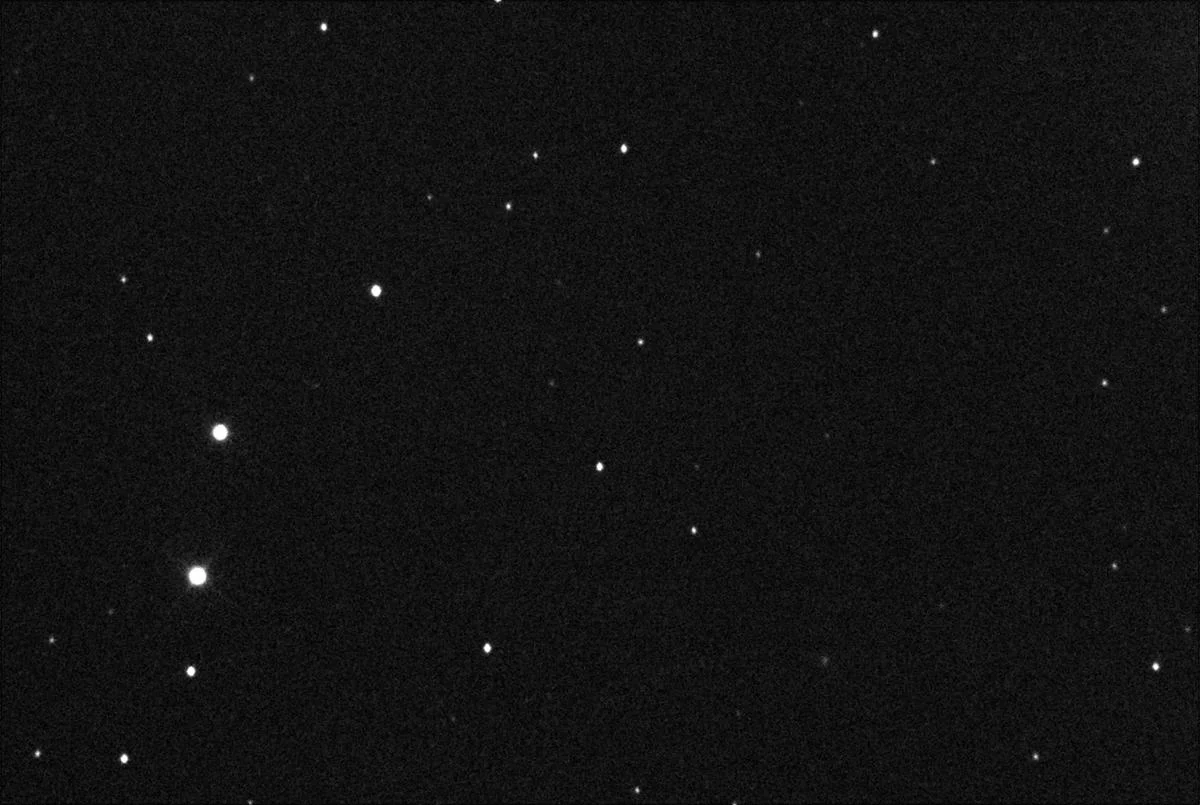
Kepler observed a supernova in our own Milky Way Galaxy, which later became known as the Kepler star. Inspired by Tycho Brahe's work, he conducted a detailed study of its appearance. His work De Stella nova in pede Serpentarii ('The New Star in the Foot of Ophiuchus') provided evidence that the universe is not static but subject to significant changes. This supernova is located approximately 13,000 light-years from Earth, and no subsequent supernova has been observed in our galaxy during historical times. Based on the evolution of its brightness, it is suspected to be a Type I supernova.
Personal Reflection: In researching this entry, I learned much about Kepler as an astronomer, particularly his important laws that would later support a figure as renowned as Newton in formulating his law of universal gravitation. I admire Kepler's relentless pursuit of knowledge since his university days, which significantly contributed to his legacy.