The Enigmatic Interstellar Comet 3I/ATLAS: A Cosmic Visitor from Beyond
The interstellar comet 3I/ATLAS, discovered in 2025, is a unique cosmic visitor traveling at 210,000 km/h. Scientists are excited about its potential to reveal secrets about our solar system's origins.
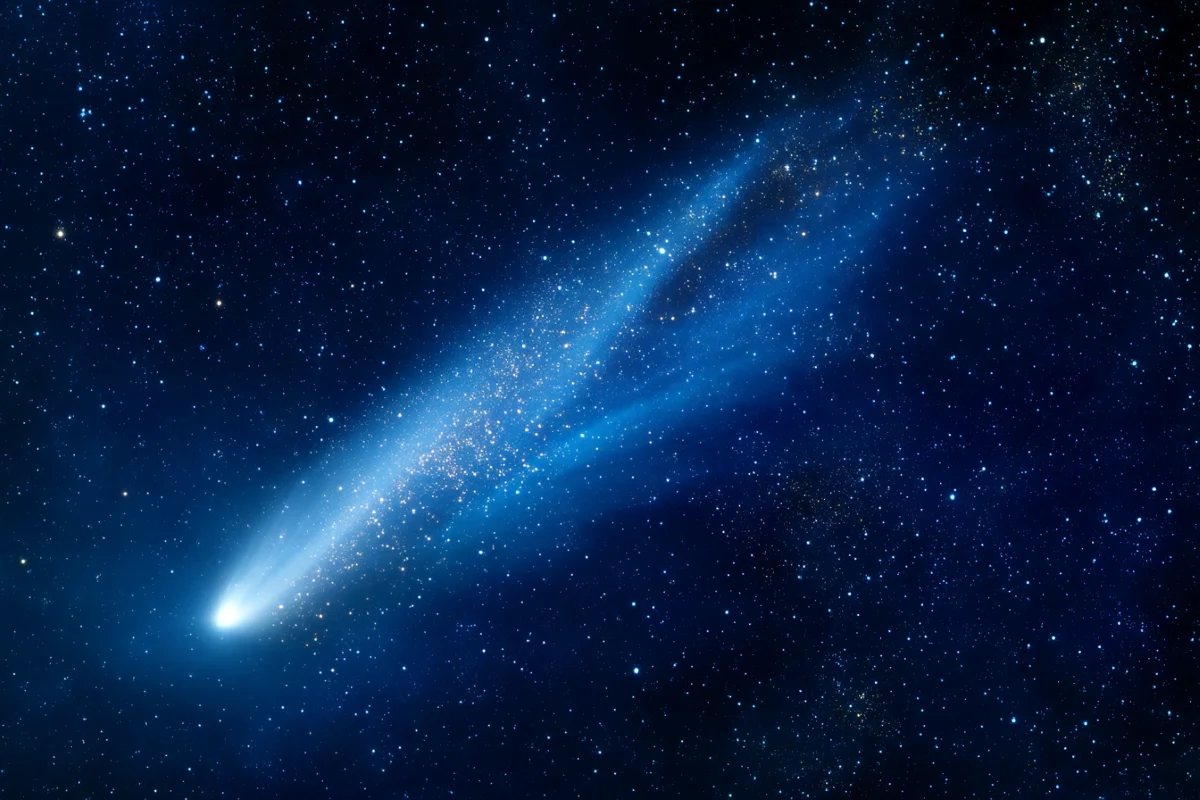
In the summer of 2025, the cosmos has revealed a remarkable phenomenon: the interstellar comet known as 3I/ATLAS, discovered on July 1 by the ATLAS surveillance network in Chile, is making its way through our solar system. This celestial body is not just another comet; it is a fleeting visitor that defies conventional understanding, traveling at an astonishing speed of 210,000 km/h.
A Galactic Visitor Defying Time
3I/ATLAS is unique in that it does not originate from any known orbit and will never return once it passes through our solar system. Initial analyses suggest that this comet may be older than Earth itself, serving as a fossilized remnant from a different time and possibly a different solar system.
A Rocket Launched from the Galactic Outskirts
Scientists believe that 3I/ATLAS comes from the thick disk of our galaxy, a region filled with ancient stars that remains largely unexplored. This comet is estimated to be over 7 billion years old, likely ejected from its original system due to a collision or the gravitational influence of a massive star. It has drifted through interstellar space for billions of years before intersecting with our path.
Its hyperbolic trajectory means that it will enter and exit our solar system without being captured by the Sun, and its speed is the fastest ever recorded for an interstellar object.
Did You Know?
The first interstellar object detected, named Oumuamua, passed through our solar system in 2017, captivating scientists with its elongated shape and unusual behavior. Some researchers even speculated about its potential as an extraterrestrial artifact, leaving many mysteries unresolved.
A Visit That Will Be (Almost) Invisible
3I/ATLAS is expected to pass approximately 210 million kilometers from the Sun, between the orbits of Mars and Earth. Unfortunately, it will not be visible to the naked eye, unlike the spectacular comets Neowise in 2020 or Hale-Bopp in the 1990s. Observations will rely on ground-based and space telescopes, including Hubble and the James Webb Space Telescope, which are prepared to monitor the comet closely. The goal is to analyze its composition and search for traces of water, ice, hydrocarbons, and perhaps even elements never before seen.
Speculations Fueling the Internet
Since the announcement of 3I/ATLAS, wild theories have proliferated online. Some sensationalist media outlets have floated the idea of it being a “cosmic spy,” with Harvard astrophysicist Avi Loeb suggesting that its trajectory—aligned with the orbits of Venus, Mars, and Jupiter—combined with its record speed, might hint at an artificial origin.
Important Considerations
Even Stephen Hawking had expressed caution regarding potential encounters with extraterrestrial civilizations, warning that contact with advanced technological societies could pose risks to humanity. This serves as a reminder of the implications of objects like 3I/ATLAS entering our stellar neighborhood.
Ice, Gases, and a Story to Decipher
Initial images have revealed a coma, the cloud of dust and gas surrounding the comet's nucleus. Spectroscopic analyses have confirmed the presence of water and hydroxyl ions, indicating that this is not merely a rock but an active comet capable of telling a story. Each particle of gas or ice released by 3I/ATLAS provides clues about the formation of planets, stars, and potentially life itself.
Summary Table
| Characteristic | Detail | |-------------------------|-------------------------------------------------| | Official Name | 3I/ATLAS (3rd detected interstellar object) | | Origin | Thick disk of the Milky Way | | Speed | ≈ 210,000 km/h (record for an interstellar comet) | | Visibility | Invisible to the naked eye – telescope observation only | | Date of Passage | October 2025 (closest approach to the Sun) | | Distance of Passage | ≈ 210 million km (between Mars and Earth) | | Notable Feature | Active comet with coma and traces of water |
Why This is Significant (and Rare)
To date, only three interstellar objects have been identified, a minuscule fraction of the billions of celestial bodies out there. This rarity underscores the significance of 3I/ATLAS. Unlike 1I/Oumuamua, which passed without a trace, or 2I/Borisov, which was more typical, 3I/ATLAS has the potential to become one of the most documented objects in modern astronomy.
Studying this comet could validate hypotheses regarding the formation of stellar systems, the presence of water in other regions of the galaxy, and the mechanisms of material ejection in protoplanetary disks. Understanding 3I/ATLAS could provide insights into our own origins.
A Galactic Thrill Not to Be Missed
3I/ATLAS will make only a single pass through our solar system, and once it departs, it will never return. In October 2025, it will be too late to observe this icy nucleus from another world, leaving behind a trail of mysteries. Yet, it also carries a sense of wonder, reminding us that we have much more to explore in our celestial surroundings.