Florence to Host 46th COSPAR Scientific Assembly in 2026
From August 1 to 9, 2026, Florence will host the 46th COSPAR Scientific Assembly, gathering over 3000 space science experts from around the world.
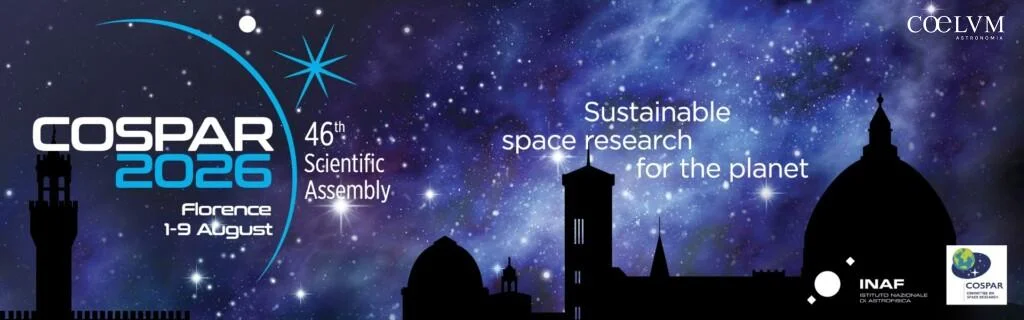
Florence to Host Global Space Research Experts in 2026
From August 1 to 9, 2026, Florence will welcome leading experts in space sciences from around the globe. This significant event, hosted at the Fortezza da Basso, is organized by the National Institute for Astrophysics (INAF). The opening ceremony is scheduled for August 3 at 3:00 PM.
The COSPAR Scientific Assembly (Committee on Space Research) is the most prestigious global event dedicated to research, exploration, and space sciences, returning to Italy after a gap of 62 years. Over the course of nine days, the city will become the epicenter of the international scientific community, drawing more than 3,000 attendees, including astrophysicists, planetary scientists, and aerospace engineers.
"Space research is one of humanity's greatest collective endeavors, and its progress relies on international collaboration," stated Pascale Ehrenfreund, President of COSPAR. "The COSPAR Scientific Assembly embodies this spirit, uniting scientists from around the world to expand knowledge, drive innovation, and inspire the next generation of discoveries."
Under the slogan “Shaping the Future of Space Research!”, this edition offers a valuable opportunity for the scientific community to engage in direct dialogue, network, and foster new international collaborations to explore the cosmos.
"It is with great pleasure that the National Institute for Astrophysics hosts the 46th COSPAR Assembly. Scientists from around the world are gathering once again under the auspices of this international body, more than sixty years since the two previous editions held in Florence in 1961 and 1964," commented Roberto Ragazzoni, President of INAF. "Back then, we had just unveiled the far side of the Moon, yet humans had not yet set foot on our satellite. Today, as we stand on the brink of returning to the Moon after its conquest in the late 1960s, having sent probes to nearly every corner of the solar system, we enter the so-called space economy. The accessibility of space, now open to commercial operators, presents new challenges—scientific, technological, political, and cultural. Astronomy, with its remarkable ability to catalyze otherwise unimaginable achievements, will continue to be a field where new generations of researchers tackle the significant challenges of our time—from understanding the deep Universe to planetary exploration, ensuring the sustainability of orbital activities, studying Earth's climate, and protecting our skies."
The extensive program for the event is coordinated by the Scientific Programme Committee (SPC), chaired by Marco Tavani, alongside Vice-Chairs Francesca Altieri and Giancarlo Ghirlanda. Local organization is managed by the Local Organizing Committee (LOC), led by Pietro Ubertini and Sofia Randich, with support from AIM Group International.
"The numbers for this 46th Assembly demonstrate the extraordinary response from the national and international scientific community," declared Pietro Ubertini, Chair of the LOC and Vice President of COSPAR. "With over 160 scientific events planned across 30 parallel sessions daily, researchers and technologists from 80 different nations will present more than 3,000 oral contributions on cutting-edge space research and approximately 600 posters dedicated to new technologies, including innovations driven by AI to manage the vast amounts of data from new satellites and ongoing missions. This impressive program positions Florence as a center for global cooperation in space, more essential than ever in light of recent international geopolitical tensions."
The conference will host high-level scientific sessions and feature a lineup of renowned invited speakers. Topics will range from the latest discoveries about the deep Universe to planetary exploration missions, climate studies from space, solar-terrestrial relationships, and space weather, as well as new frontiers in the space economy and sustainability of orbital activities through robotics and AI for nearly autonomous space exploration.
"With COSPAR 2026, we bring to Florence the most advanced challenges in space research: from the primordial Universe to the present, from planetary exploration to the search for life beyond our solar system. It is a tremendous challenge for human creativity, leveraging Big Data and artificial intelligence for new space ventures," commented Marco Tavani, Chair of the SPC. "COSPAR serves as an occasion for the global scientific community to engage directly on fundamental research topics that lead to new knowledge and future technologies. Space research indeed holds enormous discovery potential, and the enthusiasm of participants at this COSPAR Scientific Assembly reflects that spirit."
Numerous special events will take place during the Assembly. Among them, on August 3, from 9:00 AM to 12:30 PM, the event “Dark and Quiet Sky” will address the proliferation of satellite constellations for communications, which is significantly altering the appearance of the sky and outer space. Without mitigation strategies, these systems generate optical and radio pollution, severely hindering ground-based astronomy. The meeting aims to foster dialogue between the scientific community and the space industry, raising public awareness and identifying shared solutions.
In the afternoon of August 3, from 2:00 PM to 3:00 PM at the Sala Basilica, a roundtable with space agency leaders will take place, co-moderated by Gabriella Arrigo, President of the International Astronautical Federation (IAF), and Pascale Ehrenfreund, President of COSPAR. This gathering will bring together heads of major space agencies, including ASI (Italy), NASA (USA), ESA (Europe), UAESA (United Arab Emirates), NSSC (China), PRL/ISRO (India), CSA (Canada), KASI/KASA (South Korea), and JAXA (Japan), to discuss scientific priorities and future strategies for international cooperation.
Following this, the opening ceremony will announce the winners of the prestigious COSPAR Awards.
On Tuesday, August 4, from 7:00 PM to 8:30 PM at the Sala Teatrino Lorenese, a special session dedicated to “ASI Roadmaps for Astrophysics and Solar System Studies” will present the results achieved in the first two years of activities by working groups promoted by the Italian Space Agency (ASI) in 2023, showcasing the synergistic collaboration between the Agency, key research entities, and Italian universities. In a context driven by Big Data, multimessenger astronomy, and AI, the meeting will outline guidelines and technological priorities for upcoming challenges in studying the Universe and the solar system.
Special attention has been devoted to involving new generations of researchers; the Assembly will actively engage numerous students, PhD candidates, and young scientists under 35, who will support logistical and congress activities through a dedicated volunteer program, gaining a unique opportunity to interface with global leaders in the field. An evening event, the Young Researchers’ Night, is scheduled for August 5 at Villa Vittoria to share experiences and promote networking.
For the public in Florence, the series “COSPAR OFF” will include three evening meetings (starting at 9:00 PM, in Italian) at the Teatro Niccolini featuring prominent figures in space research and exploration. Kicking off on August 3, INAF President Roberto Ragazzoni will discuss the most fascinating challenges facing scientists studying the Universe from space. On August 5, Andrea Patassa, a test pilot for the Italian Air Force and astronaut in the ESA Reserve Corps, will share his professional journey and insights into future European space missions. Finally, on August 6, Marica Branchesi, a professor at the Gran Sasso Science Institute, will discuss her expertise in gravitational wave studies and multimessenger astronomy.
The event has received sponsorship from the Tuscany Region, the Municipality of Florence, the National Research Council (CNR), the University of Florence – Department of Physics and Astronomy, and the National Institute of Nuclear Physics (INFN), alongside partnerships with major players in the aerospace industry.