Comet 67P/Churyumov-Gerasimenko: A Closer Look
New observations of Comet 67P/Churyumov-Gerasimenko provide detailed insights into its structure and behavior, captured through advanced imaging techniques.
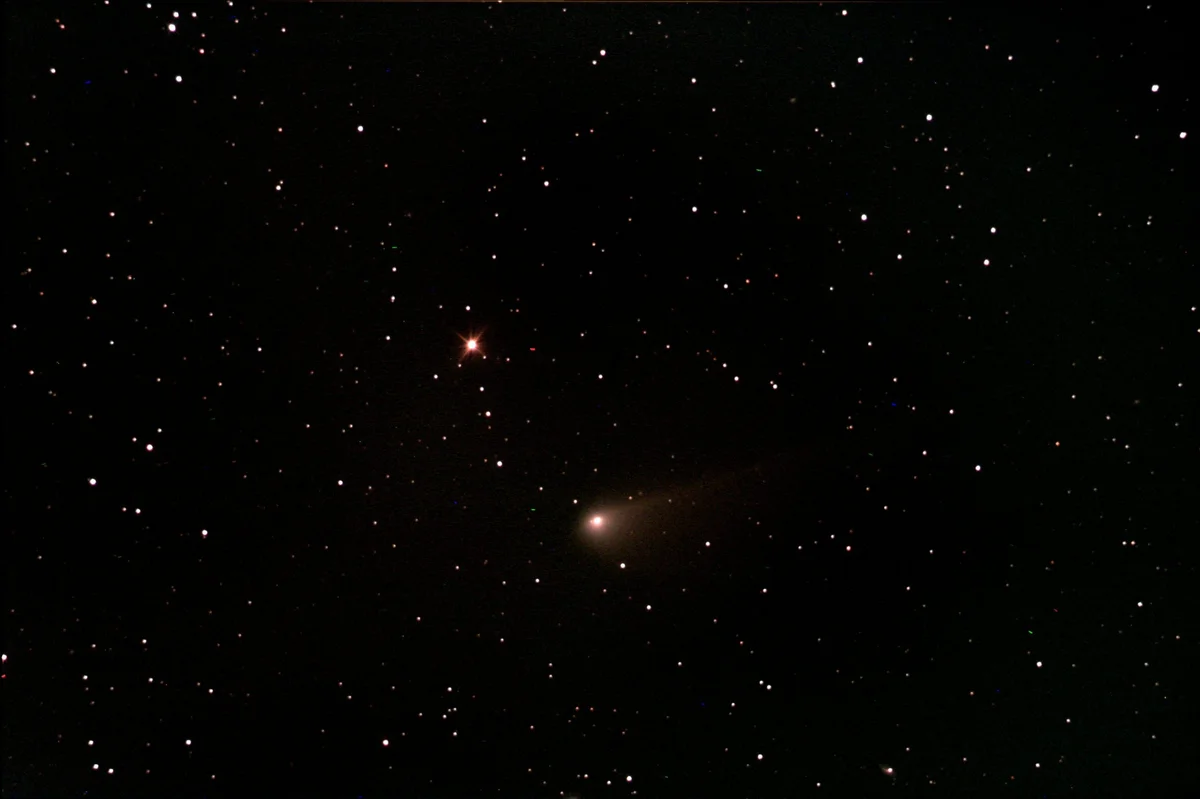
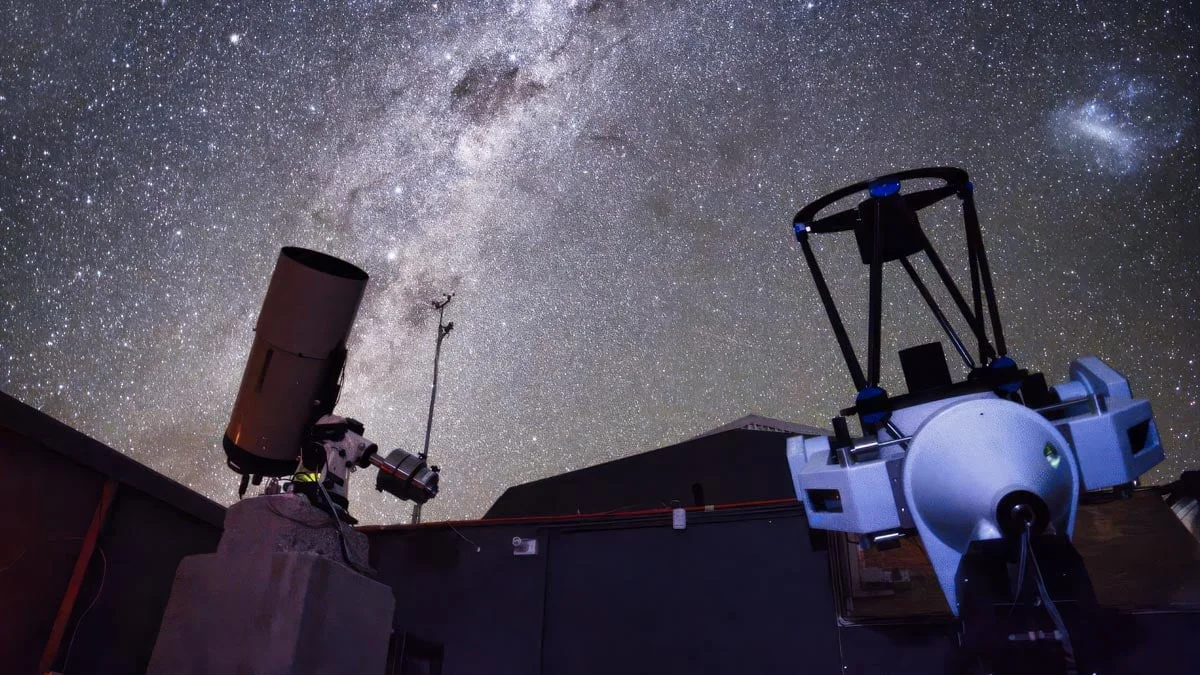
Recent observations of Comet 67P/Churyumov-Gerasimenko have yielded new images that allow for a more detailed analysis of this intriguing celestial body. The comet was photographed from the outskirts of Sassari, Sardinia, on the night of December 30-31, 2021, between 21:39 UT and 22:10 UT. Conditions were favorable, with clear skies and no wind, rated at Bortle 5.7. The imaging process involved six exposures of five minutes each, taken with a 250mm Skywatcher Newton telescope and a 1250mm focal length (f/5) on an EQ6Pro mount, utilizing a cooled CCD QHY8L camera at -15°C with an Astronomik UHC filter. Automatic guiding was achieved with a ZWO ASI 120MC CMOS camera and a parallel 60mm refractor with a 700mm focal length (f/12), using PHD2 software for tracking. The data acquisition was performed with Astro Photography Tool (APT), and processing was done with Maxim DL4, applying Dark Frame, Bias, and Flat Fields corrections.
At the time of the last exposure, the comet was approximately 0.4773 AU from Earth, equating to about 71.4 million kilometers, and 1.4114 AU from the Sun, or roughly 211.1 million kilometers. Its orbital speed was recorded at 31.6 km/s, with an apparent movement of 23.5” per hour in the sky, at a position angle of 295°. Given the telescope's focal length and the comet's minimal apparent motion, even with a total integration time of 30 minutes, the comet's movement was slight, making stars appear as point sources despite tracking being set on the comet's nucleus. Numerical verification confirmed this assessment; over the 30-minute exposure period, the comet shifted only 11.75”, translating to less than 10 pixels in the final image. For reference, a star with a magnitude of 11.75m would appear as a disc of 10 pixels, indicating that the comet's movement was effectively absorbed by intrinsic image errors.
In the captured image, the comet displays a well-defined central region with a stellar appearance, transitioning into a dust tail that fans out in a west-southwest direction. The dust tail becomes apparent from a position angle (PA) of 207° and extends to approximately PA 311°. The maximum length of this tail appears to be at PA 280°, with an approximate length of 7.9’. The fan-shaped tail's midpoint is around PA 258°, extending about 5.3’. The gas tail is located at an apparent PA of 290°, measuring approximately 13.3’ in length and appearing filamentous and uninterrupted. Based on the observational data, it is estimated that the gas tail stretches at least 280,000 km into space, while the dust tail reaches approximately 110,000 km at its median position and 164,000 km at its maximum length. As of the observation date, Comet 67P was moving away from the Sun, having passed its perihelion on November 2, 2021; thus, its activity is likely diminishing. All measurements regarding the dimensions and extents of the tails are subject to integration time and should be regarded as minimum reference values, indicative rather than precise.
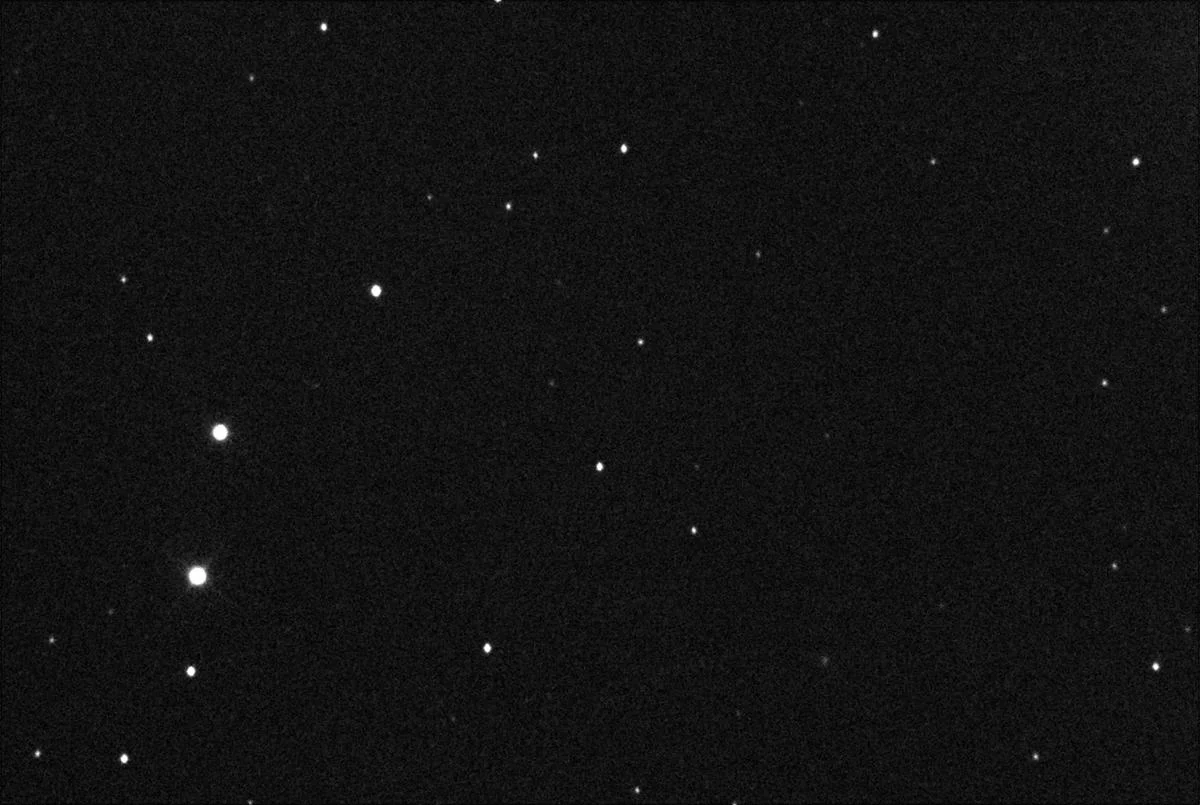
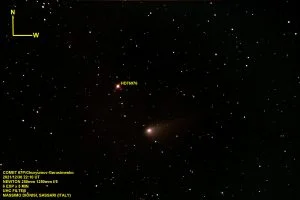
In the eastern direction, 20.95” from the geometric center of the central structure, lies a faint star designated UCAC4-593-045704, with a magnitude of 16.1m and a B-V color index of 0.35. This star provides a limit for the size of the central condensation, suggesting it is less than 40”, or approximately 15,000 km. These measurements are highly approximate and can only offer a rough estimate of the actual dimensions involved. Zooming in on the southern part of the central condensation reveals a circular structure of varying color and brightness, raising questions about whether it represents a physical feature of the comet, such as a halo or coma generated by gas and dust emissions, or if it is merely an artifact from the image processing.
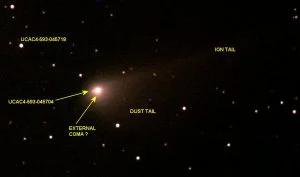
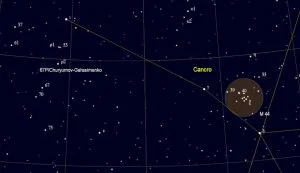
The brightest star visible in the image is HD76976, with a magnitude of 7.6m and a B-V color index of 1.532, classifying it as an M0 red giant located approximately 1,035 light-years from Earth. The entire star field belongs to the constellation Cancer, as illustrated in a wide-field image extracted from the "Skychart" program (Cartes du Ciel), which was also used for controlling the EQ6Pro mount; each rectangle in the chart measures 5 degrees in width and height, presented in an altazimuthal projection for Sassari at the time of the photographic captures.
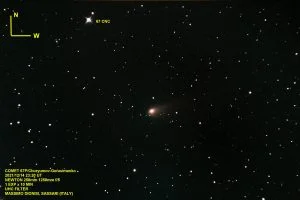
A comparison of the December 30 image with one taken on December 14, 2021, which featured a single 10-minute exposure, reveals the absence of the circular corona-like structure observed surrounding the southern part of the central condensation, as well as a potential lack of the fan shape in the dust tail. Due to differing exposure times between the two sessions, direct comparisons of the sizes and extents of the dust and gas tails are not feasible; however, the gas tail appeared continuous and uninterrupted on December 14 as well.
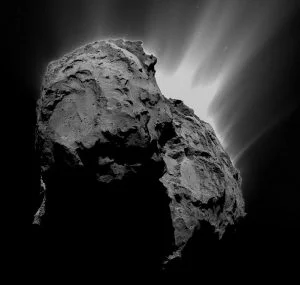
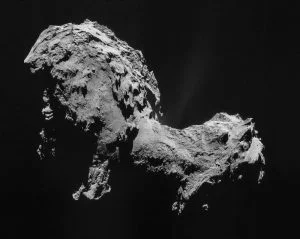
Comet 67P/Churyumov-Gerasimenko is a periodic short-period comet belonging to the Jupiter family, with its aphelion distance nearing the semi-major axis of Jupiter's orbit. Its orbital period is 6.45 years, characterized by an eccentricity of 0.64, resulting in a highly elliptical orbit that brings the comet as close as 185.8 million km to the Sun, in contrast to its aphelion distance of 850 million km. The comet was visited by the European Space Agency's Rosetta spacecraft in August 2014, which conducted extensive analyses of the comet's nucleus and captured a wealth of images. On November 12 of the same year, Rosetta deployed a lander named Philae for direct exploration of the comet's surface. This mission continued to monitor the comet's evolution as it approached perihelion. By September 2016, the Rosetta mission was officially concluded, with the spacecraft being deliberately crashed onto the comet's surface. Among the findings, it was determined that the nucleus of 67P has an irregular, non-spherical shape, consisting of two lobes connected by a narrower neck, with the larger lobe measuring approximately 4.1 km x 3.3 km x 1.8 km and the smaller lobe around 2.6 km x 2.3 km x 1.8 km. The comet loses material with each orbit, as gases sublimate from the heat of the Sun, carrying away significant amounts of dust from the surface; the solar wind then pushes this material away, forming the two tails that are lost irretrievably into interplanetary space. It is estimated that the comet currently loses an average of about 1 meter of material with each orbit, with a total mass of approximately 10 billion tons. The two-lobed shape of the comet is the result of a low-velocity collision between two objects. Notably, the overall shape of this comet's nucleus closely resembles that of the asteroid 486958 Arrokoth, also known as "Ultima Thule," discovered on June 26, 2014, during a survey conducted with the Hubble Space Telescope to identify Kuiper Belt objects potentially reachable by the New Horizons probe after its exploration of the Pluto system. Arrokoth orbits at an average distance of 6.67 billion km from the Sun, and on January 1, 2019, New Horizons successfully captured close-up images of the object, revealing its two-lobed structure connected by a narrow neck, mirroring the characteristics of Comet 67P.
Data from the Rosetta mission also indicated that the water vapor emitted by Comet 67P has a different composition than that found on Earth, making it unlikely that terrestrial water originated from comets like Churyumov-Gerasimenko. The water vapor is also mixed with significant amounts of formaldehyde (0.5% by weight) and methanol (0.4% by weight), with these concentrations falling within the common range for comets in the solar system.