Mars Opposition: A Celestial Event on January 16, 2025
On January 16, 2025, Mars will reach heliacal opposition, providing a significant opportunity for stargazers to observe the Red Planet as it shines brightly in the night sky.
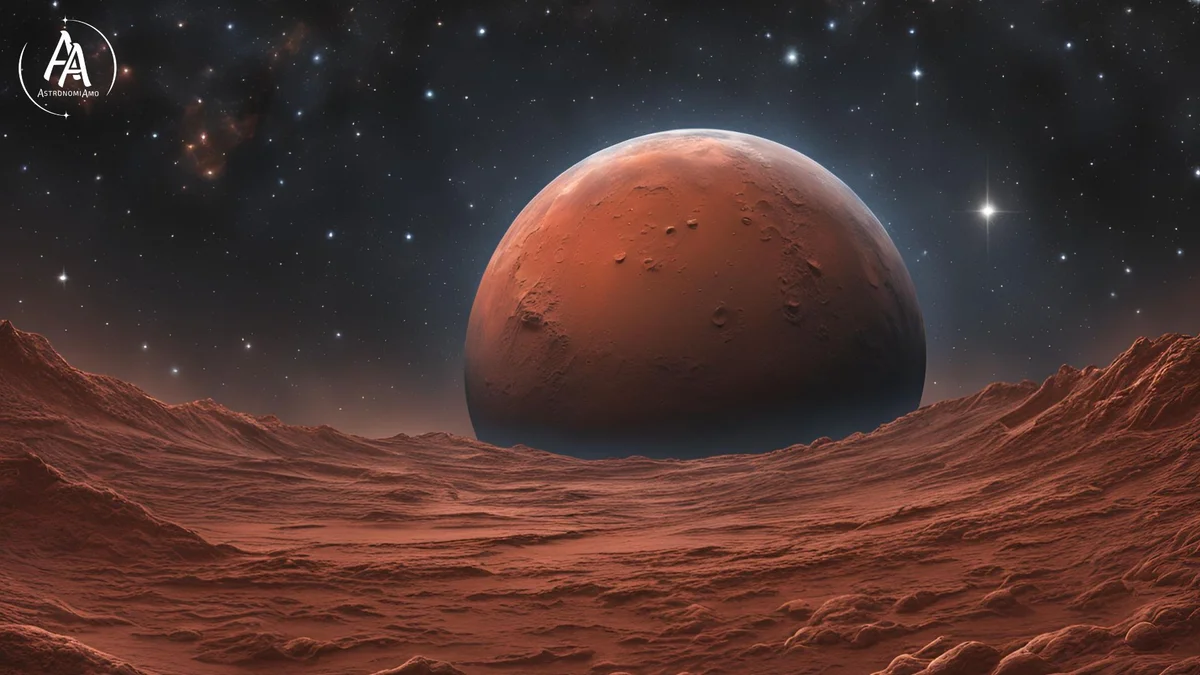
The night sky on January 25 presents a noteworthy opportunity for stargazers, despite common misconceptions about the frequency of viewing Mars. The Red Planet graces our skies every two years, but its visibility can vary significantly.
On January 16, 2025, Mars will reach heliacal opposition, providing a chance for observers to witness this celestial event.
Understanding Opposition
An outer planet—defined as one whose orbit lies beyond Earth's, such as Mars, Jupiter, Saturn, Uranus, and Neptune—occurs in opposition when Earth is positioned directly between the Sun and that planet.
This alignment results in the planet appearing opposite the Sun in the night sky. As the Sun sets in the west, the planet rises in the east, making it visible throughout the night and at its highest point in the sky.
Mars experiences opposition approximately every 26 months (around 780 days), which corresponds to its synodic period. The distance between Earth and Mars during these oppositions varies widely due to their elliptical orbits. Notably, oppositions where Mars is particularly close to Earth are termed “great oppositions”, occurring roughly every 15 to 17 years.
The 2025 Opposition
While the January 2025 opposition is not classified as a “great opposition,” it still offers decent observational conditions. On January 16, 2025, Mars will shine with an apparent magnitude of about -1.4, comparable to that of Sirius, the brightest star in the night sky. Its apparent diameter will measure around 14.5 arcseconds, making it sufficiently visible even through modest telescopes. For more detailed ephemeris data, refer to Mars's page on SkyTour. In contrast, during the last Great Opposition on July 27, 2018, Mars's diameter was nearly 25 arcseconds, with a magnitude of -2.8—double the size and brightness, noting that magnitude increases by a factor of four with each step.
Observational Aspects
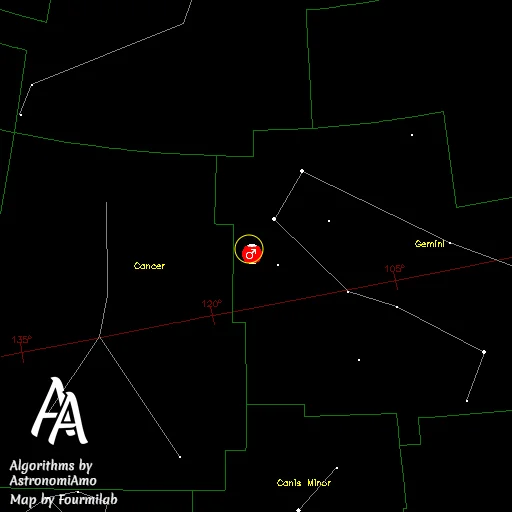
Mars will remain prominently visible for several months surrounding the opposition, located within the constellation of Gemini, making it easy to spot near bright stars like Castor and Pollux. Beyond telescopic observations, Mars can be seen with the naked eye as a bright, fixed point of reddish-orange hue.
Using binoculars enhances the perception of the planet's reddish color, while even small telescopes allow viewers to discern surface details, such as the polar ice caps (weather permitting) and various shades of red associated with Martian surface features.