Exploring Celestial Conjunctions: Worth the Wake-Up Call?
Discover the celestial conjunctions occurring in July, their visibility, and the best times for observation. This guide helps distinguish between visually appealing events and those worth your time.
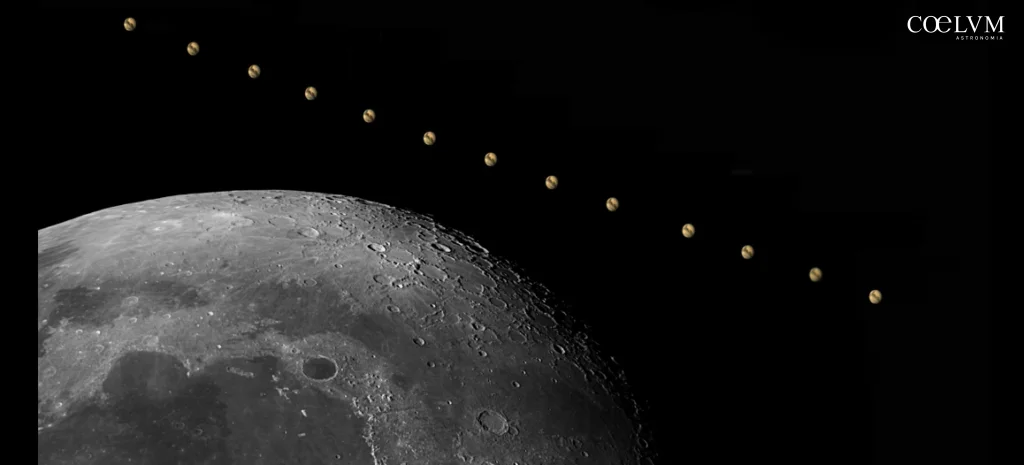
In the realm of astronomy, conjunctions are frequent events, occurring whenever two celestial bodies share the same right ascension or ecliptic longitude. However, a significant discrepancy often exists between celestial geometry and observational reality, as many of these events transpire during daylight hours, too close to the Sun, or below the horizon. This monthly guide aims to differentiate between conjunctions that look good on paper and those that truly offer a captivating observational experience.
Night of July 6-7: Moon in Conjunction with Neptune – Visibility: Critical
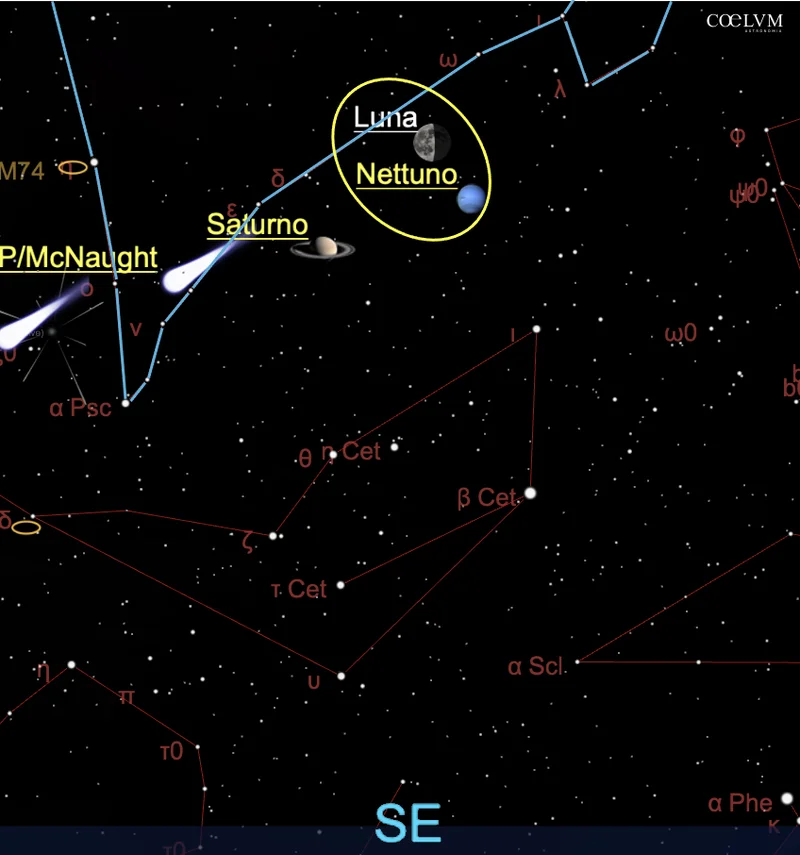
The conjunction of the Moon and Neptune will take place at 04:36 on July 7, with both celestial bodies positioned in the southeastern quadrant of the sky. At this moment, our Moon, illuminated at nearly 60%, will be identifiable at approximately 45º above the horizon in the constellation Pisces.
Despite this, observation proves challenging; Neptune's faint disk is not visible to the naked eye and can only be detected using a telescope. However, the necessary magnification to locate Neptune significantly narrows the field of view, complicating the simultaneous observation of both bodies, which are nearly 5 degrees apart. Additionally, the brightness of the Moon increases the sky's background light nearby, further diminishing the planet's contrast.
Thursday, July 9: Venus and Regulus – Visibility: Fair
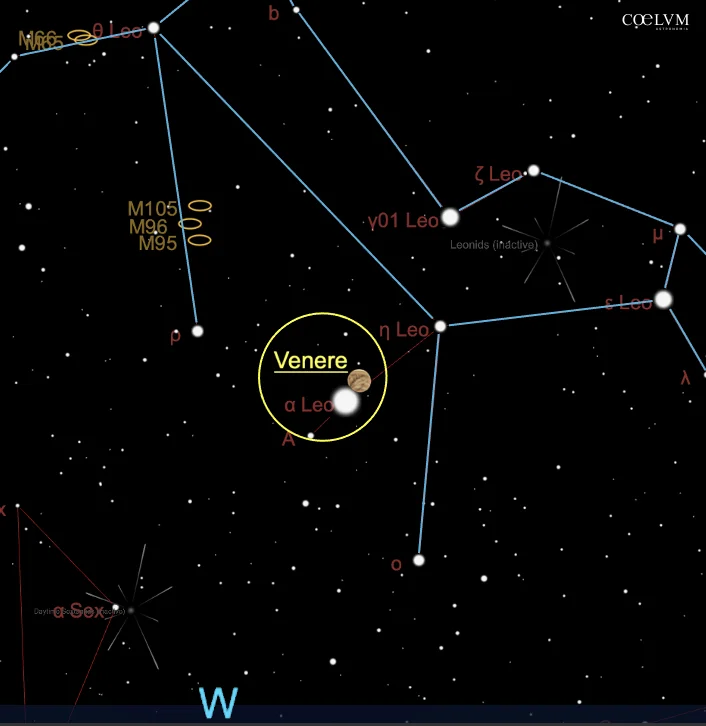
Although the conjunction is set for 15:37, making it occur during daylight, the two celestial bodies will still be closely positioned and can be observed in the early evening. As twilight dims, starting around 21:45, the brilliant Venus will be easily spotted in the western sky, approximately 1º away from Regulus, the alpha star of the constellation Leo, and nearly aligned with the imaginary line connecting it to η (Eta) Leonis. Unfortunately, the pair will be relatively low in the sky, ranging from 11 to 13 degrees in altitude, with a limited viewing window as both will set by 23:00.
Night of July 10-11: Moon-Pleiades, Mars-Hyades, Moon-Uranus, and Moon-Mars – Visibility: Fair
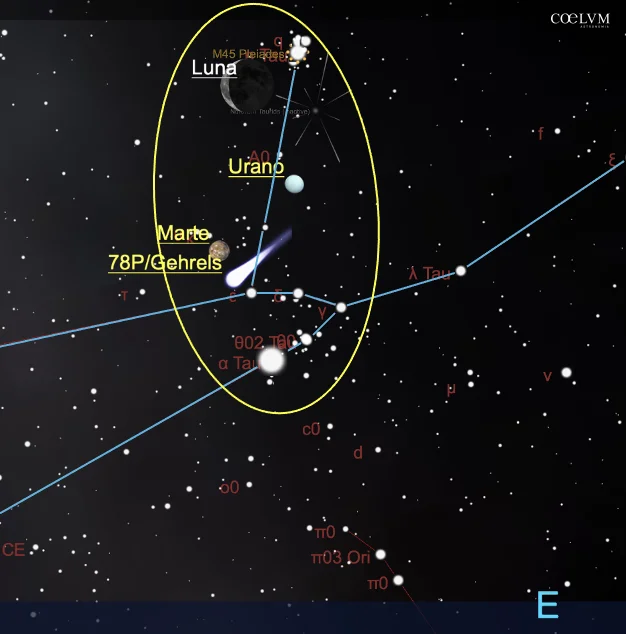
On paper, July 11 appears to be a particularly eventful night, hosting four conjunctions at various times: 01:30 (Moon-Pleiades), 08:47 (Mars-Hyades), 09:09 (Moon-Uranus), and 16:40 (Moon-Mars). Given the timings, direct observation will not be possible, but just before dawn, the resulting configuration promises to be one of the most intriguing of the month.
As nautical twilight begins at 04:30, the Moon, illuminated at 17%, will be easily visible at just over 20º above the East-Northeast horizon. Below it, at about 15º high, the planet Mars will shine brightly. If observers glance back at the Moon and then shift their gaze to the Northeast, they can spot the “Seven Sisters” of the Pleiades cluster; approximately 6º lower, Uranus will also be visible, but only through a telescope.
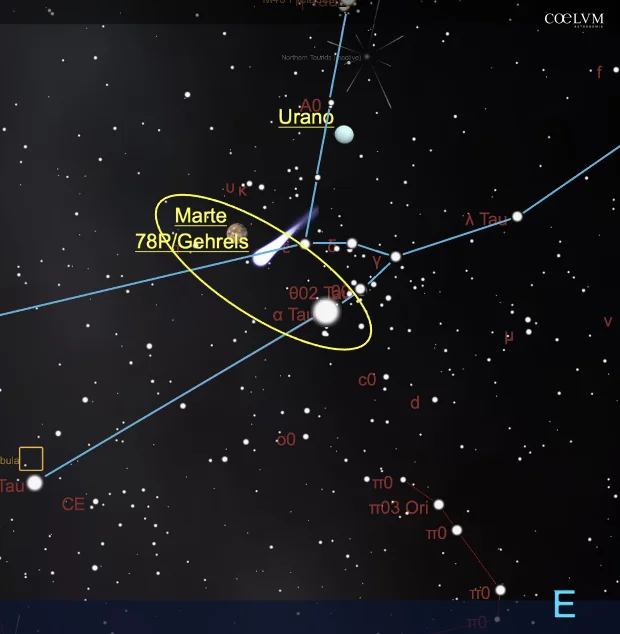
Night of July 13-14: Mars and Aldebaran – Visibility: Fair
The conjunction between Mars and Aldebaran, the eye of the Bull, will occur at 09:00 on July 14. Although sunlight will hinder direct observation at this time, both celestial bodies will be visible a few hours earlier, just before dawn.
The optimal viewing window, albeit brief, is around nautical twilight (04:32), where Mars will be located about 17º above the East-Northeast horizon, with the reddish disk of Mars appearing about 4 degrees higher and slightly to the right of the bright red star α (Alpha) Tauri.
Tuesday, July 14: Moon and Pollux – Visibility: Absent
In this instance, the astronomical event is purely geometric and not accessible for observation. The Moon, in its New phase, will have an elongation of about 7º, resulting in it rising and setting entirely in sunlight, rendering it invisible.
Wednesday, July 15: Moon-Jupiter and Moon-Manger – Visibility: Absent
On July 15, the situation mirrors that of the previous day. The two conjunctions, expected at 05:04 and 12:40, will not be visible due to their timing; unfortunately, their effects cannot be observed later in the evening either, as the Moon's extremely low elongation will cause it to set in the constellation Cancer before civil twilight concludes.
Thursday, July 16: Moon and Regulus – Visibility: Critical
This conjunction occurs overnight at 02:45 on July 17, but both celestial bodies will have already set. Therefore, the best chance to observe their configuration will be during the last light of sunset on July 16.
Skywatchers should begin scanning the sky toward the West-Northwest horizon starting at the end of civil twilight (21:16). However, a clear horizon will be necessary to spot the thin crescent Moon, which will be at an altitude of only 7 degrees. If successful, observers may also glimpse Regulus about 2 degrees higher and slightly towards Venus.
Friday, July 17: Moon and Venus – Visibility: Fair
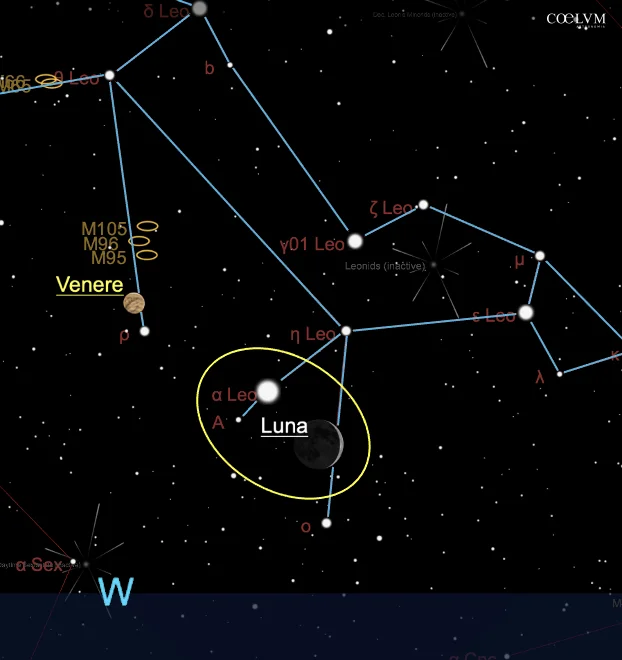
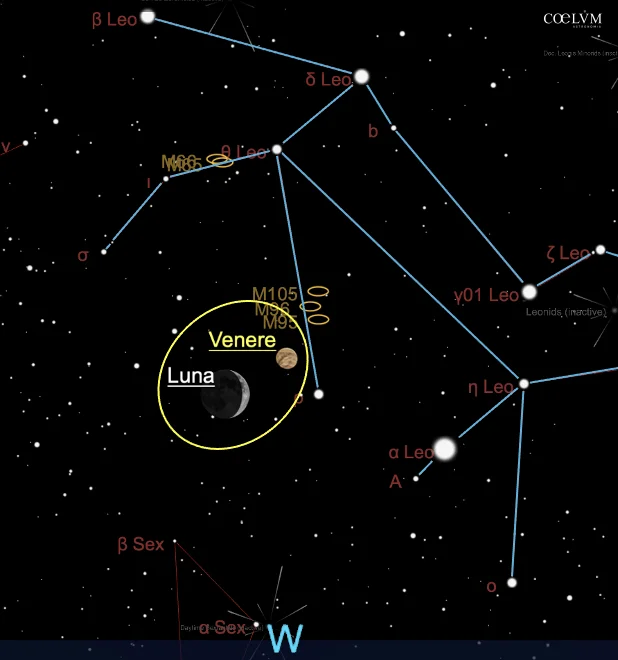
Once again, the conjunction occurs before sunset, specifically at 18:29 on July 17, but observers can see the arrangement of the Moon near Venus a few hours later.
From 21:30, looking westward, viewers will be able to identify the slender lunar crescent, illuminated at 9%, which, after its previous position next to α (Alpha) Leonis, will be located about 2º from Venus, still beneath the constellation Leo. Unfortunately, the pair will be confined to a 15º range, limiting observation until both set around 22:40.
Monday, July 20: Moon and Spica – Visibility: Fair
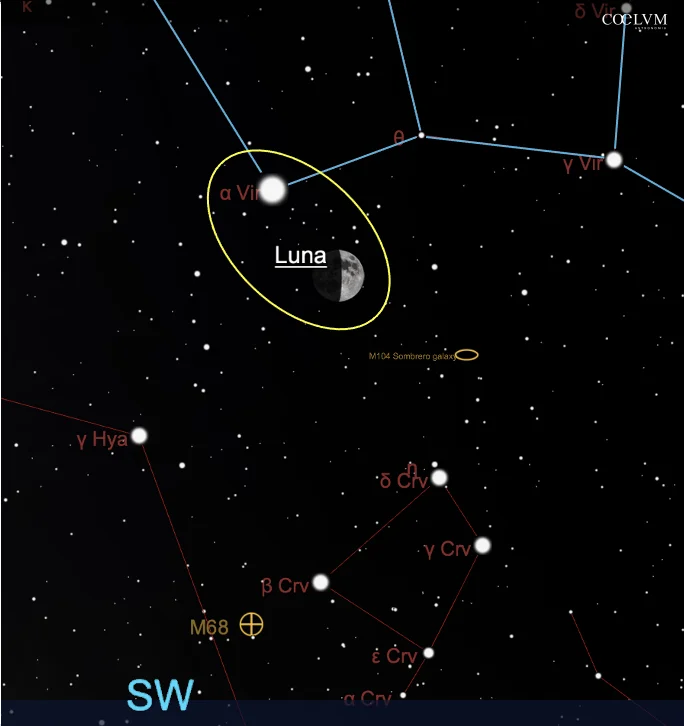
Starting at 21:45 on July 20, observers can look towards the South-West at an altitude of about 18º to witness the approach of the growing Moon, illuminated at nearly 40%, and the star Spica, the α (Alpha) Virginis.
The two bodies will be within 2.5 degrees of each other and can be seen descending toward the horizon until shortly before midnight. The exact moment of conjunction, occurring at 06:03 the following morning, will not be observable from our region.
Night of July 24-25: Moon in Conjunction with Antares – Visibility: Excellent
This conjunction is likely the most accessible of the month, taking place on Friday, July 24, at 23:44.
With only 0.6º separating them, the two celestial bodies will be visible right after sunset. By 21:45, they will be easily located in the southern sky at an altitude of 20º. After passing their meridian, they can be followed as they slowly descend until the time of conjunction. At that moment, they will be about 13º in the South-West, with the Moon, illuminated at around 70%, positioned almost directly below Antares, the reddish heart of the Scorpius constellation.
Visibility Legend
* Excellent Visibility
– The conjunction is observable at or near the exact moment
– Good height above the horizon
– Favorable observing conditions
– Phenomenon is easily recognizable
* Fair Visibility
– The conjunction is not visible at the moment of the event
– Easily observable in the hours before or after
– One or more limitations that do not significantly compromise observation
..(non-ideal height or moderately short viewing window)
– Phenomenon is easily recognizable
* Critical Visibility
– The conjunction is not visible at the moment of the event
– One or more limitations that make observation difficult or heavily dependent on local conditions
..(low height above the horizon, twilight/dawn, very narrow viewing window, faint objects)
* Absent Visibility
– Event not practically observable
For a comprehensive overview of all astronomical events for the month, refer to the “Sky of the Month” – July, published on this website on June 29, 2026.
For those interested in exploring the astronomical significance of conjunctions, the article “Conjunctions, Oppositions, and Close Encounters Between Celestial Bodies: A Guide to Major Celestial Alignments” by Luigi Civita can be found on this website, published on April 4, 2026.
In the cover image: “Sequence of Moon Mars Conjunction,” captured on September 6, 2020, by Fabrizio Guasconi for Coelum and featured on this website on September 21, 2020.