Looking Up at the Sky – Is It Worth the Wake-Up?
In astronomy, conjunctions are extremely common events. This article distinguishes between conjunctions that are worth observing and those that are not, providing a detailed schedule for June.
In astronomy, conjunctions are extremely common events: it is enough for two celestial bodies to share the same right ascension or ecliptic longitude. However, there is often a significant difference between celestial geometry and observational reality: many occur during the day, too close to the Sun, or below the horizon. How many of those that populate astronomical calendars are truly worth observing? This monthly appointment aims to distinguish between "on-paper" conjunctions and those capable of providing a truly interesting observation.
Table of Contents
- Monday, June 8: Venus and Pollux – Visibility: fair
- Night of June 9-10: Venus-Jupiter and Moon-Neptune – Visibility: fair/critical
- Night of June 12-13: Moon and Mars – Visibility: critical
- Saturday, June 13: Lunar conjunctions – Visibility: absent
- Night of June 16-17: Moon, Mercury, and Pollux – Visibility: critical
- Night of June 17-18: Jupiter, Beehive Cluster, Moon in conjunction with Venus – Visibility: fair
- Friday, June 19: Moon and Regulus; Venus in conjunction with the Beehive Cluster – Visibility: fair
- Saturday, June 23: Moon in conjunction with Spica – Visibility: excellent
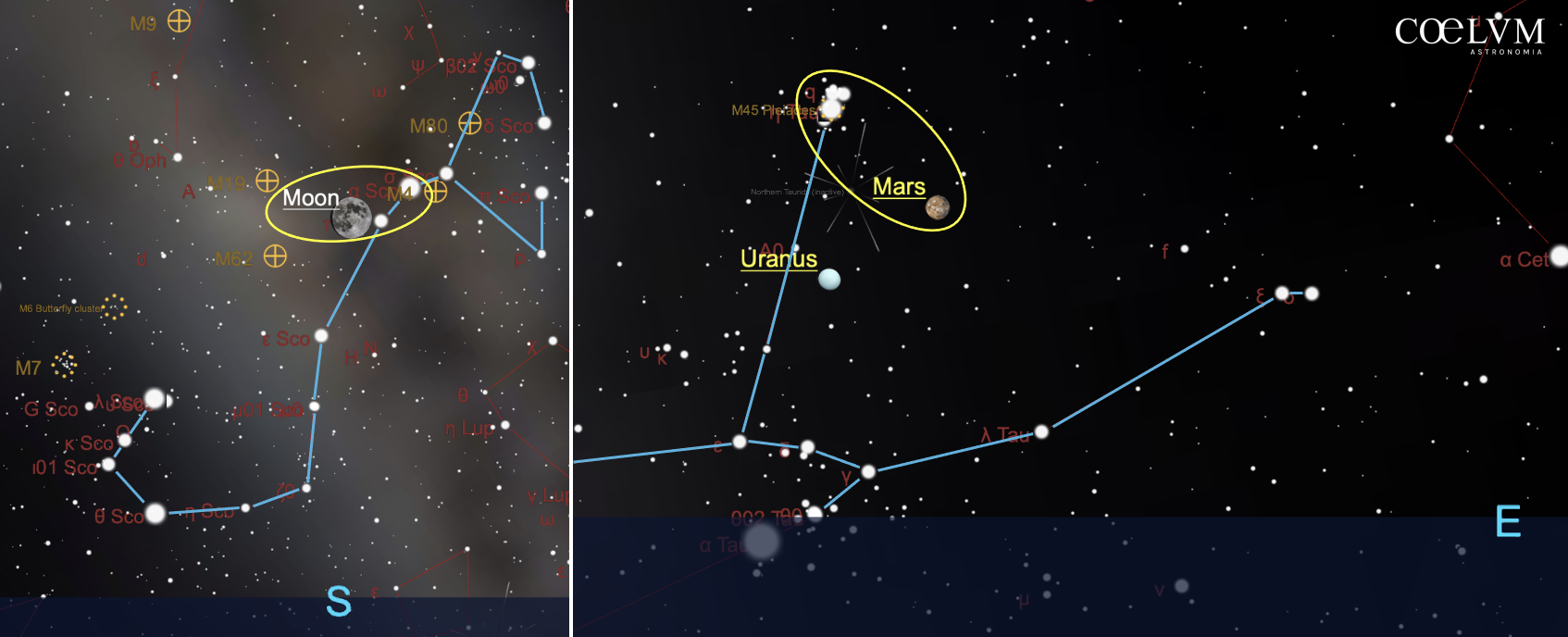
- Night of June 27-28: Moon-Antares and Mars-Pleiades – Visibility: fair/critical
- Visibility Legend
Monday, June 8: Venus and Pollux – Visibility: fair
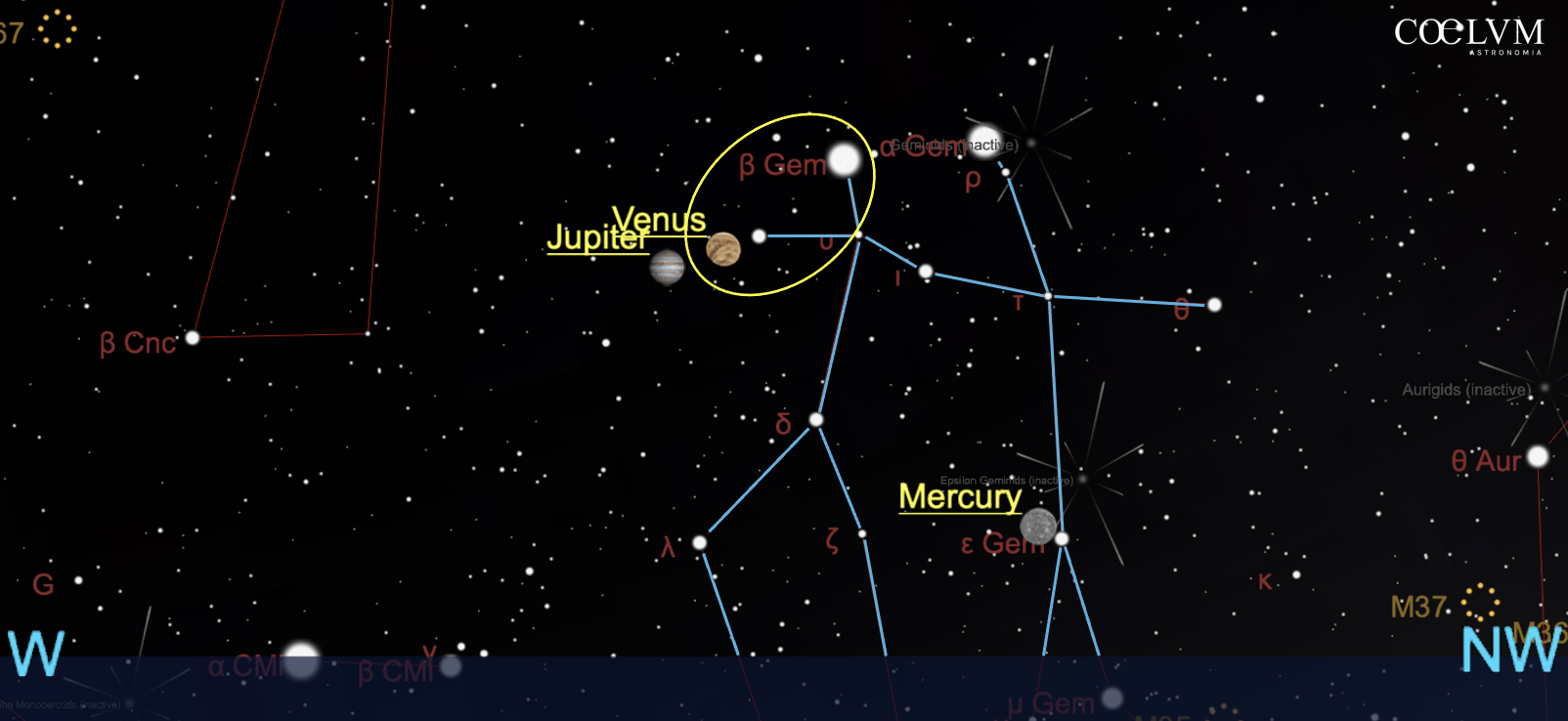
Although the exact moment of the conjunction between Venus and Pollux occurs at 17:32, it will not be observable because it is during the day. However, it will be possible to appreciate their configuration in the hours following sunset. Around 21:45, Venus will be easily identifiable in the West-Northwest direction, at about 15° in altitude, with a magnitude of -4. The planet will be positioned in a celestial field that also includes Jupiter slightly lower and Kappa Geminorum on the opposite side, while Pollux will be visible slightly higher and more distanced from the planetary pair. The configuration will remain observable until shortly after 23:00, when Venus will disappear below the horizon.
Night of June 9-10: Venus-Jupiter and Moon-Neptune – Visibility: fair/critical
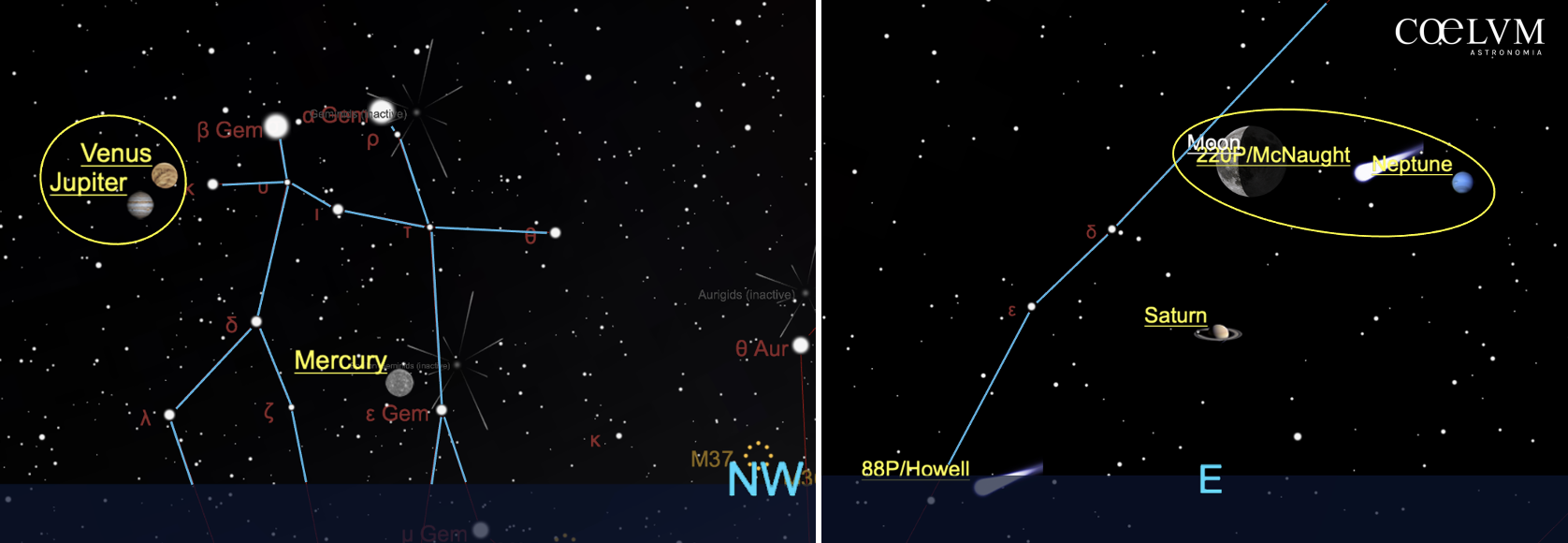
Two events are scheduled for June 9, but in both cases, the celestial bodies will not be visible at the time of conjunction. Venus and Jupiter will be in conjunction during the day at 13:39, while the Moon and Neptune will be at 20:12, several hours before their appearance above the horizon.
Even in the twilight, it will still be possible to follow the evolution of the Venus-Jupiter system, whose close proximity was already evident in the previous days. In the West-Northwest direction, at about 15° in altitude, the two planets will be immediately recognizable, separated by just over 2° and observable until around 23:00.
The case of the Moon-Neptune configuration is different, as it will only be visible starting from 03:00 in the East direction, with the celestial bodies reaching an altitude of just over 10°. The faint brightness of Neptune, observable only with good amateur equipment, and the proximity of the Moon, although in a waning phase, make the event less contrasting and challenging. However, during the same hours, it will be possible to observe Saturn rising slightly lower.
Night of June 12-13: Moon and Mars – Visibility: critical
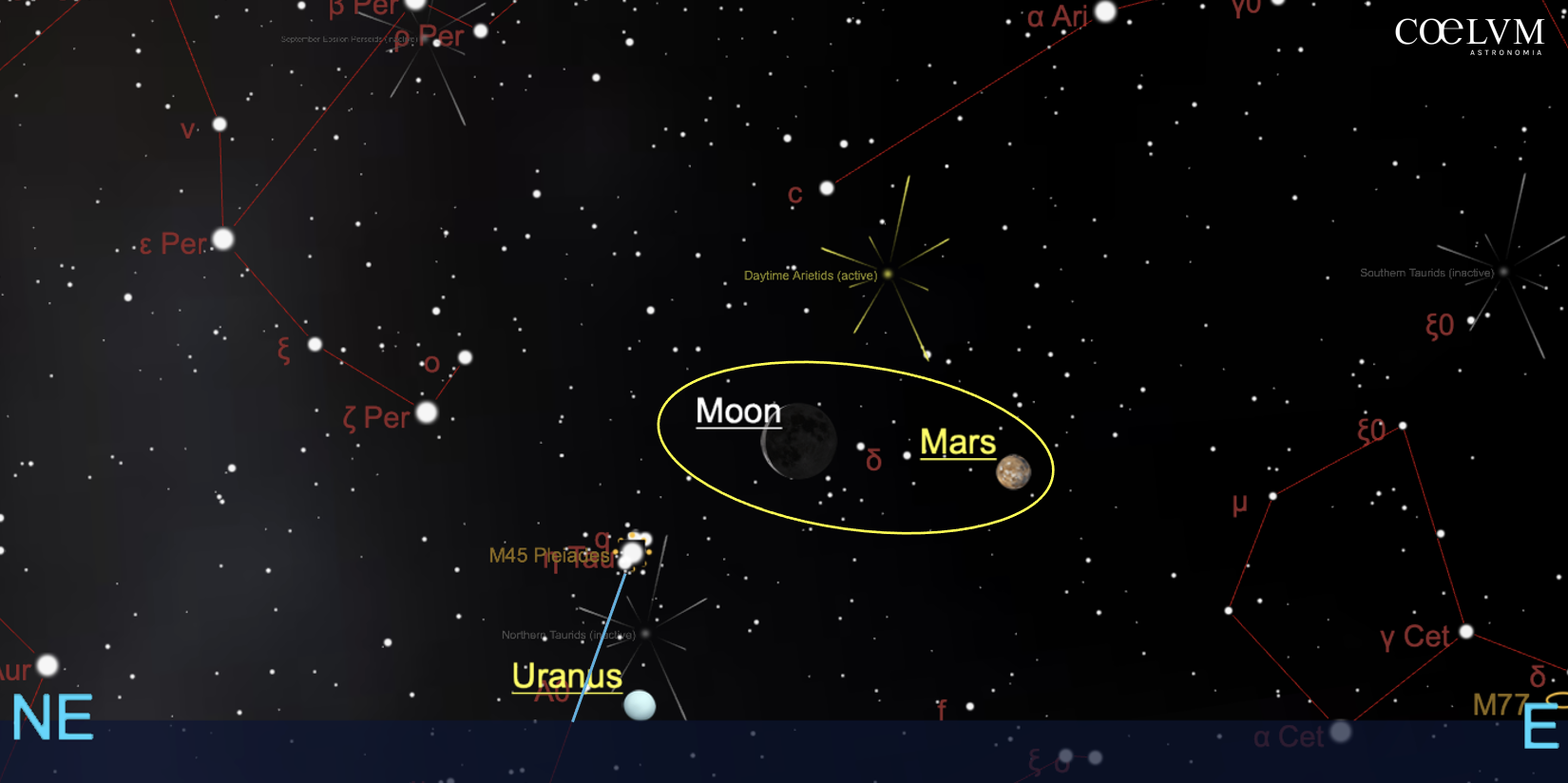
The conjunction between our satellite and the planet Mars will occur on Friday, June 12, at 22:14, when both celestial bodies will not yet be visible above the horizon. Therefore, observation will need to wait until the end of the night: the two objects will reach an altitude of about 10° around 04:30 in the morning, shortly after the start of nautical twilight. In the early morning light, the thin crescent Moon will be visible in the North-Northeast direction, in the constellation Aries; a few degrees further east, Mars will also be found.
Saturday, June 13: Lunar conjunctions – Visibility: absent
During the day on June 13, the Moon will be involved in two conjunctions with the Pleiades at 14:51 and subsequently with the planet Uranus at 20:09. In both cases, the events will not be observable: the first will occur during the day, while the second will happen when the two celestial bodies are still below the horizon. Even the resulting configuration, visible in the following hours, is practically unreachable. The Moon, in a very thin crescent phase, will only rise in the early morning light, when the brightness of the sky will make it extremely difficult to distinguish both the Pleiades and the faint Uranus.
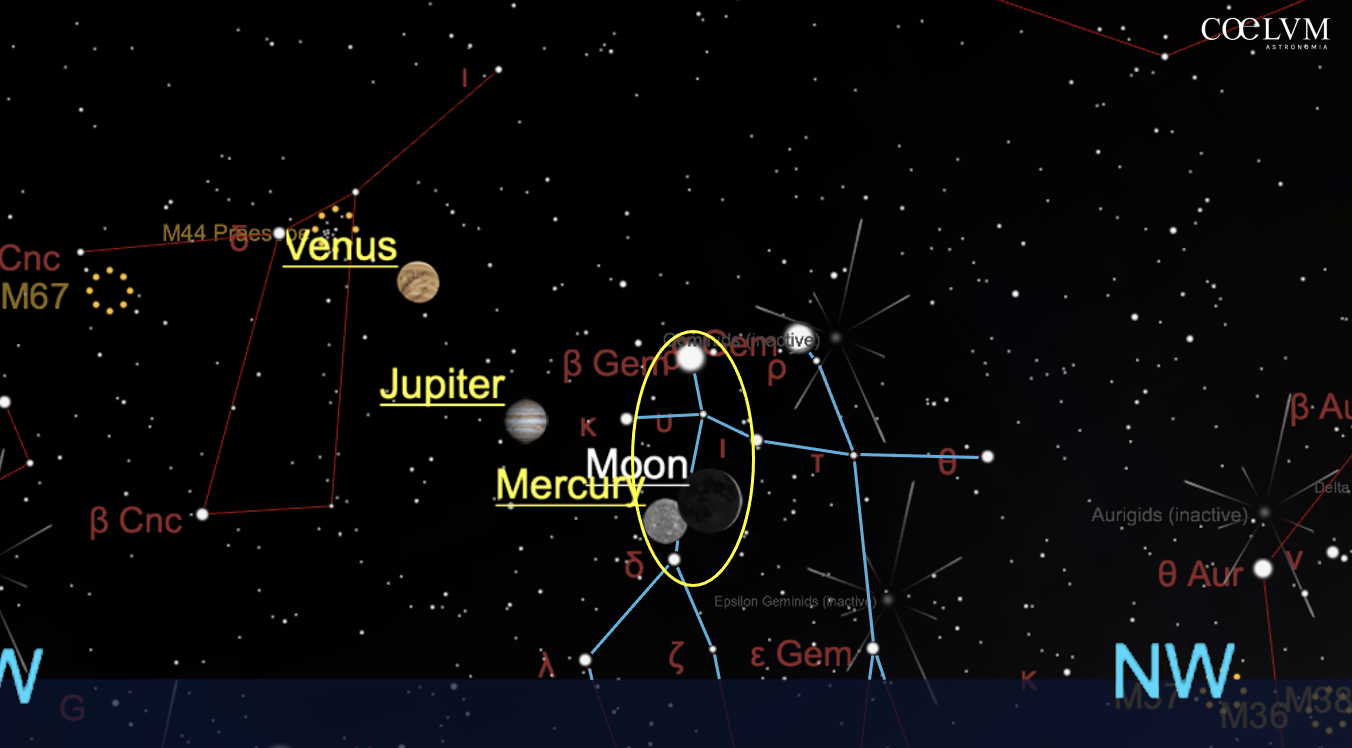
Night of June 16-17: Moon, Mercury, and Pollux – Visibility: critical
On the evening of Tuesday, June 16, a particularly interesting configuration will present itself, resulting from the approach between the Moon, Mercury, and Pollux. The actual conjunctions of the Moon-Mercury and Moon-Pollux, which will occur at 20:34 and 03:45 respectively, will not be directly observable; the best time for observation will instead be around 21:45.
In the West-Northwest direction, in the still twilight-lit sky, a very thin crescent Moon (after the New Moon the day before) will be visible at less than 10° in altitude, along with Mercury, separated by about 2°; higher up, Pollux will also complete the scene.
However, the observational window will be very short and will require favorable conditions on the western horizon. Therefore, this is a challenging configuration, but of great interest due to the close apparent proximity between the two planetary objects, along with the presence of Venus and Jupiter at a short distance.
Night of June 17-18: Jupiter, Beehive Cluster, Moon in conjunction with Venus – Visibility: fair
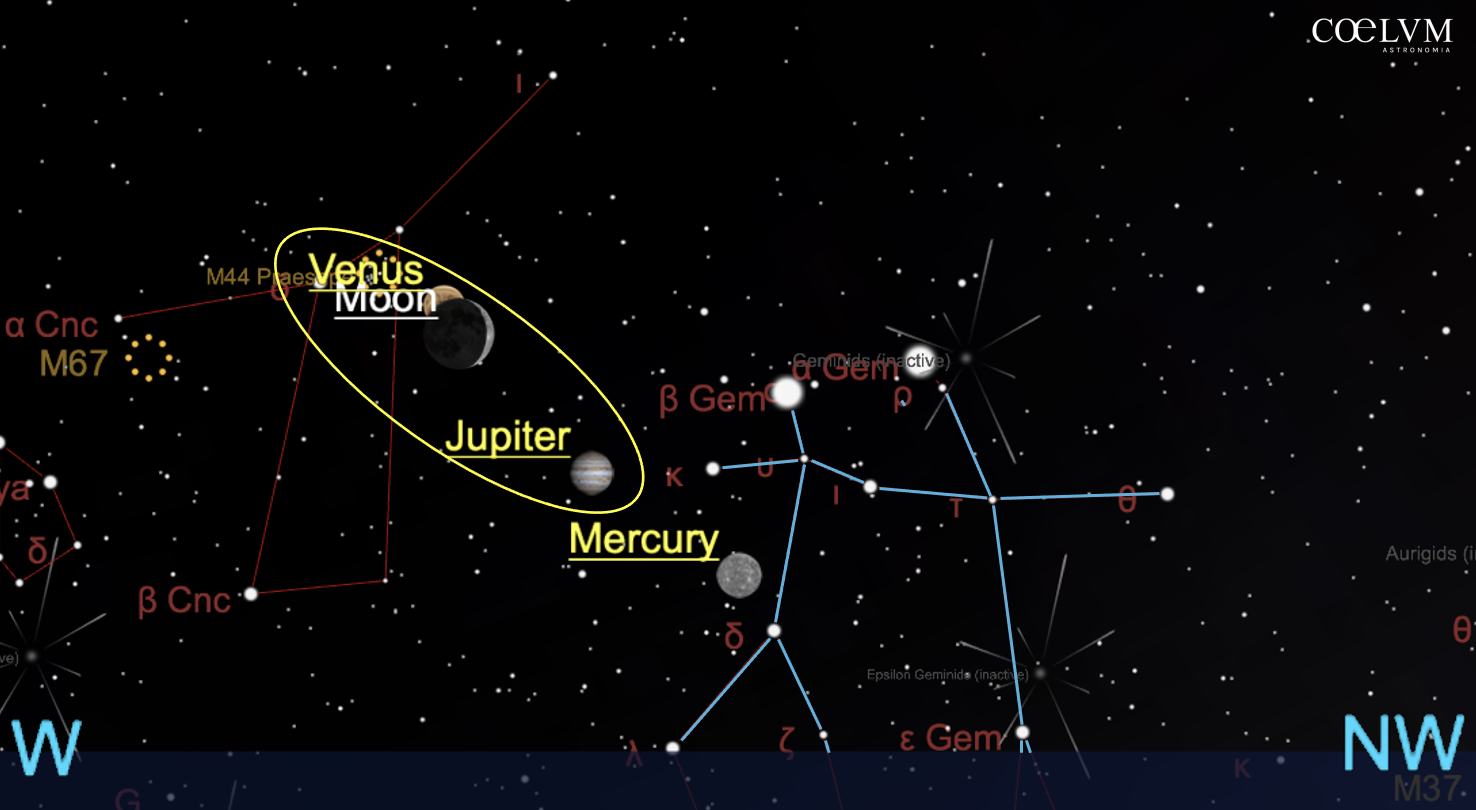
Although two of the three planned conjunctions occur during the day (Moon-Jupiter at 07:52) or when the involved celestial bodies are already below the horizon (Moon-Beehive at 01:16 on June 18), it will still be possible to observe the overall configuration in the hours following sunset.
Given the position of the Moon in the constellation Cancer instead of Gemini as the previous day, visibility will be fair this time. Starting from 21:45, in the West direction, Venus and the crescent Moon will be clearly visible at about 15° in altitude, separated by just over 1°. Higher up, the Beehive Cluster will also be observable with the aid of binoculars, while Jupiter will appear lower on the horizon, now distant from the conjunction. Mercury will also still be present very low towards the West-Northwest.
Friday, June 19: Moon and Regulus; Venus in conjunction with the Beehive Cluster – Visibility: fair
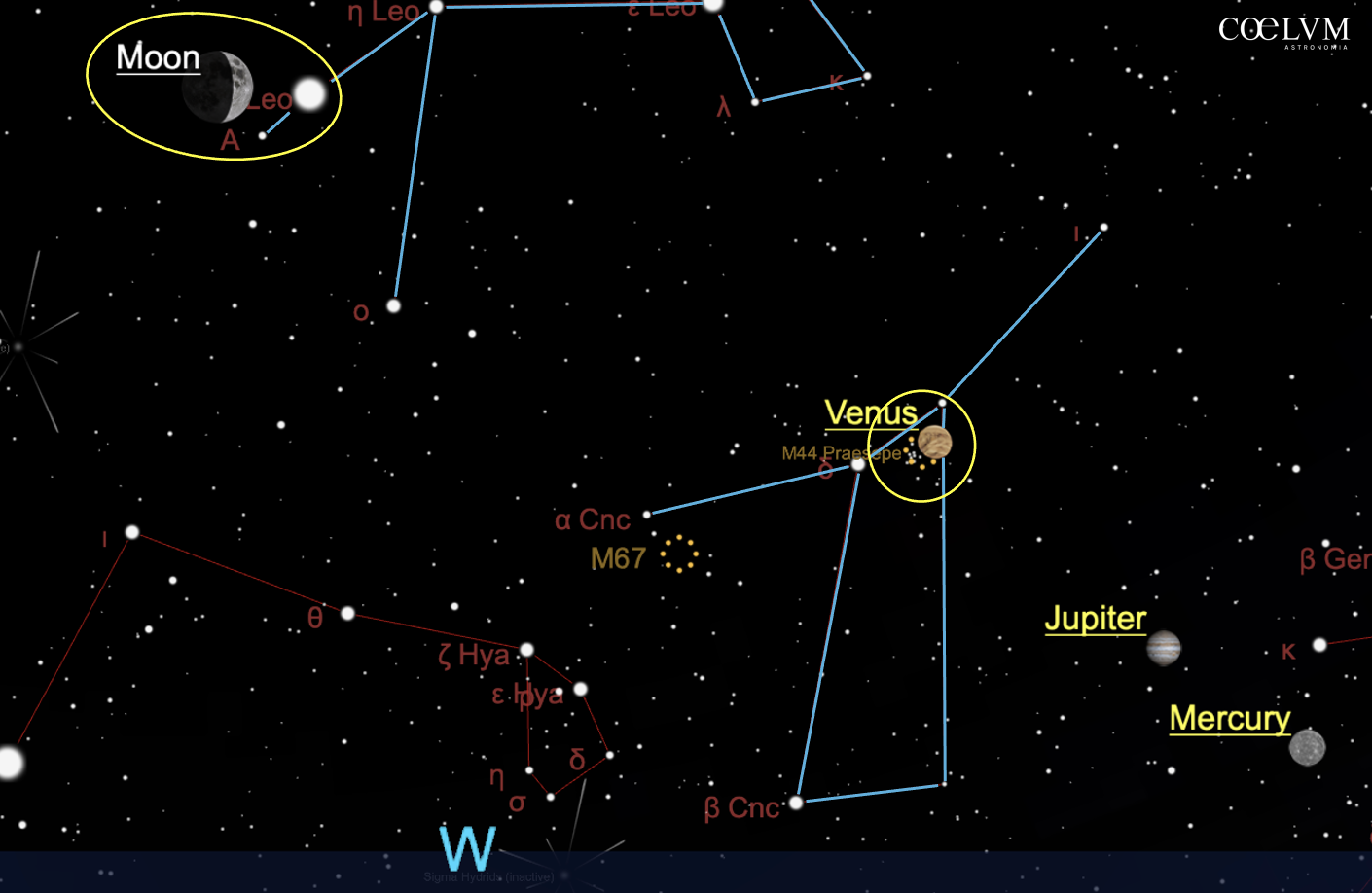
During the afternoon, the Moon will reach conjunction with Regulus at 16:08, and the event will thus not be observable. To appreciate their proximity, it will be necessary to wait until the evening, around 22:00, when our satellite will be visible in the West at an altitude between 20 and 25°, illuminated by about 20%. To its right, at less than 3°, will be Regulus, the Alpha star of the constellation Leo.
Lower down, towards the West-Northwest, it will be possible to spot Venus, immersed in the open cluster NGC2632/M44 (commonly called the "Beehive" or "Hive"), with the conjunction expected at 21:59. The phenomenon will be observable at a low height – about 13° – and will require a good pair of binoculars or an amateur telescope to be appreciated.
Saturday, June 23: Moon in conjunction with Spica – Visibility: excellent
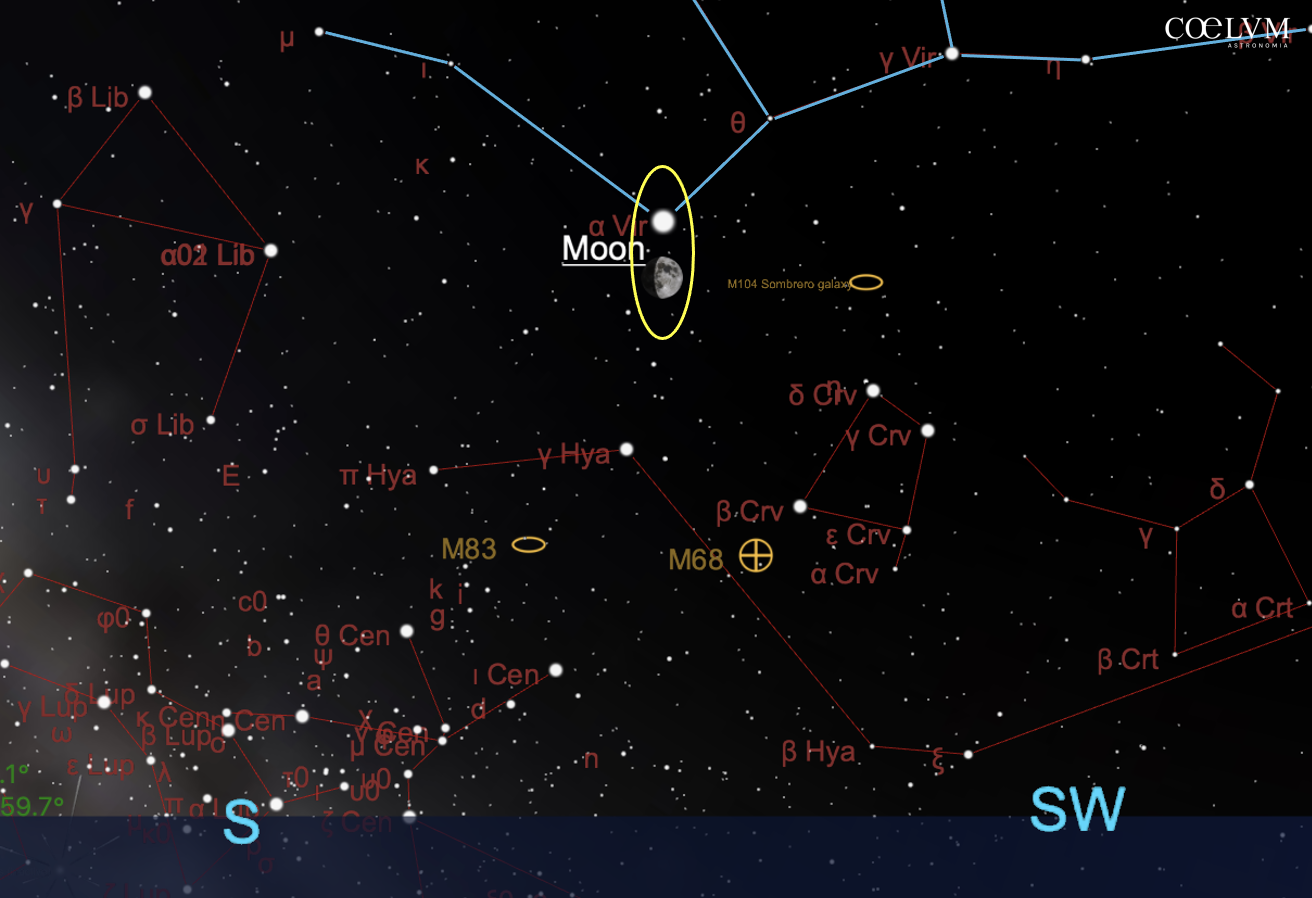
At 21:54, the conjunction between the Moon, in its waxing phase and illuminated at 60%, and the star Spica, the brightest in the constellation Virgo, will occur. The two objects, separated by about 2.5°, will be easily identifiable in the South-Southwest direction and at about 30° in altitude, in a vertical arrangement.
Night of June 27-28: Moon-Antares and Mars-Pleiades – Visibility: fair/critical
The last conjunctions of the month will not be observable at the exact moment, as they will occur when the involved celestial bodies have not yet risen. In the case of Moon-Antares, the conjunction will occur at 16:17; however, their configuration will be visible starting from 22:00 in the South-Southeast direction at about 20° on the horizon. Observation can continue until the two objects set shortly after 03:00, following the progressive distancing of our satellite from Antares, with the reference of the star Tau Scorpii.
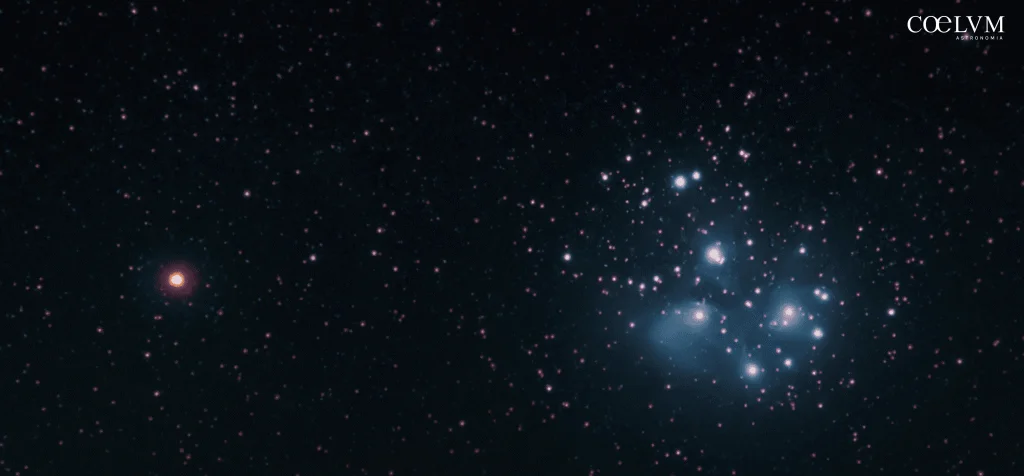
The Mars-Pleiades configuration is more complex, with the conjunction at 20:11 not observable. It will be necessary to wait until the final hours of the night, when Mars and the Pleiades Cluster will rise in the East-Northeast direction, still very low on the horizon. Around the beginning of nautical twilight (04:16), a very brief observational window will open before the increasing morning light makes the Pleiades difficult to distinguish. During this interval, it will be possible to appreciate their proximity, with about 4° of separation at an altitude close to 10°.
Visibility Legend
* Excellent Visibility
– the conjunction is observable at the moment or near the exact instant
– good height on the horizon
– favorable observational conditions
– phenomenon immediately recognizable
* Fair Visibility
– the conjunction is not visible at the moment of the event
– easily observable in the hours before or after
– possible observational limitations (non-ideal height or moderately short observational window)
– phenomenon easily recognizable
* Critical Visibility
– the conjunction is not visible at the moment of the event
– challenging observational conditions (low height on the horizon, twilight/dawn, very narrow observational window, faint objects)
* Absent Visibility
– event not practically observable
For a complete overview of all astronomical events of the month, please refer to the “Sky of the Month” – June, published on this website on May 31, 2026.
Those wishing to delve into the astronomical significance of conjunctions can consult the article “Conjunctions, oppositions, and close encounters between celestial bodies: a guide to the main celestial alignments” by Luigi Civita, published on this website on April 4, 2026.
Cover image: “Conjunction Mars – Pleiades,” photo taken on March 4, 2021, by Nunzio Micale for Coelum and published on this website on March 5, 2021.