Mars: An Introduction to Astronomy
Mars, the fourth planet in our Solar System, known as the Red Planet, shares many characteristics with Earth. Explore its physical, orbital, and atmospheric properties.
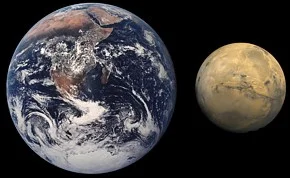
Mars, often referred to as "the Red Planet" due to its striking orange-red hue, is the fourth planet in our Solar System. It is classified among the "terrestrial planets," which are rocky in nature, similar to Earth, and is the innermost planet that orbits furthest from the Sun. In many respects, Mars bears the closest resemblance to Earth among its planetary neighbors.
The notable astronomer Tycho Brahe meticulously measured Mars's movements across the sky. His observations of the planet's apparent retrograde motion enabled Johannes Kepler to uncover the elliptical nature of its orbit, leading to the formulation of the planetary motion laws known as "Kepler's Laws." Mars derives its name from the Roman god of war, reflecting its historical significance in mythology.
Mars is categorized as a superior planet, meaning it never passes between the Sun and Earth. The phases of Mars, or the illuminated portions visible from Earth, are not as pronounced, which can be easily demonstrated geometrically. Considering the triangle formed by the Sun, Earth, and Mars, the angle of the phases is defined by the positions of the Sun and Earth as viewed from Mars.
Physical Characteristics
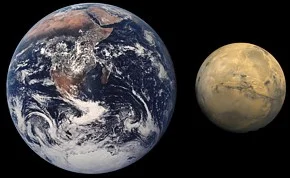
Mars has a slightly ellipsoidal shape, with an equatorial diameter of 6,794 km and a polar diameter of 6,750 km. Precise micrometric measurements have revealed a flattening of 0.01, which is three times greater than that of Earth.
This flattening affects the planet's rotational axis, causing a slow precession due to the Sun's gravitational pull on Mars's equatorial bulge. Unlike Earth, where lunar precession is twice as significant as solar precession, Mars does not exhibit a comparable phenomenon.
With its dimensions, Mars's volume is approximately 15% that of Earth, while its mass is only about 11%. Consequently, its density is lower than that of Earth, measuring 3.94 relative to water. An object on Mars would weigh one-third of its weight on Earth due to the planet's weaker gravitational force.
Orbital Elements
- Epoch: J2000
- Longitude of the Ascending Node: 49.562°
- Inclination: 1.850°
- Argument of Periapsis: 286.537°
- Semi-Major Axis: 227,939,100 km
- Eccentricity: 0.093315
- Periapsis (Perihelion): 206,669,000 km
- Apoapsis (Aphelion): 249,209,300 km
- Sidereal Orbital Period: 686.971 days
- Synodic Orbital Period: 779.96 days
- Mean Orbital Velocity: 24.077 km/s
- Mean Orbital Radius: 227,936,640 km
- Satellites: 2
Additional Physical Characteristics
- Mass: 6.4185 × 10²³ kg
- Volume: 1.6318 × 10¹¹ km³
- Density: 3.9335 ± 0.0004 g/cm³
- Surface Area: 144,798,500 km²
- Diameter: 6,794.4 km
- Angular Diameter: 3.5-25.1''
- Gravity: 3.711 m/s²
- Escape Velocity: 5.027 km/s
- Rotation Period: 24.6229 hours
- Axial Tilt: 25.19°
- Albedo: 0.15
Atmospheric Characteristics
Mars's atmosphere is extremely thin, with a surface pressure ranging from 0.636 kPa (0.4-0.87 kPa). This is a mere fraction compared to Earth's atmospheric pressure of 1033 hPa. The atmospheric pressure on Mars varies significantly with altitude, reaching nearly 9 hPa in its deepest depressions and dropping to 1 hPa at the summit of Olympus Mons.
The composition of Mars's atmosphere is primarily carbon dioxide (95.32%), with nitrogen (2.7%), argon (1.6%), and trace amounts of other gases such as oxygen (0.13%), carbon monoxide (0.08%), and water vapor (0.02%).
Water on Mars
The boiling point of water is influenced by atmospheric pressure, and on Mars, the pressure is so low that liquid water cannot exist. This indicates that if Mars once had abundant water, it would have required a much denser atmosphere that could support higher temperatures.
As most of that atmosphere dissipated into space, the pressure and temperatures dropped, leading to the disappearance of liquid water from Mars's surface. Currently, water exists only as vapor in the atmosphere and in the polar ice caps, which consist of large masses of permanent ice.
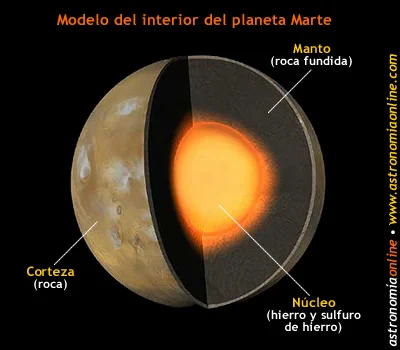
The Core of Mars