Mars, the Planet of Records
If we considered the Solar System as an elegant residential neighborhood, Mars would surely be part of our vicinity. But do we really know all the geological wonders that our cosmic neighbor holds on its surface?
If we considered the Solar System as an elegant residential neighborhood, Mars would surely be part of our vicinity. But do we really know all the geological wonders that our cosmic neighbor holds on its surface?
Let's start exploring the major ones, those so large that they are visible even on a planetary scale, orbiting around the planet itself. Thanks to the remarkable size of these mega-structures, Mars holds several records compared to other celestial bodies in the Solar System.
Valles Marineris: The Deepest Canyons
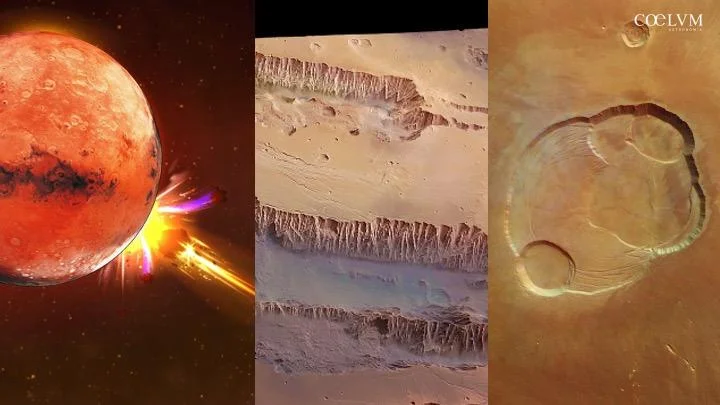
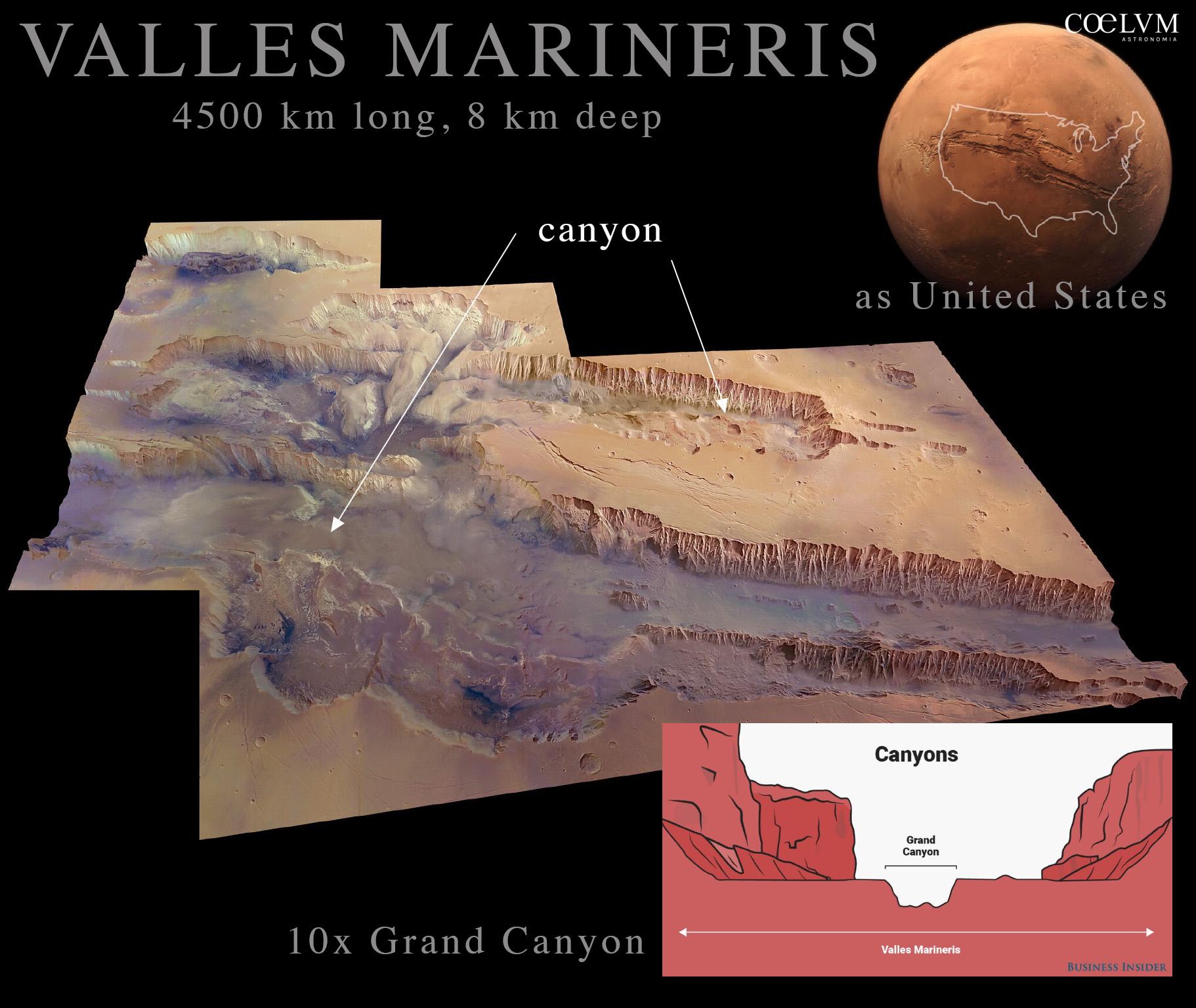
Valles Marineris is one of the distinctive features of Mars' surface, formed by an interconnected canyon system that is 4,000 km long and 8 km deep. Although its origin is linked to the volcanic province of Tharsis that looms above it, liquid water has played an important role in shaping its interior and likely also in giving rise to the spectacular Martian landslides that run down the steep slopes of these crevices, the most studied by planetary geologists.
Tharsis: The Supervolcano Province
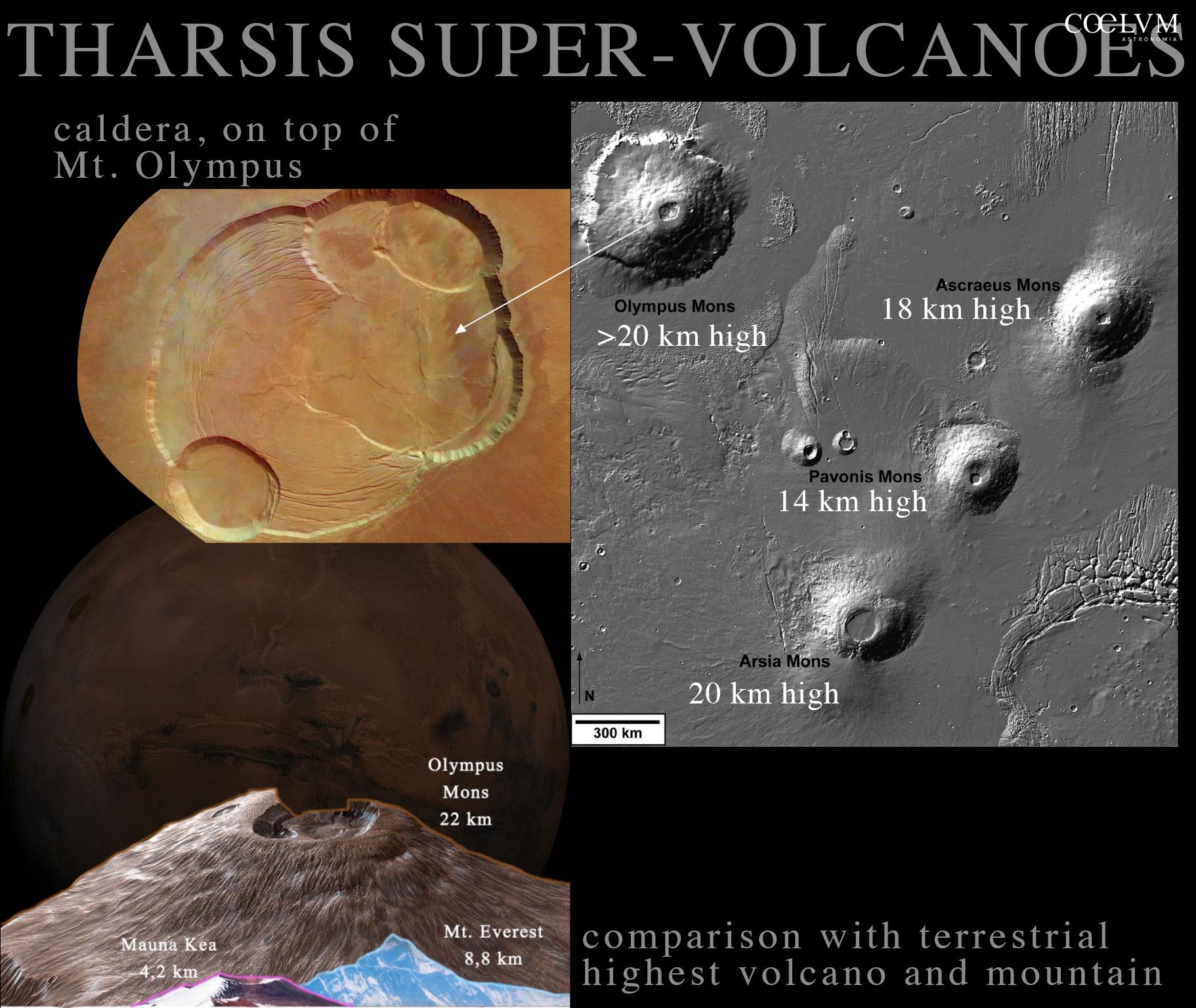
During the Noachian and Hesperian eras, Mars was a geologically very active planet, especially in terms of volcanoes. In the Tharsis region, the largest igneous province in the Solar System, there is an incredible quartet: their names are Ascreus, Pavonis, and Arsia Montes, and they are enormous shield volcanoes, with diameters ranging from 100 to over 300 km and heights of several kilometers. Among them, however, stands out Olympus Mons, the largest volcano in the entire Solar System, approximately 600 km wide and about 22 km high. To get an idea of its imposing size, taking Mount Vesuvius (about 1.2 km high) as a reference, we would need to multiply it almost 20 times before reaching a height comparable to that of the Martian supervolcanoes.
Hellas Planitia: A Planetary Catastrophe
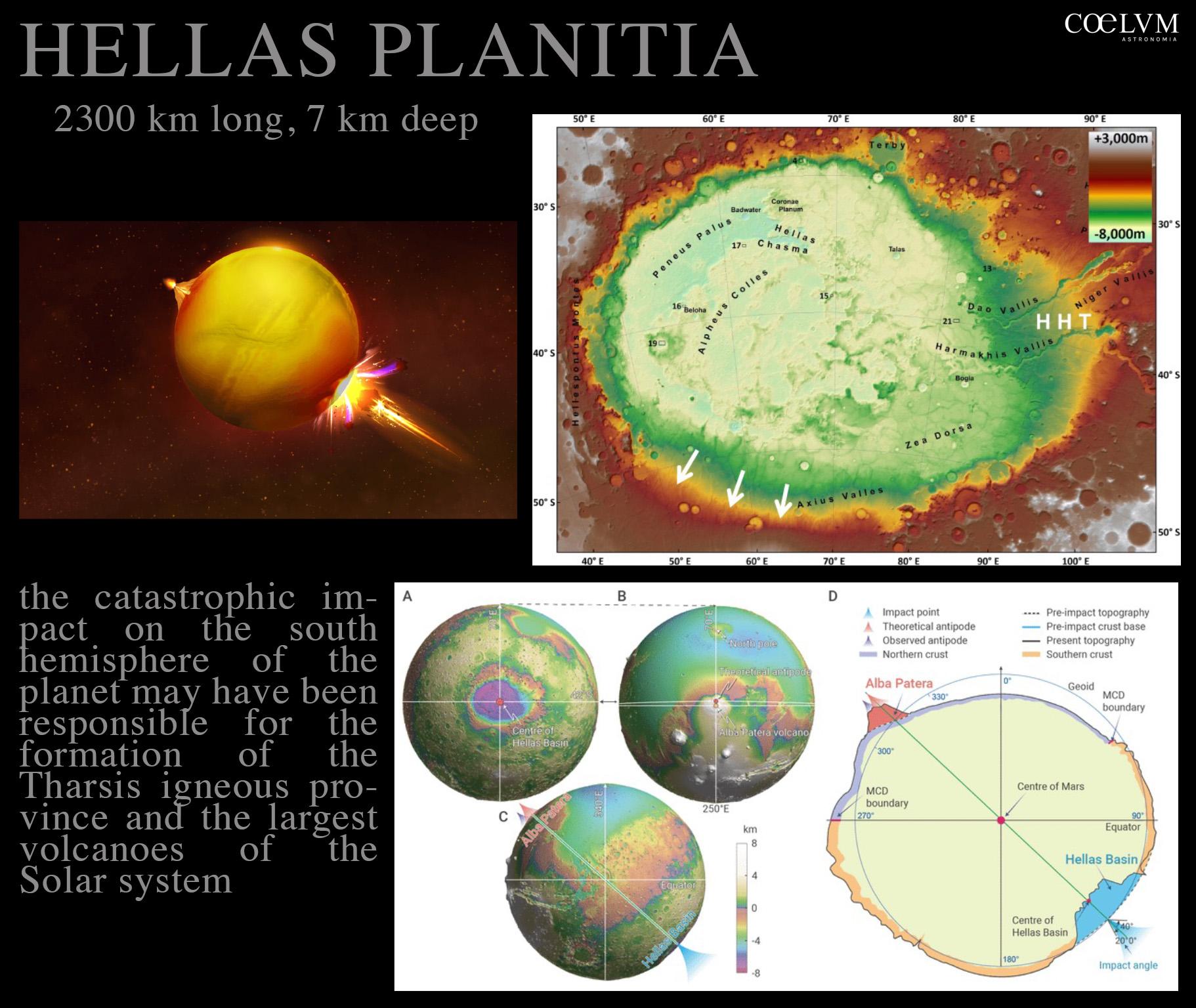
In the southern hemisphere of the Red Planet, a deep and prominent scar occupies the ancient plateaus of the Tyrrhena and Noachis Terrae regions. It is a witness to a meteoritic impact that occurred in the early days of our Solar System's formation (~ 4 billion years ago), possibly caused by a meteorite over 100 km in diameter! Hellas Planitia is a plain about 7 km deep and 2,300 km wide. Reconstructing the consequences of such an event, scientists have hypothesized that the formation of the Tharsis supervolcanoes is linked to the crustal weakening caused by the cataclysm that formed Hellas.
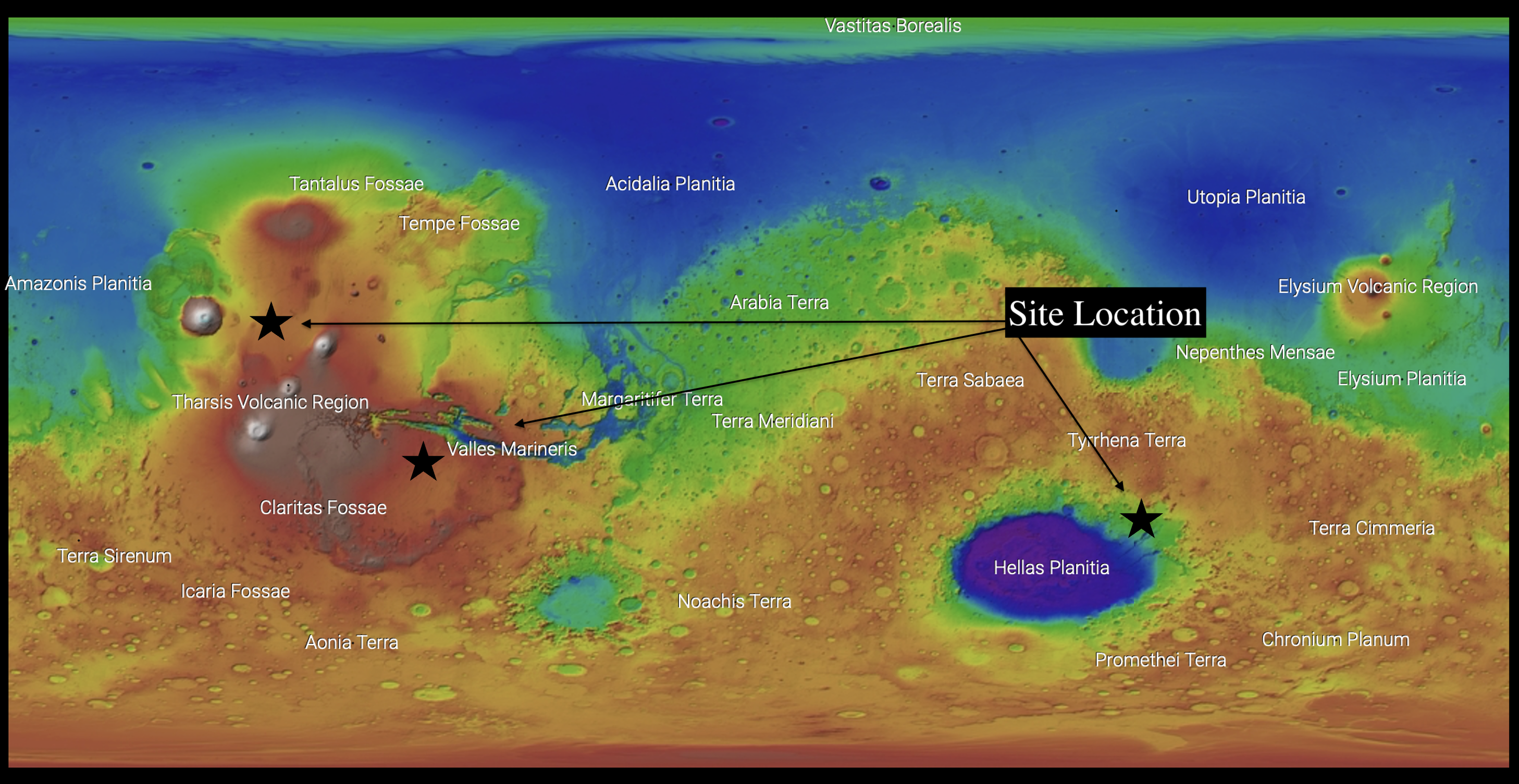
These are just some of the breathtaking geological structures that can be found on Mars, the most studied planet in the Solar System. However, many mysteries remain to be unveiled regarding its past and evolutionary history.
.