June 26 - The Galaxy Pair M81 & M82
The galaxy pair Messier 81 and Messier 82, known as Bode's Galaxy and the Cigar Galaxy, is among the most spectacular deep-sky objects visible in the northern night sky.

Overview
The galaxy pair Messier 81 and Messier 82, also known as Bode's Galaxy and the Cigar Galaxy, ranks among the most spectacular and frequently observed deep-sky objects in the northern hemisphere. Located in the constellation Ursa Major, these two disparate neighbors are circumpolar for observers in Central Europe, allowing for year-round visibility. While M81 presents itself as a classic, majestic spiral galaxy, M82 is characterized as an extremely dynamic starburst galaxy, making this duo one of the most contrasting pairs in the universe.
Location and Finding
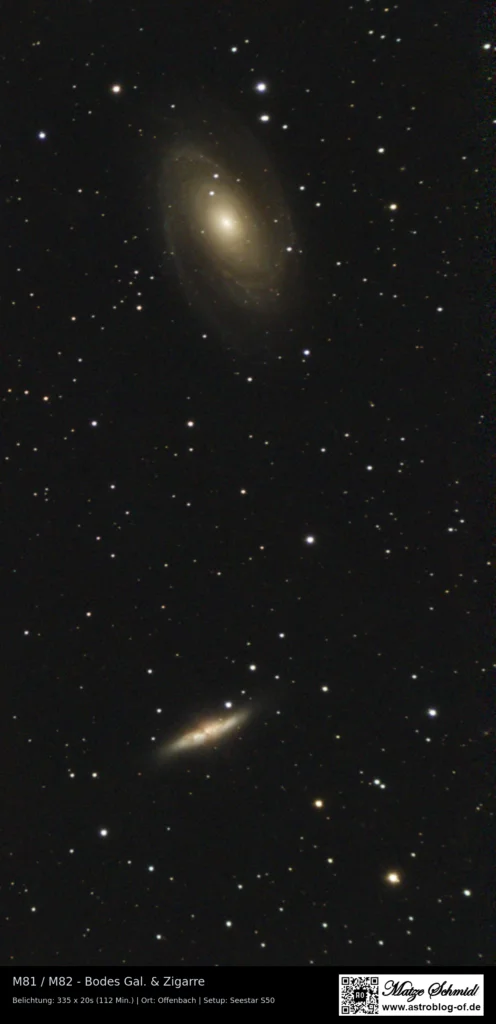
M81 and M82 are relatively easy to locate, situated near the prominent Big Dipper asterism. Although they do not lie directly in the line of the Dipper's stars, these stars serve as excellent guides.
To find M81 and M82, one can use Dubhe (Alpha Ursae Majoris), the northern pointer star of the Big Dipper, as a starting point. By following an imaginary line from Dubhe towards 23 Ursae Majoris, observers will reach the target area after about two-thirds of the distance. The galaxies are located slightly east of this line and near the star 24 Ursae Majoris. Even a small pair of binoculars will reveal M81 and M82 as two closely spaced nebula-like patches against a dark sky. Due to their small angular separation, both galaxies are typically visible together in the same field of view.
Observation
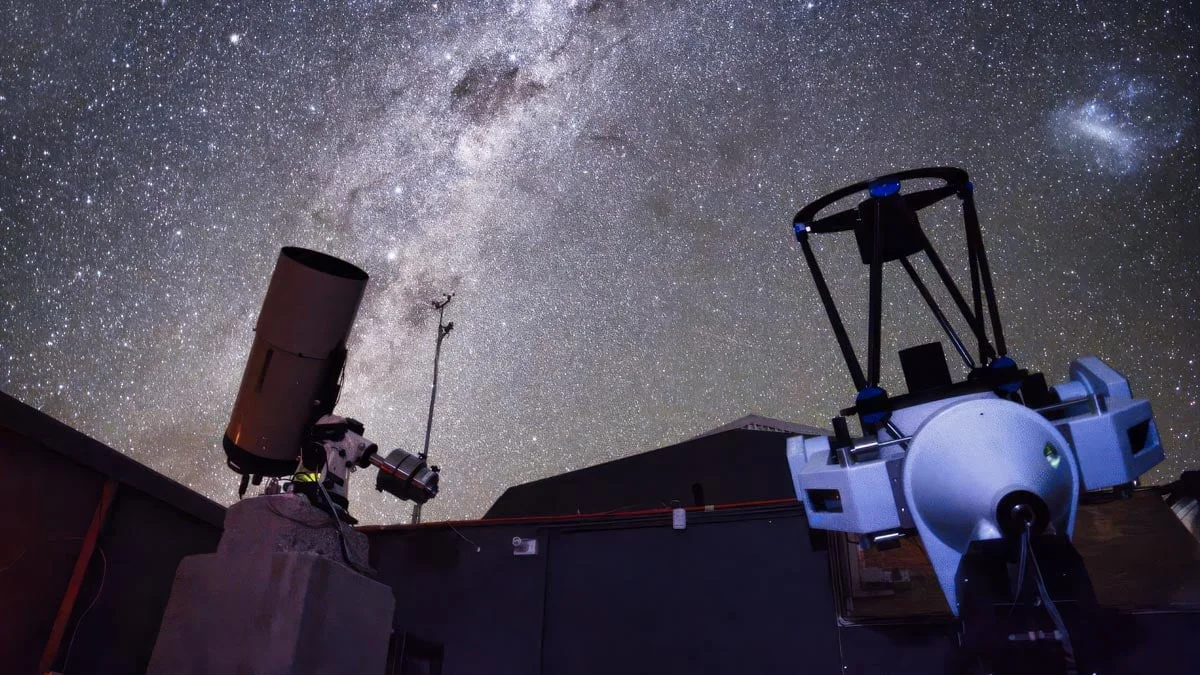
M81 and M82 are classic showcase objects for telescopes and binoculars of all sizes. Given their proximity of about half a degree, they offer an unforgettable view when observed at low to medium magnifications.
In smaller telescopes, M81 appears as a bright, oval nebula with a prominent, almost star-like center. M82, positioned right next to it, manifests as a narrow, elongated streak of light—resembling a cosmic cigar. In a 16-inch Dobsonian telescope under good transparency, the contrast becomes strikingly apparent: while M81's fine, expansive spiral arm structure floats in space, M82 reveals a turbulent, dust-laden structure crossing its center. This marked difference in appearance grants the pair a beautiful visual dynamism.
Background and Facts
Contrary to their apparent proximity, M81 and M82 form a genuine, physically interacting galaxy pair. They are approximately 12 million light-years away and constitute the core of the M81 galaxy group, one of the nearest galaxy groups outside our Local Group.
The two galaxies had a close encounter a few hundred million years ago, during which immense gravitational forces triggered an extreme wave of star formation, known as a starburst, in M82. This galaxy is currently consuming its gas reserves at an extraordinary rate. Both objects were discovered on the same evening, December 31, 1774, by the German astronomer Johann Elert Bode, after whom M81 is still named today.
Conclusion
This galaxy pair is an absolute highlight of the night sky and rarely disappoints. Thanks to well-known orientation stars, they are easy to find, require no expensive equipment, and offer an unforgettable view even through small optics. The direct comparison between a perfect spiral and a chaotic starburst galaxy makes this duo an ideal showcase object for both beginners and advanced observers alike.