Webb Telescope Reveals New Details of the Lion Nebula
The James Webb Space Telescope has captured a detailed view of the Lion Nebula (NGC 2392), revealing intricate structures and the effects of a dying star at its center.
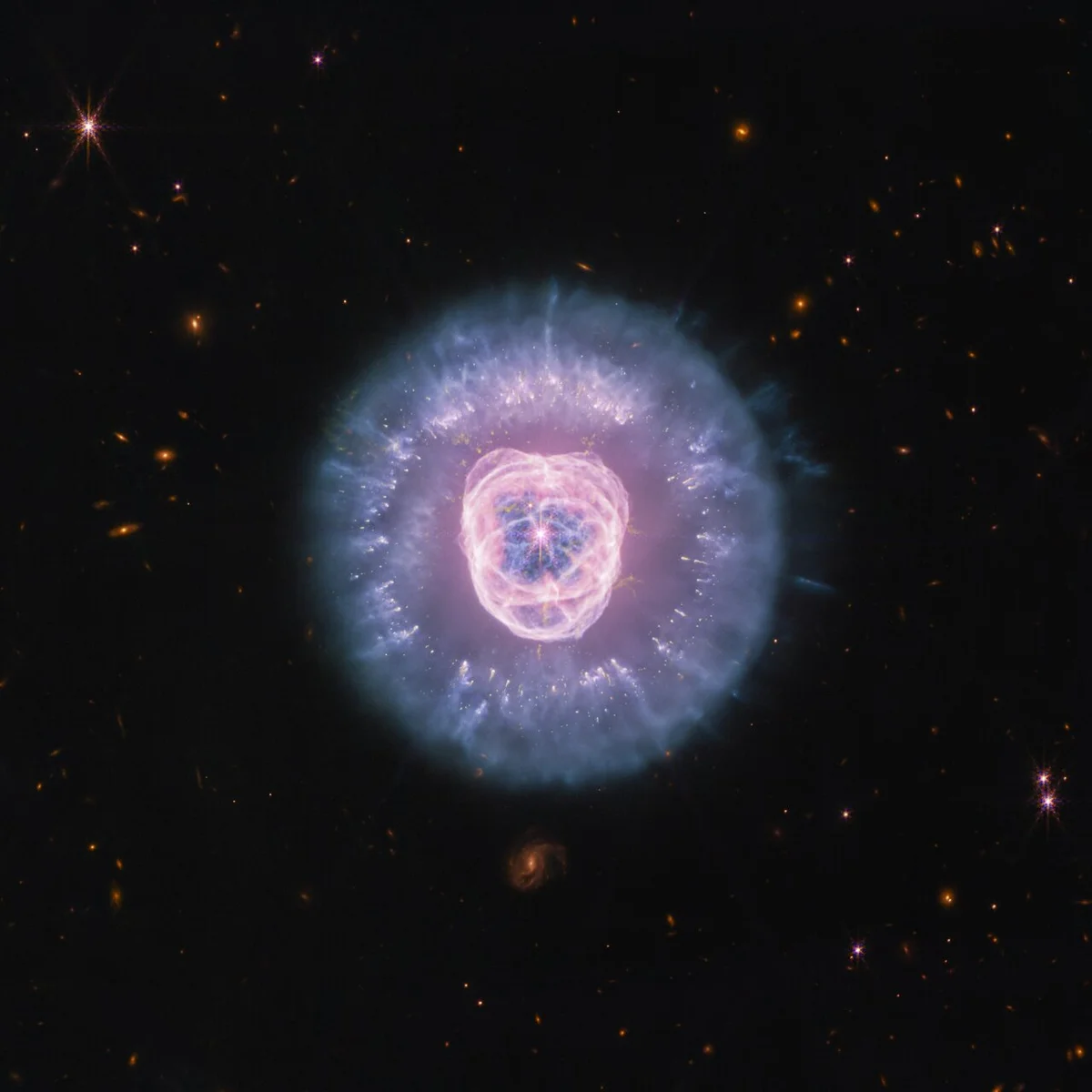
The Hubble Space Telescope, a joint project of NASA and ESA, previously captured the Lion Nebula, known as NGC 2392, in visible light back in 2000. At that time, features resembling a lion's mane, formed by nebulous, comet-like objects, were observed. However, the James Webb Space Telescope (JWST) has now provided a clearer and more detailed view of this planetary nebula through its advanced imaging capabilities.
While the overall structure of the nebula appears somewhat similar in Webb's infrared images—taken with both the Near Infrared Camera (NIRCam) and the Mid-Infrared Instrument (MIRI)—to Hubble's earlier visible light observations, Webb's infrared perspective brings out features such as compact dust clumps and a veil of ionized gas. This accumulation of gas and dust has taken thousands of years to form its current shape, and the nebula's components continue to evolve.
The ongoing changes and the nebula's distinctive appearance are driven by the remnants of a dying star at its center. Although it resembles a lion's snout, the energy and radiation emitted by this central star nourish the complex structures visible in the nebula.
Massive stars end their lives in spectacular supernova explosions, but such events are rare. Most stars in the universe have lower masses, like the one found in NGC 2392. When a lower-mass star can no longer sustain itself through internal nuclear reactions, it becomes unstable and pulsates, shedding its outer layers. These layers transform into shells of gas and dust, which are referred to as planetary nebulae. Stars in this phase produce a significant portion of the observable dust in the universe. The radiation from the star pushes the expelled material outward, leaving behind an extremely hot stellar core known as a white dwarf.
In the case of the Lion Nebula, the death of its oxygen-rich central star has left behind a white dwarf that heats the surrounding material, creating a bubble of ionized gas. This gas bubble forms the lion's face and expands over time, destroying dust that obstructs its path. The complexity of the gas structure, characterized by rings and shells—a common feature of planetary nebulae—remains a subject of ongoing research.
The mane of the lion represents the inner part of a dust shell illuminated by the central white dwarf. The clumps of material, resembling comet tails, are compact dust aggregates that have withstood the radiation from the stellar core, protecting the material behind them.
Webb's images effectively "freeze" this planetary nebula in time, even as the star's death and its turbulent aftermath continue. NGC 2392 is expected to change further as its gas and dust move away from the stellar core. Astronomers estimate that the "Lion" will eventually dissolve in approximately 10,000 years—a relatively brief period on astronomical timescales.
Background Information
The James Webb Space Telescope is the largest and most powerful telescope ever launched into space. Under an international cooperation agreement, ESA provided the launch service for the telescope using an Ariane 5 rocket. In collaboration with partners, ESA was responsible for the development and qualification of the Ariane 5 adaptations for the Webb mission, as well as securing the launch service through Arianespace. Additionally, ESA provided the main spectrograph NIRSpec and 50% of the MIRI instrument, which was developed and constructed by a consortium of publicly funded European institutes in collaboration with JPL and the University of Arizona.
Webb represents an international partnership between NASA, ESA, and the Canadian Space Agency (CSA).
Image Credit: NASA, ESA, CSA, STScI. Image Processing: A. Pagan (STScI).