Venus: The Infernal Planet That May Have Once Hosted Oceans
A new study suggests that Venus, today a scorching and inhospitable world, may have once hosted oceans covering about 90% of its surface before being engulfed by a runaway greenhouse effect.
New Research Suggests Venus May Have Once Harbored Oceans Covering 90% of Its Surface
A recent study indicates that Venus, known today for its extreme heat and hostile conditions, might have supported oceans across about 90% of its surface before succumbing to an uncontrollable greenhouse effect.
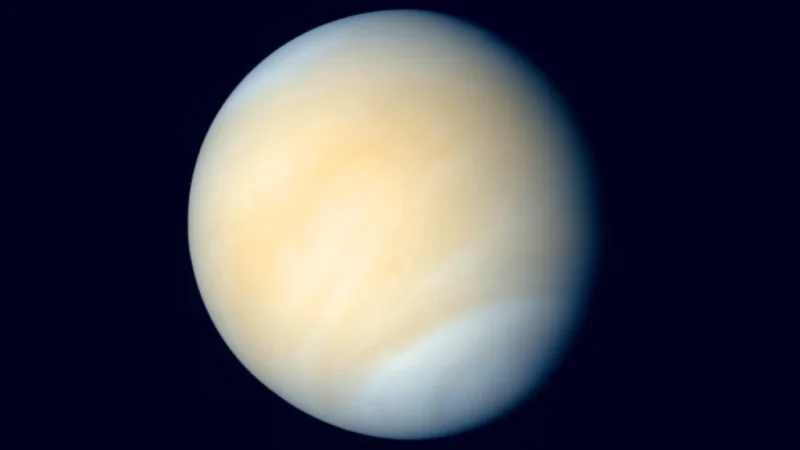
Few planets in the Solar System resemble Earth as closely as Venus, yet they are also starkly different. While Earth is abundant in liquid water and teeming with life, Venus presents itself as its dark twin: with temperatures high enough to melt lead, crushing atmospheric pressure, and clouds composed of carbon dioxide that rain sulfuric acid. Despite these differences, both planets share similar dimensions, densities, and mineral compositions, leading scientists to ponder whether Venus once was a water-rich planet.
Geological Evidence of Lost Seas
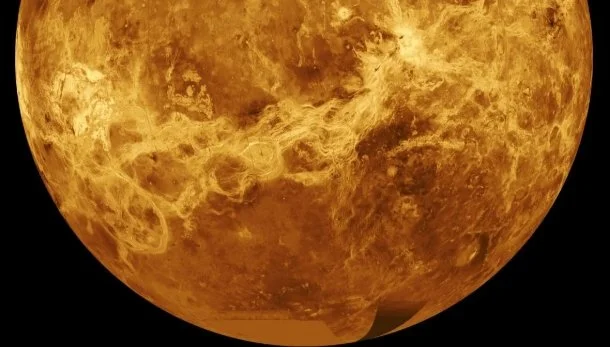
A study published in Earth & Planetary Science Letters, led by geologist Richard Ghail from the University of London, posits that the surface of Venus still bears the marks of ancient oceans, which may have once harbored life. The research team estimates that water could have covered around 90% of the planet's surface, with a volume equivalent to approximately 40% of Earth's oceans. Much of the existing data on Venus comes from NASA's Magellan spacecraft, which mapped the planet using radar in the 1990s, revealing a landscape dominated by intense volcanism, with over 85,000 volcanic structures identified so far. Researchers have questioned whether some of these formations, traditionally attributed to volcanic activity, might actually have marine origins.
Three Clues Indicating the Presence of Water
The first clue involves vast expanses marked by giant polygonal networks. While these fractures were previously explained as a result of cooling volcanic rock, the team suggests that they resemble polygonal fault systems found on Earth’s ocean floors, formed when thick layers of mud compact and lose water over time.
The second clue comes from the massive channels known as Venusian channels, which have typically been interpreted as lava flows. However, some extend for thousands of kilometers, a distance challenging to justify with lava alone. The authors of the study propose that these channels resemble submarine channels carved by dense currents, a theory supported by the fact that many emerge from plains without clear volcanic origins and terminate in deeper basins.
The third clue pertains to the rippled ridges that dot the lowlands of Venus, which could cover thick layers of salt left behind by the evaporation of ancient oceans, akin to processes that occurred in Earth’s Mediterranean during the Messinian Salinity Crisis around 5.5 million years ago.
A Hypothesis Still to Be Validated
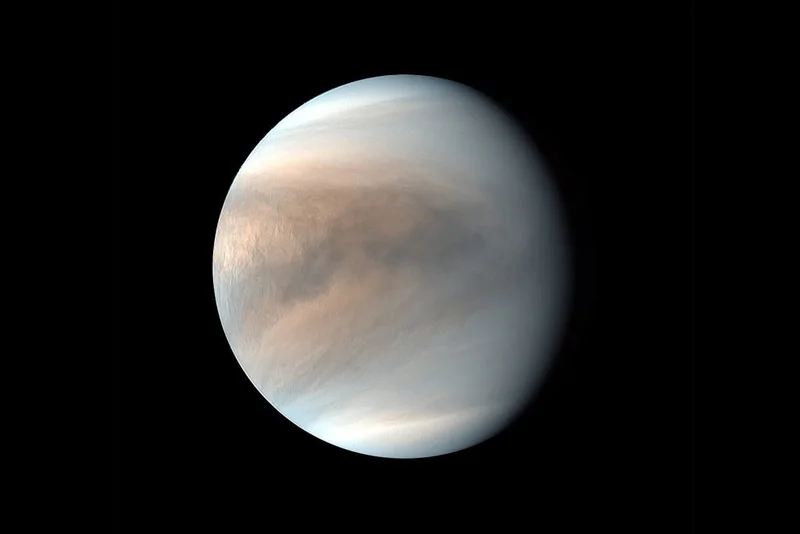
None of these three clues are definitive on their own; each could arise from alternative volcanic or tectonic processes. However, taken together, they paint a picture of a world that might have once hosted oceans before being overwhelmed less than a billion years ago by an uncontrolled greenhouse effect. Upcoming missions, such as ESA's EnVision and NASA's VERITAS, both aimed at mapping Venus with significantly greater precision than Magellan, could provide the necessary data to confirm or refute this intriguing hypothesis.
Source:
- https://www.sciencedirect.com/science/article/pii/S0012821X2600436X?via%3Dihub