The Illusion of Celestial Wonders: Disappointments in Cometary Predictions
Exploring the disappointments surrounding comet predictions, focusing on C/2025 F2 (SWAN) and its place in a history of failed celestial spectacles.

In the realm of astronomy, comets have long captivated human imagination, embodying both awe and trepidation. The recent case of comet C/2025 F2 (SWAN) exemplifies a pattern of inflated expectations surrounding these celestial bodies, often leading to disappointment.
 Historically, comets have been interpreted as omens or harbingers of doom, but today they are subjects of scientific inquiry and public fascination. Their sudden appearances, distinctive tails, and ephemeral nature continue to inspire wonder.
However, in the digital age, this fascination has been compounded by a recurring and often misleading phenomenon: the media hype cycle. Every promising comet discovery ignites a wave of excitement, with sensational headlines dubbing them as the next "Christmas Comet," "Easter Comet," or even the more grandiose "Comet of the Century." This sensational narrative frequently clashes with observational reality, resulting in spectacles that fall far short of expectations, comets that are barely visible, or, in some instances, those that disintegrate before reaching their anticipated peak.
The comet C/2025 F2 (SWAN) is a recent illustration of this cycle. Initially heralded as a potential springtime spectacle, its trajectory took an unexpected turn, leading to its probable disintegration as it approached the Sun. This brief story encapsulates the gap between media-generated expectations and the complex, often unpredictable nature of these celestial visitors.
This article examines the case of C/2025 F2 (SWAN) within the broader context of other "failed" comets, shedding light on the scientific reasons behind their unpredictability and the factors affecting their visibility, often overlooked in mainstream communication. It critiques the role of media hype and clickbait tactics in creating unrealistic expectations, only to pivot at the last moment, ignoring crucial elements like actual visibility windows. The ultimate goal is to equip readers with tools to interpret future comet news with a more critical and informed perspective, appreciating these celestial wanderers for their true nature, beyond sensational promises.
The core issue lies not only in the inherent unpredictability of comets but also in the amplifying effect of modern media, particularly online platforms and social networks. These channels disproportionately disseminate the most optimistic scenarios, often based on preliminary and uncertain data, generating expectations that far exceed the likely reality. The speed at which these sensational narratives spread vastly outpaces the more cautious and nuanced scientific communication that considers probabilities, uncertainties, and observational challenges.
The Case Study: The Brief Life of Comet C/2025 F2 (SWAN)
The narrative of C/2025 F2 (SWAN) serves as a poignant example of the discovery, expectation, and disillusionment cycle that often accompanies these celestial objects in the age of instant information.
Discovery and Designation
Discovered in late March 2025 by three amateur astronomers analyzing data from the SWAN instrument aboard the SOHO spacecraft, C/2025 F2 (SWAN) was designated based on pre-discovery images dating back to September 2024. Its nearly parabolic orbit suggested a source from the Oort Cloud, with an inbound orbital period of approximately 81,000 years and a close approach to the Sun at 0.333 AU.
Initially bright at magnitude 11, it quickly rose to 8.6, fueling optimistic predictions that it would be visible to the naked eye near its predicted perihelion on May 1, 2025. However, its low elevation in the sky during morning and evening made observation difficult. By mid-April, the comet ceased to brighten, starting to fade and showing changes in morphology.
The most plausible interpretation is that the comet began to disintegrate during an outburst in early April, due to intense thermal stress and tidal forces from its close passage to the Sun.
The Science Behind the Disappointment
The disintegration of C/2025 F2 (SWAN) is not surprising scientifically, given its trajectory. The close approach to the Sun subjected it to extreme thermal stress and strong gravitational tidal forces. Comets originating from the Oort Cloud are often on their first (or one of the first) passes through the inner Solar System. Their nuclei, composed of a mix of volatile ices (water, CO2, CO, etc.) and dust, may not be structurally cohesive enough to withstand such extreme conditions. Rapid heating, violent sublimation, and gravitational forces can easily lead to fragmentation. Once disintegration is confirmed, the comet's designation changes to D/2025 F2, where "D" stands for "disappeared" or "defunct."
A History of Disappointments: The 'Failed' Comets
The saga of C/2025 F2 (SWAN) is not an isolated incident but part of a long history of comets that, despite being announced with great media fanfare, failed to deliver the promised celestial spectacle.
The Archetype of the 'Flop': Comet Kohoutek (C/1973 E1)
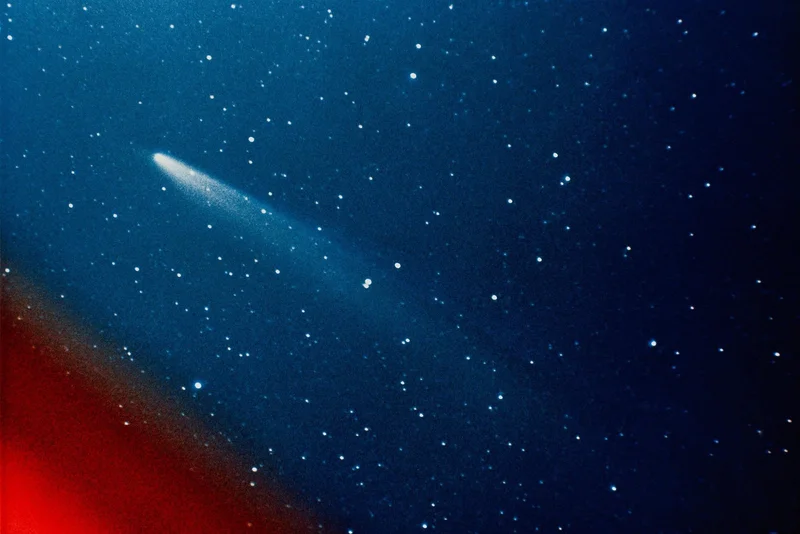 The comet Kohoutek (C/1973 E1) is perhaps the most famous example of this phenomenon. Discovered in March 1973 by Czech astronomer Luboš Kohoutek while still far from the Sun, its initial intrinsic brightness appeared exceptionally high for that distance, leading astronomers to extrapolate an extremely optimistic prediction that it would become one of the brightest comets of the 20th century, potentially visible even during the day.
Media outlets eagerly embraced these predictions, dubbing it the "Comet of the Century" and igniting fervent anticipation among the public. Scientific and popular magazines featured it on their covers, special cruises were organized for viewing (with Kohoutek himself aboard, suffering from seasickness), and sales of telescopes and binoculars surged.
The reality, however, was quite different. Kohoutek reached its theoretical peak brightness during perihelion at the end of December 1973, but at that point, it was too close to the Sun to be observed from Earth, except by space-based instruments like those aboard the Skylab. When it reemerged from solar glare in January 1974, its brightness for Earth observers peaked between magnitude 0 and 4, far below initial predictions (which had estimated peaks of up to -10). It quickly became invisible to the naked eye, earning nicknames like "Comet Ko-flop-tek" or "the Edsel of the sky," becoming synonymous with spectacular disappointment.
The most accepted scientific explanation for Kohoutek's behavior is that it was a "new" comet, on its first close pass to the Sun, likely covered by a layer of extremely volatile materials (like frozen nitrogen or carbon monoxide) that sublimated rapidly even at a great distance from the Sun, giving it an initially deceptive brightness. Once this surface layer was depleted, the comet's activity diminished drastically, failing to meet expectations. Despite its media "flop," Kohoutek proved scientifically valuable: it became the most studied comet at that time and allowed for the first detection of complex molecules like methyl cyanide and hydrogen cyanide.
Recent Déjà Vu: ISON (C/2012 S1) and ATLAS (C/2019 Y4)
The pattern has repeated itself multiple times in recent years:
Comet ISON (C/2012 S1) was discovered in 2012, also from a great distance, and was quickly labeled as a potential "Comet of the Century." Its trajectory classified it as a "sungrazer," a comet destined to skim the solar surface (perihelion at just 0.012 AU, about 1.8 million km). The hype was enormous, fueled by predictions that it would become as bright as a full moon. However, months before perihelion, its brightness increase unexpectedly slowed. Despite many scientists expressing uncertainties, the media narrative remained largely optimistic. Ultimately, ISON did not survive its close passage to the Sun in November 2013, disintegrating completely and leaving behind only a trail of debris.
Comet ATLAS (C/2019 Y4) showed a rapid brightness increase in early 2020, raising hopes for a remarkable display. However, as with previous comets, reality proved more complex, leading to yet another disappointment for skywatchers.
The recurring theme of these cometary tales underscores the necessity for a more nuanced understanding of celestial phenomena, emphasizing the importance of tempering expectations with scientific realities.