Halley's Comet: A Journey Through Time
Halley's Comet, officially known as 1P/Halley, is a large and bright comet that orbits the Sun every 75-76 years. It is one of the best-known short-period comets, with its next appearance expected in 2061.
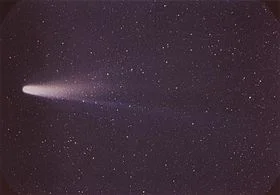
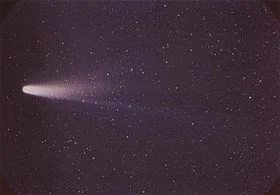
Halley's Comet, officially known as 1P/Halley, is a prominent and luminous comet that completes its orbit around the Sun approximately every 75 to 76 years, although this orbital period can vary between 74 and 79 years. It stands out as one of the most well-documented and brightest short-period comets originating from the Kuiper Belt. The last sighting occurred in 1986, with its next anticipated appearance expected in 2061. Despite the existence of other brighter comets, Halley's is unique as the only short-period comet visible to the naked eye, making it a significant subject of historical records.
The comet was the first to be identified as periodic, with its orbit calculated by astronomer Edmund Halley in 1705. Historical observations trace back to 1472 when it was noted by German astronomer Johann Müller Regiomontano, and earlier records suggest it was first observed in 239 B.C.
Edmund Halley compared the characteristics of the comet with those described in 1682, as well as with observations from 1531 by Petrus Apianus and 1607 by Johannes Kepler in Prague. He concluded that these sightings referred to the same celestial object, returning every 76 years. Halley estimated its orbit and predicted its return for 1757; however, this prediction was not entirely accurate, as the comet was not seen until December 25, 1758, by amateur astronomer Johann Georg Palitzsch. The gravitational influences of Jupiter and Saturn delayed its return, and Halley himself did not witness this event, having passed away in 1742.
In 1986, several space probes, including Vega 1 and 2, Giotto, Suisei (or PLANET-A), Sakigake, and ISEE-3/ICE, encountered Halley's Comet, providing invaluable data about its composition and structure.
Comets are believed to have two distinct origins within our Solar System: the Kuiper Belt, a flat, icy disc of stellar debris located about 50 astronomical units (AU) from the Sun, and the Oort Cloud, a spherical shell of cometary bodies with its inner edge around 50,000 AU. Short-period comets, which take less than 200 years to complete their orbits, typically originate from the Kuiper Belt, while long-period comets, like Hale-Bopp, with orbits spanning thousands of years, are thought to come from the Oort Cloud. Halley's Comet is an anomaly as it is classified as a short-period comet, yet its origin is traced back to the Oort Cloud rather than the Kuiper Belt. Its orbit suggests it was originally a long-period comet that was captured by the gravitational pull of the gas giants, resulting in its entrapment within the inner Solar System.
The orbit of Halley's Comet is highly elliptical, with one focus located at the Sun. Its closest approach to the Sun, known as perihelion, is 0.6 AU, situated between the orbits of Mercury and Venus, while its farthest point, or aphelion, reaches 35.3 AU, nearly the distance of Pluto's orbit. Interestingly, among Solar System objects, Halley's orbit is retrograde, meaning it travels in the opposite direction to the planets, with an inclination of 18 degrees relative to the ecliptic.
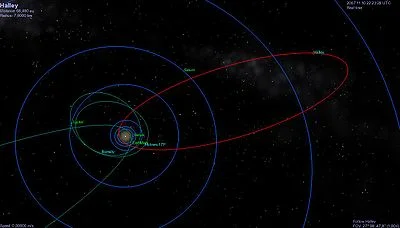
Although not clearly visible, the red ellipse represents the comet's orbit in relation to that of the planets.