Exploring Pluto's Mountains: A Journey Over 6 Billion Kilometers from Earth
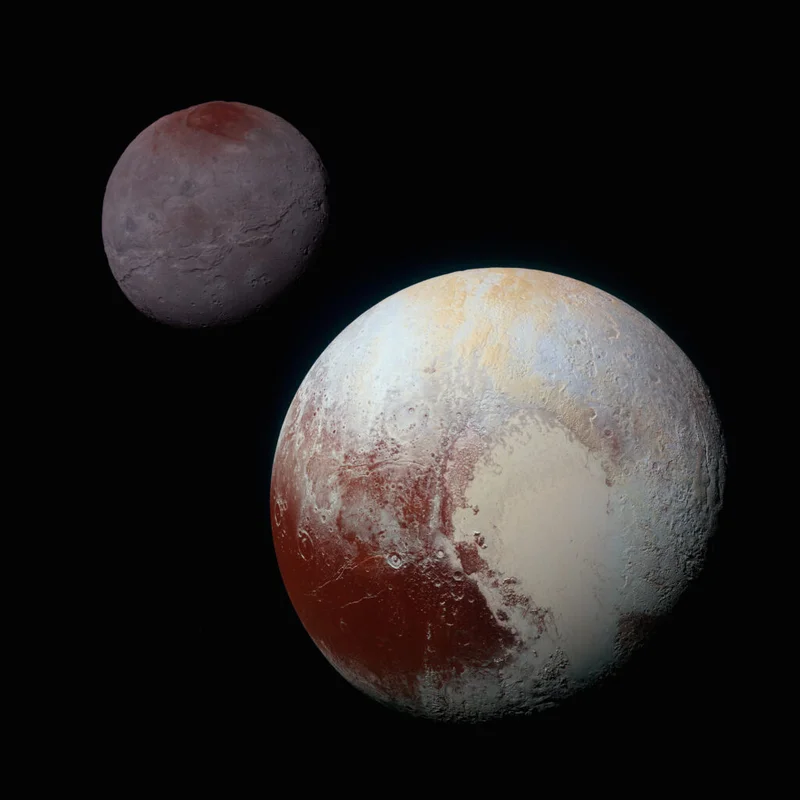
NASA's New Horizons spacecraft provided stunning images of Pluto during its 2015 flyby, revealing the dwarf planet's complex geology and its largest moon, Charon.

In a remarkable achievement for space exploration, NASA's New Horizons spacecraft made its historic flyby of Pluto on July 14, 2015, delivering stunning images and data that have significantly expanded our understanding of this distant dwarf planet. The spacecraft's wide-angle Ralph/Multispectral Visual Imaging Camera (MVIC) captured breathtaking views of Pluto's mountainous landscapes, illuminated beautifully by sunlight.
Surface Features of Pluto
The imagery highlights the diverse terrain of the dwarf planet, showcasing its extensive atmosphere. The captured scene spans approximately 1,250 kilometers in diameter, providing a spectacular aerial view from over 6 billion kilometers away from Earth.
The Flyby of Pluto
The New Horizons mission culminated a decade-long quest to observe and understand the farthest planet in our solar system. However, the flyby was just the beginning, revealing the potential complexity of small planetary systems, or dwarf planets, in the Kuiper Belt. Equipped with seven scientific instruments, New Horizons collected over 50 gigabytes of data during its approach, passage, and departure from Pluto. The findings indicated that Pluto is a geologically and meteorologically active world, with its size and density determined to be greater than previous Earth-based estimates.
For more insights, see our detailed exploration of why Pluto was reclassified as a dwarf planet.
Charon: Pluto's Largest Moon
Pluto's largest moon, Charon, boasts a radius of approximately 606 kilometers, making it about half the size of Pluto itself. This unique moon is the largest known satellite relative to its parent body, completing an orbit around Pluto every 6.4 Earth days. The Pluto-Charon system is the only known double planetary system in our solar system. Charon is tidally locked to Pluto, always showing the same face to its parent planet, akin to how the Earth’s Moon behaves. However, unlike our Moon, Charon resides in a geostationary orbit, appearing stationary in Pluto's sky due to the phenomenon known as tidal locking.