The Crucial Role of Magnetospheres in the Architecture of Jupiter and Saturn's Moons
A new study explores the differences in the satellite systems of Jupiter and Saturn, revealing how magnetospheres influence their formation and architecture.
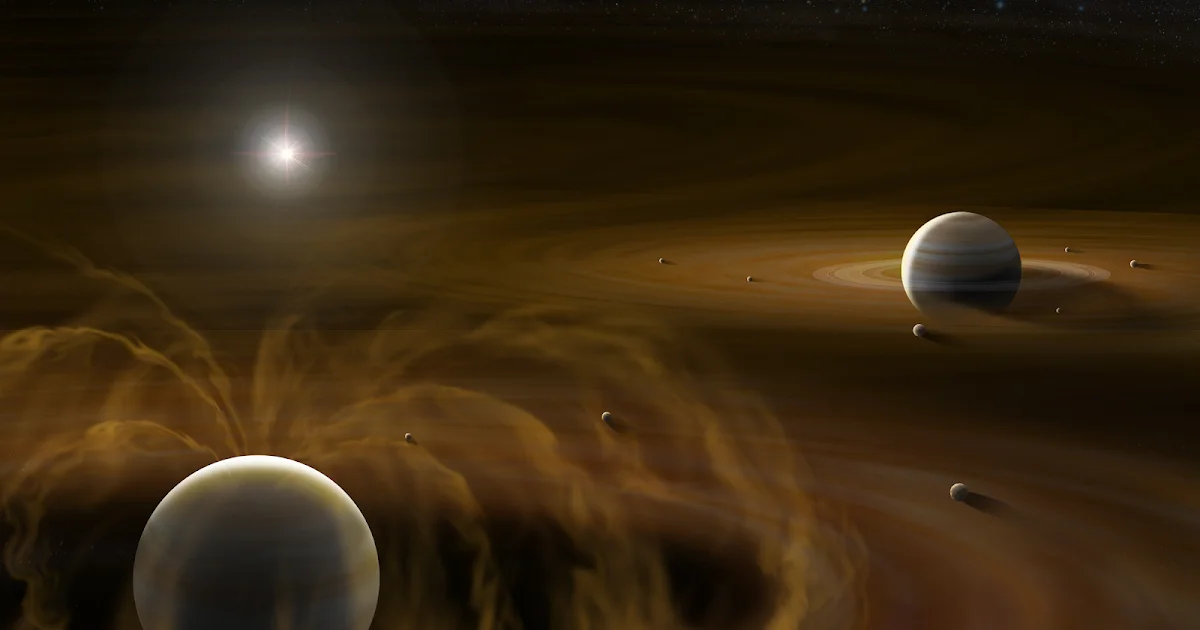
The morphological diversity of the satellite systems around Jupiter and Saturn is striking. While Jupiter boasts four large moons—Ganymede, Io, Callisto, and Europa—Saturn's architecture is dominated by a single massive moon, Titan. A collaborative study by Chinese and Japanese researchers has uncovered a potential explanation for this disparity, with their findings published in Nature Astronomy.
The gas giants Jupiter and Saturn host the most complex and densely packed satellite systems known in our Solar System. Jupiter is home to over a hundred objects, while Saturn has more than 280, all within a dynamic environment that includes its intricate ring system.
The structural differences between these two systems present a significant challenge in planetary science. Despite the similar gaseous nature of both giant planets, the traditional paradigms of satellite formation are being reevaluated in light of recent studies exploring the interactions between stellar and planetary magnetic fields and circumplanetary disks. A major theoretical friction point lies in the potential existence of a magnetospheric cavity within the accretion disk, which is the primordial material accumulation zone that governs satellite formation during the early stages of planetary development.
To propose a physically coherent model applicable to exoplanetary systems, Yuri I. Fujii from Kyoto University and his team undertook a multi-scale modeling approach of the systems of Jupiter and Saturn.
The researchers employed an integrated methodology that combined various techniques: simulations of internal structure, thermal evolution modeling, and dynamo activity of Jupiter and Saturn during their proto-giant phases, along with hydrodynamic simulations of circumplanetary disks. They also tracked the accretion and orbital migration of satellites through dynamic N-body simulations conducted on the high-performance computing cluster at the National Astronomical Observatory of Japan (NAOJ).
Fujii and his colleagues demonstrated that the differentiation of the Jupiter and Saturn systems directly results from the magnetic pressure exerted on their accretion disks. The intense magnetic field of young Jupiter created a robust magnetospheric cavity, acting as an "orbital trap" that halted the inward migration of proto-satellites, allowing for the stabilization of Io, Europa, and Ganymede.
In contrast, the weaker magnetosphere of young Saturn was unable to truncate the inner disk. Without a protective cavity, most forming satellites experienced uncontrolled migration into the planet, with the exception of those that survived in the outer regions or through specific resonance mechanisms.
This magnetic dichotomy hinges on the principle that if a planet's magnetic field is sufficiently strong (as with young Jupiter), it "pushes away" gas from the disk, creating a void of material between the planet's surface and the inner edge of the disk. It is in this "trap" that satellites cease their migration. When a satellite forms in a gaseous disk, it generates spiral density waves, and the gravitational interaction with these waves produces a torque that generally reduces the satellite's orbital energy, forcing it to migrate towards the planet.
However, at the edge of the magnetospheric cavity, the gas density profile abruptly reverses. This positive density gradient creates a compensatory torque (or corotation torque) that halts the migration.

For Saturn, the weaker magnetic field would have resulted in a truncation radius very close to the planet's surface. Consequently, satellites likely continued their migration without encountering a magnetic barrier, ultimately being "swallowed" by the giant planet, leaving only the material located farther out, from which Titan originated.
The difference in magnetic field intensity between the two giants at the time of their formation can be attributed to their internal thermal structures. The magnetic field is generated by a dynamo effect within metallic hydrogen layers. Jupiter's greater mass allows for higher internal pressure and temperature, maintaining a more extensive and stable conductive zone over a longer period than Saturn. This results in a powerful dipolar magnetic field during the early phases of satellite accretion.
These findings lay crucial theoretical groundwork for future detection of exomoons and observation of circumplanetary disks. The model's predictions suggest a direct correlation between a giant planet's mass (and thus its magnetic moment) and the configuration of its moons: Jovian-mass planets or larger tend to support compact and multiple systems, whereas Saturnian-mass planets are likely to have poorer systems, limited to one or two major satellites.
Extending this model to exomoon systems should enhance our understanding of the architectural diversity of distant planetary systems.