First Reliable Evidence of Magnetic Fields on Exoplanets
A team of astronomers has found the clearest evidence to date that some planets outside our solar system may exhibit magnetic fields, marking the first reliable detection of magnetism on exoplanets.
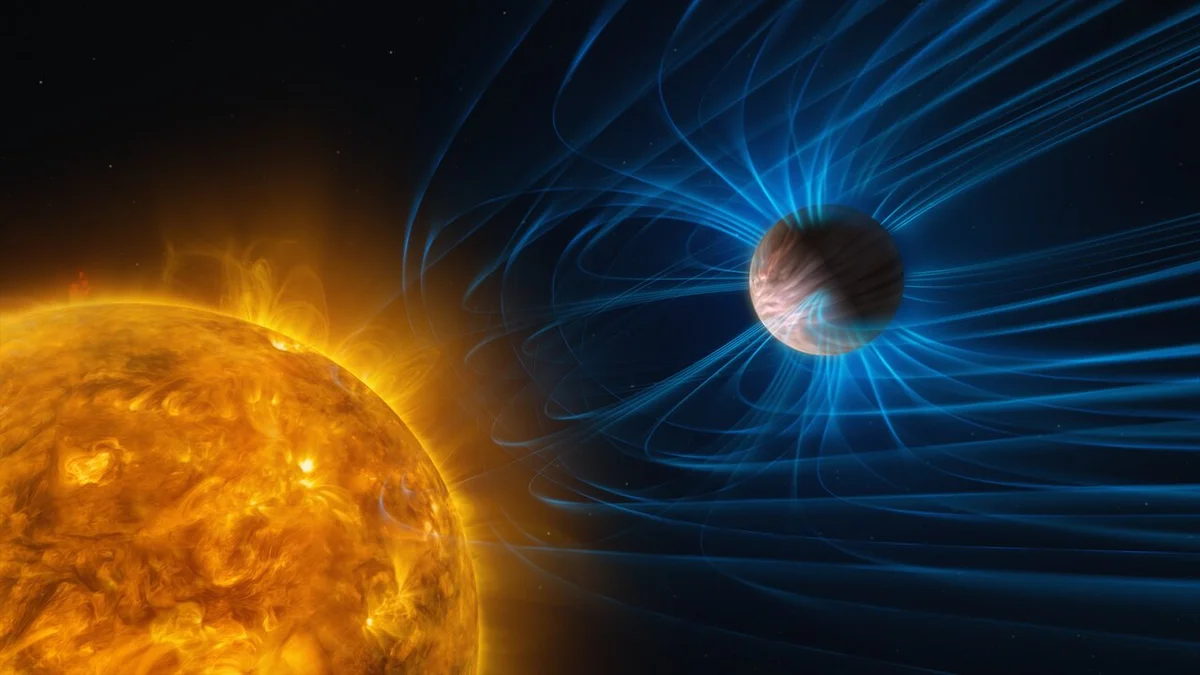
A team of astronomers has found the clearest evidence to date that some planets outside our solar system may exhibit magnetic fields. Using the Very Large Telescope (VLT) of the European Southern Observatory (ESO) and the Gemini North Telescope, the research team determined wind speeds on seven very hot, Jupiter-like exoplanets. The observations indicated that the winds on these planets are most likely influenced by magnetic fields. This marks the first reliable detection of magnetism on planets outside the solar system.
"This advancement opens entirely new perspectives for exoplanet research. For the first time, we can compare the magnetic fields of other worlds – a crucial step in ultimately understanding which planets may remain habitable, retain their water, and perhaps even host life as we know it,” says Julia Seidel, an astronomer at the Lagrange Laboratory, Côte d’Azur Observatory, France, and lead author of the study published today in Nature Astronomy.
The Earth's magnetic field affects our atmosphere in various ways and is therefore a critical factor in understanding what makes a planet habitable for life. Magnetic fields also exist on other planets in the solar system, such as Jupiter and Saturn. However, for the past 15 years, no one has succeeded in directly measuring the strength of magnetic fields of exoplanets – until now.
The team, however, did not aim to measure the magnetic field but rather the winds. They determined the wind speeds on seven exoplanets orbiting different stars: gas giants like Jupiter, whose rotation has been synchronized with their orbit by the tidal forces of their parent star and are located very close to it. Just as we always see only one side of the Moon, these planets always show one side to their star. This has resulted in a scorching hot day side and a frigid night side. This temperature difference creates a climate that is entirely different from that on our planet, characterized by extremely strong winds. The wind speeds in their sample ranged from about 7,200 km/h to over 25,000 km/h; for comparison, the fastest winds measured on Jupiter reach speeds of about 1,500 km/h.
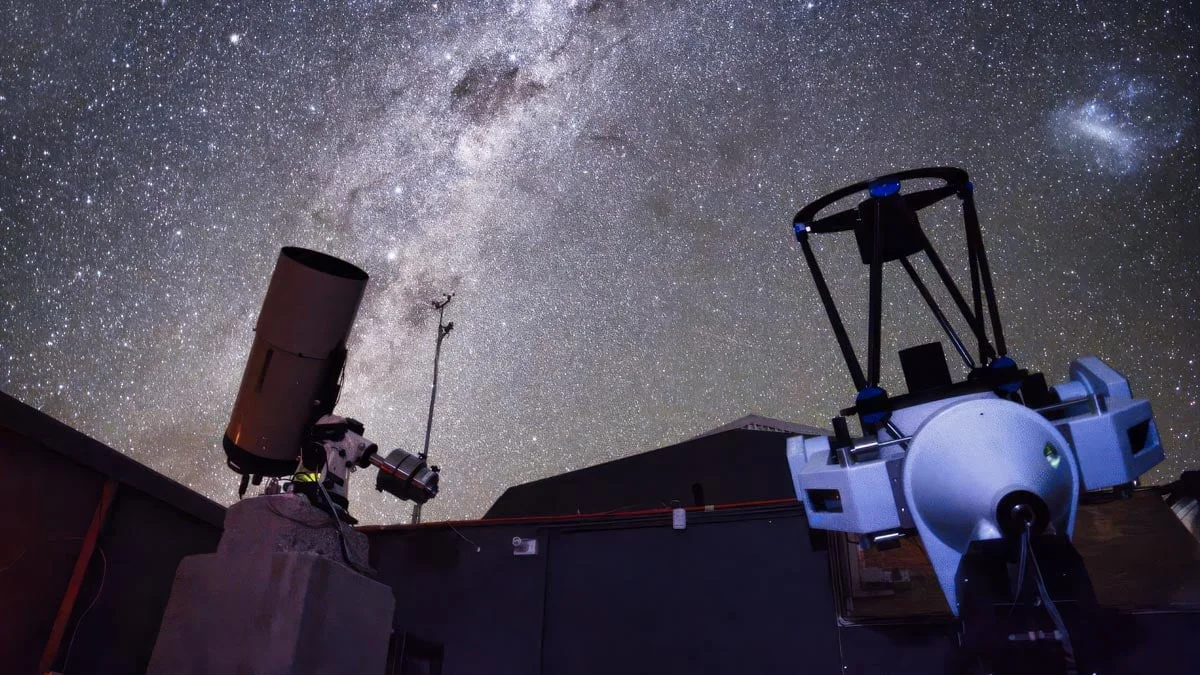
"Initially, we wanted to find out whether the atmospheric winds behave similarly on all hot planets,” explains Seidel, who previously worked as an astronomer at ESO in Chile. For their measurements, the team used data from the ESPRESSO instrument at the ESO's VLT in the Chilean Atacama Desert, as well as a similar instrument at the Gemini North Telescope in Hawaii, USA. (The VLT is a telescope of the ESO, while Gemini North is one half of the International Gemini Observatory, which is partially funded by the US National Science Foundation (NSF) and operated by NSF NOIRLab.)
However, when they investigated the dependency of wind speeds on planetary temperature, a very fascinating pattern emerged: the hotter the planet, the slower the wind. "This completely contradicts intuition, as under otherwise equal conditions, hot planets have more energy to accelerate the winds! Something must be slowing the wind on hotter objects,” says Vivien Parmentier, co-author of the study and professor at the Lagrange Laboratory.
The team concluded that the most plausible explanation for this puzzle is the presence of planetary magnetic fields, as they can act like a brake and slow down the movement of charged particles in the atmosphere. Based on the data, the researchers were able to derive the strength of the magnetic field on each of the studied planets. They found that these strengths are comparable to those in our solar system: about four times stronger than that of Saturn or about half as strong as that of Jupiter.
Such strong magnetic fields could influence more than just the wind on these distant planets. "Here on Earth, we know the beauty of the auroras, where particles from the Sun collide with our magnetic field and are directed towards the poles. There, they collide with gases in the atmosphere and create colorful displays in green, pink, and violet,” explains Bibiana Prinoth, co-author of the study, former PhD student at Lund University in Sweden, and now an astronomer at ESO in Garching, Germany. On the studied exoplanets, magnetically driven auroras could be even more spectacular.
The team eagerly awaits the commissioning of the Extremely Large Telescope of the ESO, which will help characterize not only large, Jupiter-like exoplanets but also smaller ones like Earth, and possibly even detect gases that could produce auroras on these distant worlds. Prinoth says: "I like to imagine that the sky of some of these worlds is filled not only with stars but also with huge curtains of colorful light dancing over a planet that is half in eternal day and half in endless night."