Third Planet Discovered in Beta Pictoris System
A third planet, Beta Pictoris d, has been discovered orbiting the star Beta Pictoris, marking a significant achievement in exoplanet research.
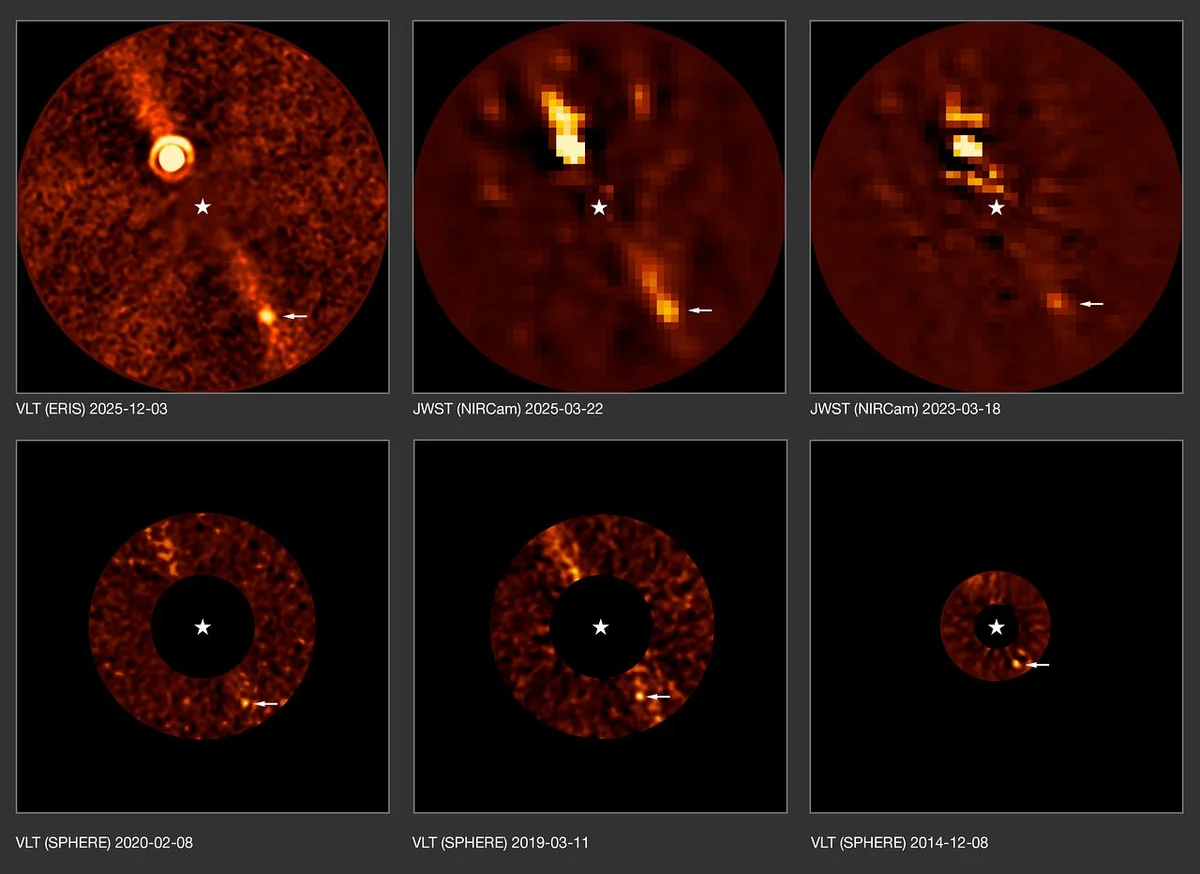
A team of astronomers has identified a third planet orbiting the star Beta Pictoris. This newly discovered planet, designated Beta Pictoris d, is notably one hundred times dimmer than its counterpart, Beta Pictoris b, the first planet detected in this system. Moreover, it ranks among the least massive exoplanets ever captured in direct images from Earth. The team utilized the Very Large Telescope (VLT) from the European Southern Observatory (ESO) to locate the planet, which had been hidden in archival data for over a decade.
"This was a serendipitous discovery,” stated Ben Sutlieff, co-leader of the study published in The Astrophysical Journal Letters and an astronomer at the University of Edinburgh, UK. He explained that the team initially intended to conduct a detailed study of the known planet Beta Pictoris b to investigate its temporal variations. However, during their analysis of the system's images, they detected an additional signal that redirected their research entirely.
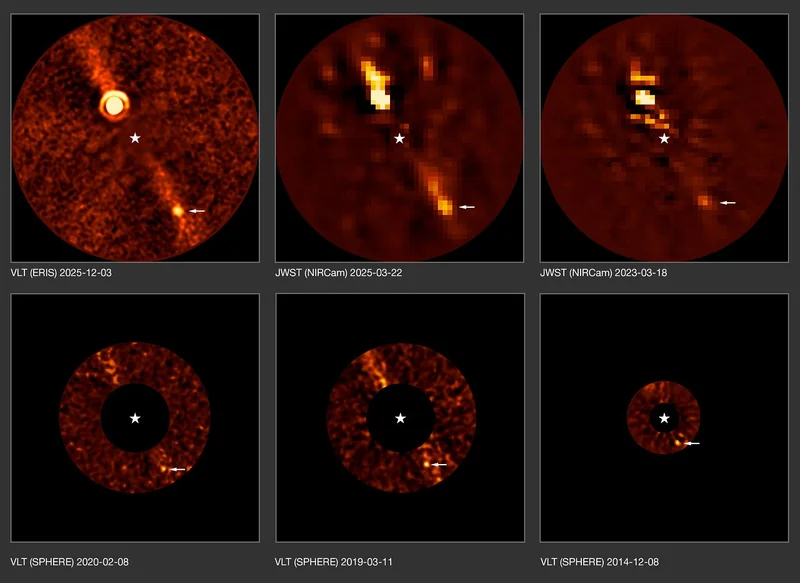
Markus Bonse, an ESO astronomer in Germany and co-leader of the study, recalled his reaction upon observing the data: "There’s something else, did you see that?" To confirm the nature of the detected object, the team sifted through the ESO archive, which contains records of previous observations made with ESO telescopes. They found the new planet Beta Pictoris d in several images dating back as far as eleven years, including one where it barely stood out against the bright light of its larger neighbor, Beta Pictoris b. "Planet d has evidently been playing hide and seek with us for over a decade, and only now can we say: ‘Gotcha!’" said Jayne Birkby, co-author of the study and an astronomer at the University of Oxford, UK.
The newly discovered planet is a gas giant, akin to Jupiter or Saturn, but it has a significantly larger orbit compared to the other planets in the system, Beta Pictoris b and Beta Pictoris c. While the first two planets each possess about ten times Jupiter’s mass, Beta Pictoris d has only 2.4 times Jupiter's mass, making it one of the least massive planets ever directly imaged from Earth. Additionally, it is relatively cold, resulting in extremely faint luminosity compared to its central star.
Direct imaging, which captures the light of an object like a photograph, is only feasible for planets bright enough to stand out against their much brighter central stars. Capturing an image of such a dim planet as Beta Pictoris d is a significant achievement. "The new planet is one hundred times dimmer than Beta Pictoris b, the famous planet in the same system. This makes it the faintest exoplanet ever directly photographed from Earth," explained Bonse.
The initial definitive detection of Beta Pictoris d, located 63 light-years away, was achieved by Sutlieff, Bonse, and their team using the ERIS instrument at the VLT. A separate team, led by Aidan Gibbs at the University of California, also discovered the same planet using the James Webb Space Telescope (JWST), a collaborative facility of the U.S., European, and Canadian space agencies. Their findings were similarly published in The Astrophysical Journal Letters.
To confirm a planet's discovery, astronomers typically conduct follow-up observations. However, this system had already been extensively studied, resulting in numerous images archived by both ESO and JWST. "To our delight, it suddenly appeared in earlier SPHERE observations," Birkby remarked, referencing another VLT instrument that had previously been used to investigate the Beta Pictoris system. The planet was also found in archival data from NIRCam, a JWST instrument. Now that the team knew where to search for the potential new planet, "it turned out it had been hiding in the data all along!" Birkby noted. Co-author Valentin Christiaens, a researcher at CEA Paris-Saclay in France, added, "The detections in the SPHERE archive are not only highly exciting in themselves, but they also show that there are still many treasures hidden in the archives of VLT instruments!"
Beta Pictoris is only the second system, after HR 8799, where more than two planets have been directly imaged. "Systems with multiple directly imaged exoplanets are considered the crowning achievements of such discoveries. They tell us much about how different exoplanets evolve in the same formation environment," Sutlieff explained. Furthermore, Beta Pictoris d resolves a mystery within its planetary system, as it possesses the precise mass and position to explain the distinctive shape of the surrounding debris disk, which consists of remnants from planet formation.
The discovery of Beta Pictoris d encourages further direct imaging of planetary systems where dim planets may have been hiding in plain sight—potentially with the future Extremely Large Telescope (ELT) from ESO. "Planets seem to occur in company," stated Beth Biller, also a co-author and astronomer at the University of Edinburgh. "Many of the known systems with directly imaged exoplanets host multiple giant planets. It is likely that other lower-mass planets are hiding in these systems, which could be revealed with the instruments of the ELT."