First Stellar Black Hole Discovered in Omega Centauri
Astronomers have discovered a stellar-mass black hole in Omega Centauri using data from Hubble and Webb telescopes, contributing to theories on black hole formation.
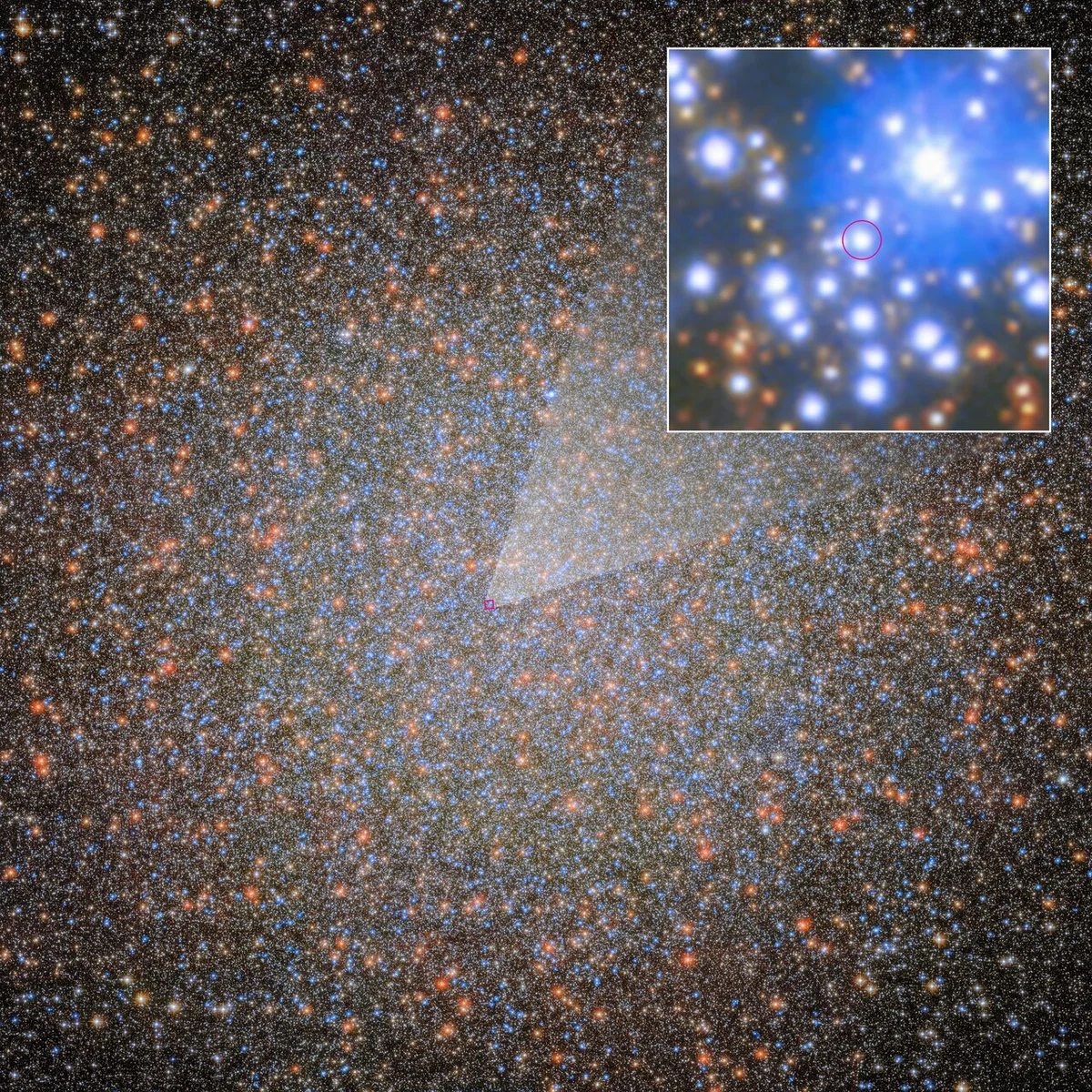
The vast globular cluster Omega Centauri has intrigued astronomers for decades. It was long presumed to be teeming with black holes left behind by exploded stars, yet evidence of their existence remained elusive. Recently, astronomers have successfully identified a stellar-mass black hole within this cluster, utilizing archival data from NASA/ESA's Hubble Space Telescope alongside additional observations from the NASA/ESA/CSA's James Webb Space Telescope. This groundbreaking discovery marks the first instance of such a black hole being found in Omega Centauri, contributing valuable insights into current theories on the formation of black holes in environments like this.
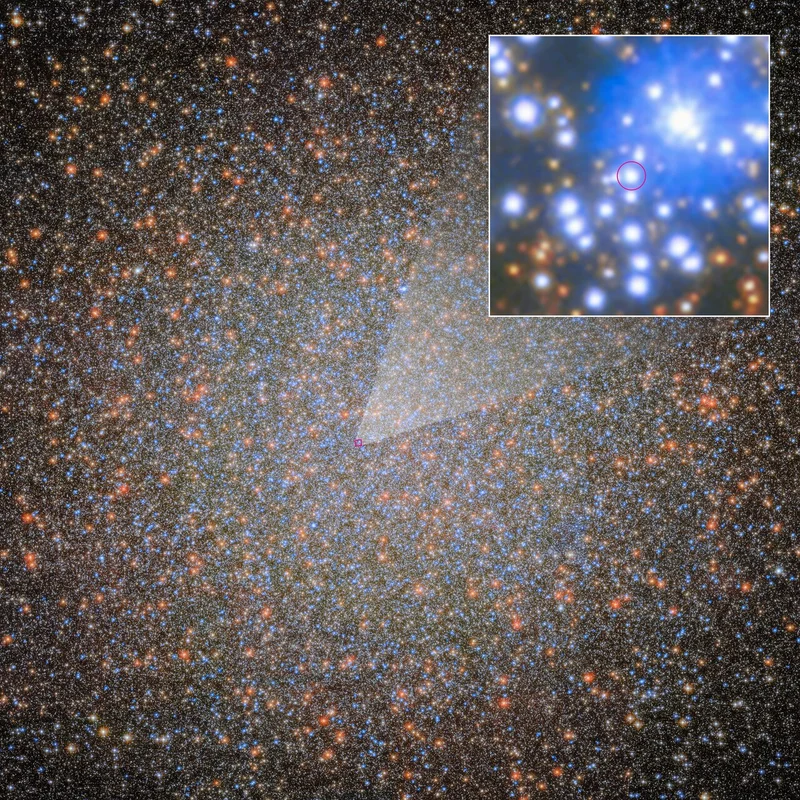
Omega Centauri comprises around 10 million gravitationally bound stars. While previous studies using Hubble had suggested the presence of a medium-mass black hole at its center, models indicated that the cluster should also contain approximately 10,000 smaller stellar-mass black holes. This significant population had gone undetected in earlier research, which primarily employed the radial velocity method [1] or searched for radio and X-ray emissions from matter falling into black holes.
The recent discovery employed a different technique known as astrometry [2], which measures the minute movements of stars over time. By analyzing more than 20 years of Hubble archival data and incorporating recent Webb data to refine astrometric measurements, the team was able to pinpoint a star that orbits an invisible object with sufficient mass to be classified as a black hole. This object, designated oMEGA Cat BH-2, is the first stellar-mass black hole confirmed in Omega Centauri and displays some surprising characteristics. Notably, oMEGA Cat BH-2 has a lower mass than expected, and the black hole-star duo has the longest orbital period of any known black hole binary system.
The findings were published in The Astrophysical Journal Letters.
"Using data from Hubble and Webb, we were able to observe the motion of the visible main-sequence star [3] that is part of this binary system located about 18,000 light-years away in the dense environment of Omega Centauri," stated Matthew Whitaker, the study's lead author from the University of Utah in Salt Lake City, USA. "The precision of these measurements is incredible—down to a fraction of a pixel on the detectors of Hubble and Webb. Without these two space telescopes, it would have been impossible to discover this black hole."
The team's results clarify earlier research suggesting that this binary system contained a neutron star. By expanding the analyzed Hubble data to include astrometric measurements from 2002 to 2023 and incorporating near-infrared data from the Webb telescope to enhance accuracy, the team was able to more precisely determine the mass of the dark companion of the visible star, thereby ruling out the possibility of a neutron star.
"While we already knew the star had a mass of 0.78 solar masses, we can now calculate the mass of the black hole: it is 4.46 solar masses, which is too high for a neutron star. However, this mass is significantly lower than one would expect in a metal-poor environment like Omega Centauri. This is surprising and exciting," remarked Anil Seth from the University of Utah, a co-author of the study. "We now know that a metal-poor star can form such a black hole, and we need to find out how that happens. This discovery provides data for those conducting relevant modeling work."
Long Anticipated
Using precise data from Hubble and Webb, the team traced the star's orbit over more than 20 years, fortuitously capturing the phase when it was closest to its companion, the black hole, and moving fastest across the sky. From this extensive data, the team found that the visible star oMEGA Cat BH-2 completes an orbit every 94 years, making this system the binary black hole with the longest known orbital period.
The lengthy orbital period also offers clues about the origin of this binary system. It likely formed through dynamic processes, suggesting that the star and its black hole companion did not originate together but rather found each other within the star cluster. The researchers calculated that a system like oMEGA Cat BH-2 will survive for less than a billion years before being disrupted by encounters with neighboring stars—a timespan significantly shorter than the age of the star cluster, which is approximately 12 billion years.
"Understanding the populations of black holes in globular clusters is crucial, as there are still uncertainties regarding their physics and formation," stated Seth. "In particular, understanding the formation of black holes and the subsequent dynamic formation of binary systems is essential, as this affects our ability to interpret and understand gravitational wave events. Environments like Omega Centauri are considered the places where such binary systems merge and produce these waves."
The discovery of the stellar black hole oMEGA Cat BH-2 by the team using the Hubble-Webb dataset is just the beginning of the search for these elusive populations of black holes in globular clusters.
"This new discovery underscores the immense value of the Hubble Space Telescope archive for future research," said Maximilian Häberle, a postdoctoral researcher at the European Southern Observatory (ESO), who led the data processing for the Hubble and Webb data. "It marks the second breakthrough of our astrometric reanalysis within the oMEGA Cat project, following the confirmation of a medium-mass black hole in Omega Centauri."
Endnotes
[1] The component of the velocity of an object that moves away from or toward the observer. By observing Doppler shifts in spectral lines, astronomers can derive the radial velocity and determine how quickly objects are moving away from or toward us. Measuring such shifts in a star's light can reveal the presence of exoplanets and brown dwarfs orbiting it.
[2] Astrometry measures the precise positions and movements of stars over time. A planet's orbit can cause a star to wobble in relation to neighboring stars in the sky.
[3] A normal star forms from a clump of dust and gas in a star-forming region. Over hundreds of thousands of years, the accumulation gains mass, begins to spin, and heats up. When the core of the accumulation reaches millions of degrees, nuclear fusion begins. This process occurs when two protons, the nuclei of hydrogen atoms, merge to form a helium nucleus. Energy is released during fusion, which heats the star and generates pressure that counteracts the star's gravity. A star is born. Scientists refer to a star that fuses hydrogen into helium in its core as a main-sequence star. Main-sequence stars make up about 90% of the star population in the universe. They vary in brightness, color, and size—from one-tenth to 200 times the mass of the Sun—and have lifespans of millions to billions of years.
Background Information
The Hubble Space Telescope is a project of international collaboration between ESA and NASA.
Image credit: ESA/Hubble & NASA, M. Häberle (MPIA), J. DePasquale (STScI)