Young Star Clusters in Focus of Nearby Galaxies
Astronomers have utilized the James Webb Space Telescope and Hubble Space Telescope to examine thousands of young star clusters in nearby galaxies, revealing insights into star formation and the birth of planets.
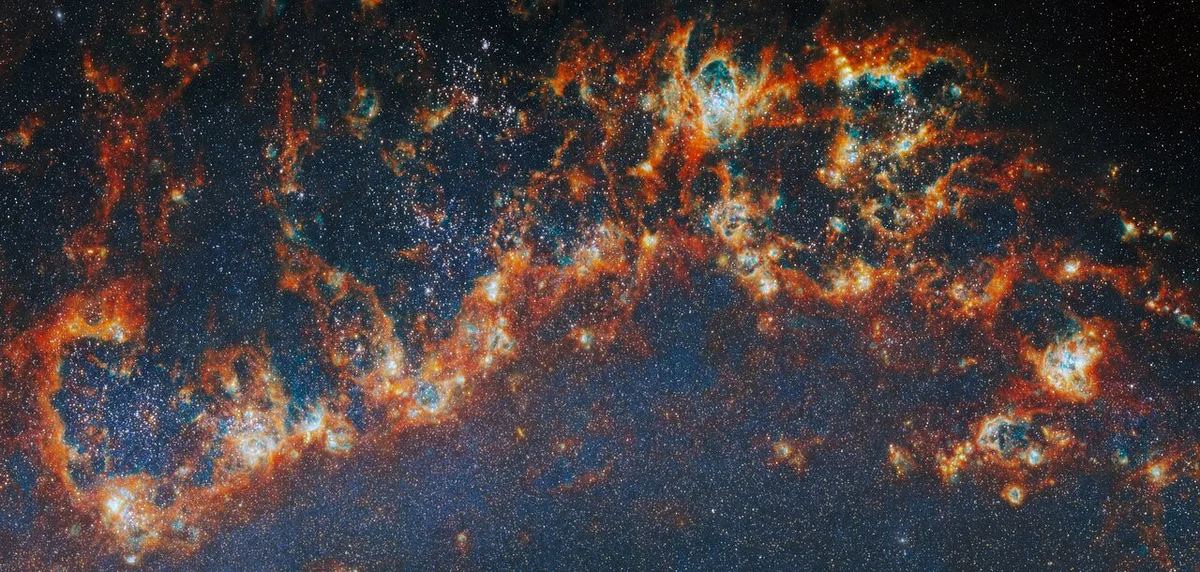
Astronomers have taken a deep look at thousands of young star clusters in four nearby galaxies using the NASA/ESA/CSA James Webb Space Telescope in combination with the NASA/ESA Hubble Space Telescope, examining star clusters in various stages of development. Their results show that more massive star clusters emerge from the clouds in which they form more quickly, dispersing gas and flooding the galaxy with ultraviolet light. This result provides us with a more detailed understanding of star formation in galaxies as well as how and where planets can form.
Astronomers have long known that understanding the formation of star clusters is key to unlocking further mysteries of galactic development. Stars form in clusters that arise when gas clouds collapse under the influence of gravity. As more stars form in a collapsing cloud, strong stellar winds, intense ultraviolet radiation, and supernova explosions from massive stars eventually disperse the cloud, ending star formation before all the gas is exhausted. Once the gas cloud in which a star cluster formed has vanished, its light can also influence other star-forming regions in the galaxy. This process is referred to as stellar feedback and means that most of the gas in a galaxy is never used for star formation. Therefore, studying the development of star clusters can answer questions about star formation on a galactic scale.
Studies of the nearest star-forming regions—in our Milky Way and in the dwarf galaxies that orbit it—allow us to analyze star clusters in minute detail; however, our position within the disk of our own galaxy means that only a few such regions are directly accessible to us. By observing nearby galaxies, astronomers can capture thousands of star-forming regions and characterize entire populations of star clusters in various stages of development—a feat made possible only through the use of space telescopes, primarily the NASA/ESA Hubble Space Telescope. Both observational approaches are essential for comprehensively understanding the mechanisms of star formation in galaxies.
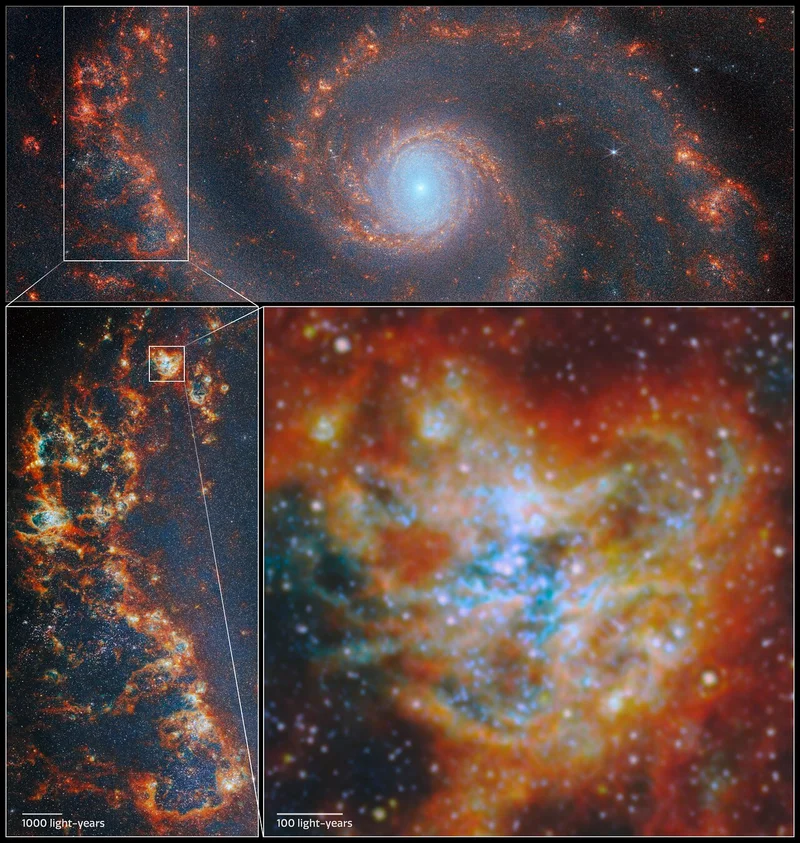
The continuous advancement of infrared astronomy has allowed us to lift the "gaseous veil" that still shrouds the youngest star clusters, gaining insights into the earliest phases of their development. Nevertheless, some phenomena still puzzle researchers. One of these questions is: What factors determine how long it takes for a star cluster to dissolve its birth cloud and begin to emit ultraviolet light into the galaxy?
Now, the state of the art has been further developed as Hubble and Webb jointly provide a broad-band image of thousands of young star clusters. An international team of astronomers has closely examined images of four nearby galaxies—Messier 51, Messier 83, NGC 628, and NGC 4449—from the FEAST (#1783) observing program to solve this puzzle. Their results, published today in Nature Astronomy, show that it is the most massive star clusters that shed their gaseous envelopes the fastest and begin illuminating their galaxy the earliest.
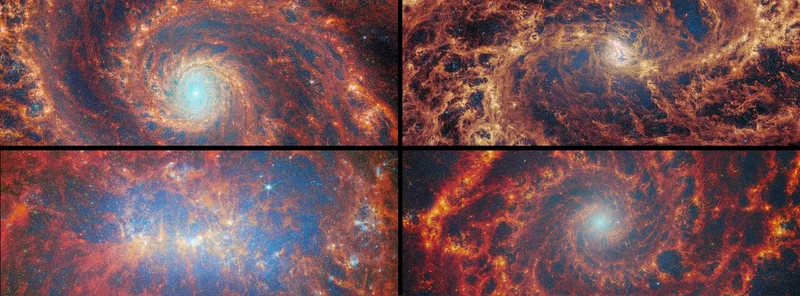
The team identified nearly 9,000 star clusters in different stages of development across the four galaxies: young clusters that are just beginning to emerge from their birth gas clouds, clusters that have already partially displaced the gas (both groups based on Webb images), as well as fully exposed clusters that are visible in optical light (found in Hubble images). Thanks to Webb's ability to peer deeply into the gas clouds, researchers could then determine the mass and age of each individual cluster based on its light spectrum. The most massive clusters were fully emerged and had displaced their gas clouds after about five million years, while less massive clusters were between seven and eight million years old when they left their "stellar nurseries."
Answering the open question of which star clusters dissolve their birth clouds the fastest deepens our understanding of galaxy formation. "Simulations of star formation and the stellar feedback process have had difficulty replicating the formation of star clusters and their exit from their birth clouds. These results provide us with important new insights into this process," explained Angela Adamo from Stockholm University and the Oskar Klein Center in Sweden, one of the lead authors of the study and project leader of the FEAST program.
Massive star clusters naturally emit most of the ultraviolet light in galaxies due to their wealth of hot stars. However, this study confirms that they also have a temporal advantage in generating stellar feedback compared to less massive clusters. Knowing where and when this stellar feedback is strongest throughout a galaxy's lifetime allows astronomers to better predict how the "fuel" for star formation is distributed in the galaxy and how stars and star clusters are likely to form.
Our theories of planet formation are also influenced by this research. The faster gas is depleted within a star cluster, the sooner protoplanetary disks around stars are exposed to the strong ultraviolet radiation of other stars, and the less opportunity they have to attract additional gas from the nebula. This reduces their chances of accumulating dust and forming planets.
"This work brings together researchers who simulate star formation, those who work with observations, and groups that deal with planet formation," said Alex Pedrini, lead author and also affiliated with Stockholm University and the Oskar Klein Center in Sweden. "With the help of Webb, we can look into the nurseries of star clusters and connect planet formation with the cycle of star formation and feedback from the stars."