Hubble Provides New Insights into the Reionization of the Universe
Astronomers have discovered ultraviolet light from a galaxy that existed 1.4 billion years after the Big Bang, shedding light on the reionization era of the universe.
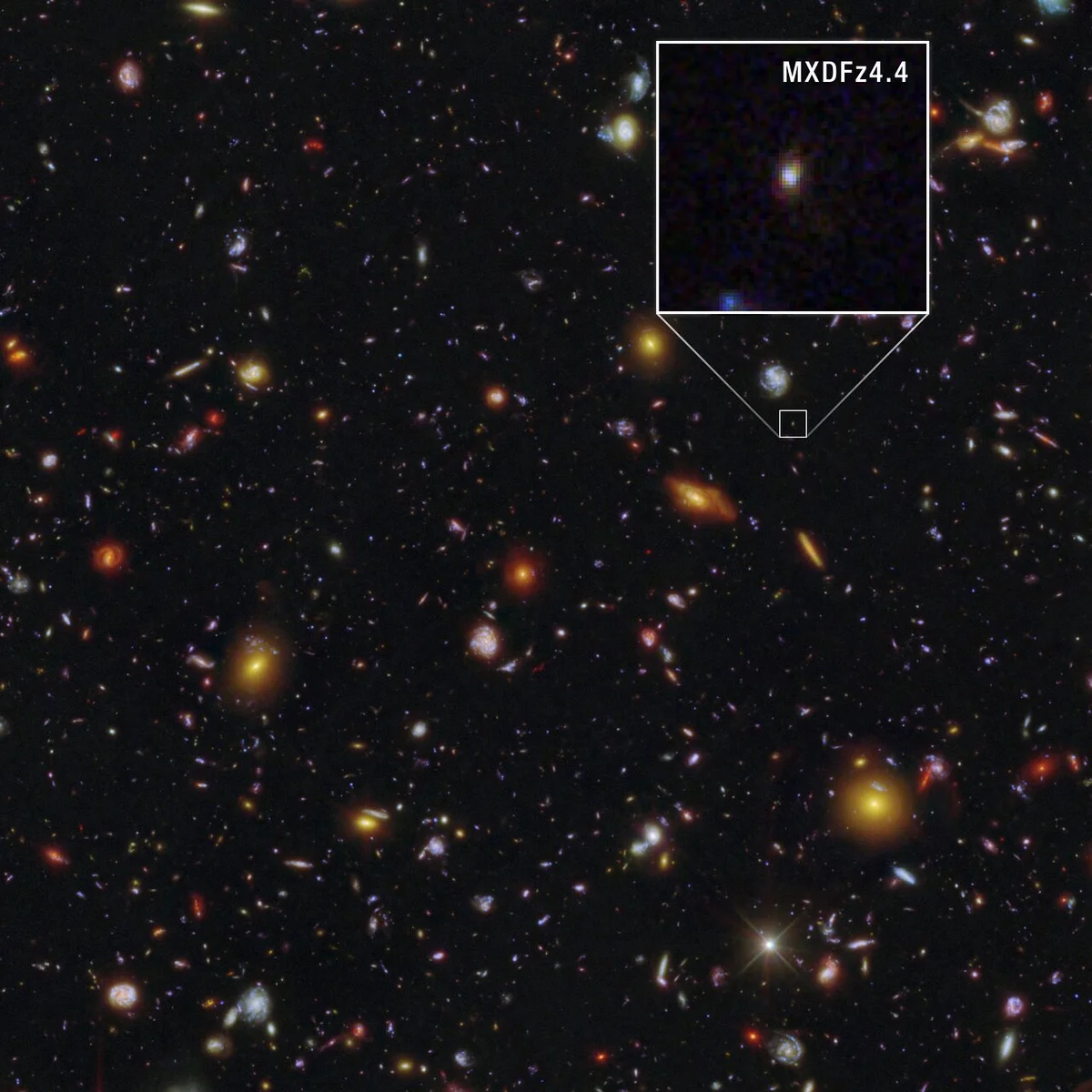
Astronomers have discovered something they never expected with the help of the Hubble Space Telescope from NASA/ESA: ultraviolet light from a galaxy that existed just 1.4 billion years after the Big Bang. This galaxy contains closely packed young stars that emit ionizing light, transforming the opaque neutral gas within and immediately around the galaxy, thus clearing the view. This suggests that similar galaxies in the early universe were responsible for clearing the neutral hydrogen gas fog that once filled the cosmos.
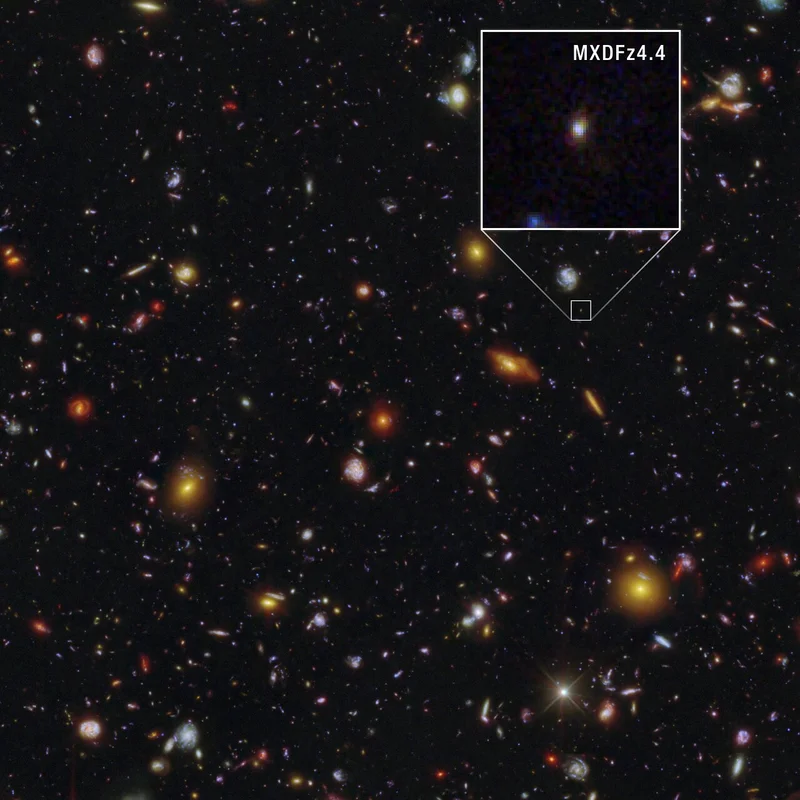
The galaxy cataloged as MXDFz4.4 existed at the end of the reionization era, a time of upheaval in our universe. During the first roughly billion years of the cosmos, the gas between stars and galaxies was opaque to energetic ultraviolet light. Over time, the gas became transparent or ionized everywhere. This transition did not happen abruptly but likely took hundreds of millions of years. Researchers continue to gather evidence to fully understand this process. Therefore, MXDFz4.4 represents an important precedent.
An article describing this discovery was published on June 23, 2026, in the Astrophysical Journal.
"Observing such a galaxy was long considered impossible," said lead author Ilias Goovaerts, a postdoctoral researcher at the Space Telescope Science Institute (STScI) in Baltimore. "Researchers assumed that the 'fog' of neutral hydrogen filling the early universe was too dense and would obscure our view of its ionizing light. Hubble not only discovered this light but also revealed incredible details about the properties of the galaxy."
Great 'Escape' of Light
Young, massive stars emit ultraviolet light that can ionize hydrogen atoms. As this light traveled for over 12 billion years to reach the Hubble Telescope, space expanded, and the light was stretched or redshifted [1] into visible light. The wavelength range of the Hubble Telescope, combined with the sensitivity and resolution of its location in space, makes it the only telescope capable of capturing this ultraviolet light from the early universe.
"Astronomers have discovered many galaxies that existed at this point in the history of the universe, but we have not detected ionizing photons [2] from any of them, making MXDFz4.4 unique," said Marc Rafelski, co-author and deputy Hubble mission leader at STScI.
The long-exposure images from the Hubble Telescope, derived from several existing surveys, showed that the young, massive stars of the galaxy are the source of the ultraviolet light illuminating the surrounding space. These stars formed in the last millions of years of MXDFz4.4's existence in bursts and are closely packed together. This densification effect is further enhanced as MXDFz4.4 is about 100 times smaller than our Milky Way but forms stars ten times faster.
"Many young, hot, massive stars in a small space can penetrate opaque gas better," said Goovaerts. The researchers estimate that 50 to 100% of the energetic, ionizing light from the young stars escapes into the surrounding gas.
The lifespan of massive stars also plays a role, as they exist for only a few million years. Many explode as supernovae, releasing gigantic amounts of energy and tearing massive holes through which even more light can escape.
Collaboration with Other Observatories
Hubble could not have achieved this alone. These conclusions are supported by data collected from the James Webb Space Telescope of NASA/ESA/CSA in the near-infrared range and from the MUSE eXtreme Deep Field (MXDF), the namesake of the galaxy, captured by the Very Large Telescope (VLT) of the European Southern Observatory in visible light. The team used Webb's data to determine the mass of the galaxy, analyze its older stars, and reconstruct its star formation history. The older stars of the galaxy are less massive and cooler and therefore not responsible for altering the surrounding gas.
A comparison of the data from Hubble and Webb also showed that the most recent star formation occurred in bursts. VLT data further pinpointed when MXDFz4.4 existed: 1.4 billion years after the Big Bang. Before this discovery, researchers had only identified one galaxy that emitted ionized light from a time when the universe was 1.6 billion years old. Only a few other examples have been identified that existed when the universe was about 2 billion years old. MXDFz4.4 brings researchers closer to well-founded conclusions about how the reionization era unfolded.
"These insights about MXDFz4.4 were made possible by the powerful combination of Hubble, Webb, and the VLT," said co-author Alexander Beckett, a postdoctoral researcher at the Laboratoire d’Astrophysique de Marseille. "Even then, we could only measure the properties of this remarkable galaxy using state-of-the-art analysis software, primarily developed in Marseille."
Expanding Our Knowledge
Exploring the reionization era is a decades-long endeavor. Researchers use statistics about star populations in nearby galaxies, which we can observe in great detail, to make well-founded assumptions about what might be happening in galaxies in the early universe, partly because their star populations are too distant to resolve in detail.
In 2023, researchers using the Webb Telescope showed that the stars of galaxies emitted enough light 900 million years after the Big Bang to heat and ionize the gas around them. This was a breakthrough, yet astronomers need galaxies like MXDFz4.4 to fully explain the process, as they show how the high-energy light from young stars managed to escape the gas and dust within the galaxy itself.
It is possible that other galaxies like MXDFz4.4 are waiting to be discovered.
"Hubble's observations of MXDFz4.4 allow us to test our hypotheses much closer to the age of reionization than ever before," said Rafelski. "The discovery of more galaxies, especially from slightly later cosmic epochs where larger samples are within reach, would allow us to refine these measurements and find out what cleared our view as this era came to an end."
Notes
[1] When light from a great distance reaches the mirrors of the Hubble Telescope, it is increasingly redshifted due to the expansion of the universe – a so-called cosmological redshift. Astronomers can examine known features in the spectrum of an object to determine whether they have shifted from their normal position in the spectrum. The difference between their normal and their new position is referred to as cosmological redshift. Since space and time are interconnected, distant objects with increasing redshift are temporally further back, as their light takes so long to reach us. In addition to measuring the expansion of the universe, Hubble can also receive light from early galaxies billions of years ago with its detectors.
[2] A photon is a fundamental particle that represents the smallest amount of light (a quantum) and is the carrier (gauge boson) of the electromagnetic force. Photons have no rest mass, no electric charge, always move at the speed of light in a vacuum, and possess energy corresponding to the product of their radiation frequency and Planck's constant.
Background Information
The Hubble Space Telescope is a project of international collaboration between ESA and NASA.
Image credit: NASA, ESA, STScI, I. Goovaerts, M. Rafelski, A. Koekemoer (STScI). Image processing: A. Pagan (STScI)