Spectral Analysis Illuminates the Mystery of the "Little Red Dots"
The complex puzzle surrounding the objects known as "Little Red Dots" (LRDs) has gradually been pieced together since their discovery by NASA, ESA, and CSA's James Webb Space Telescope in 2022.
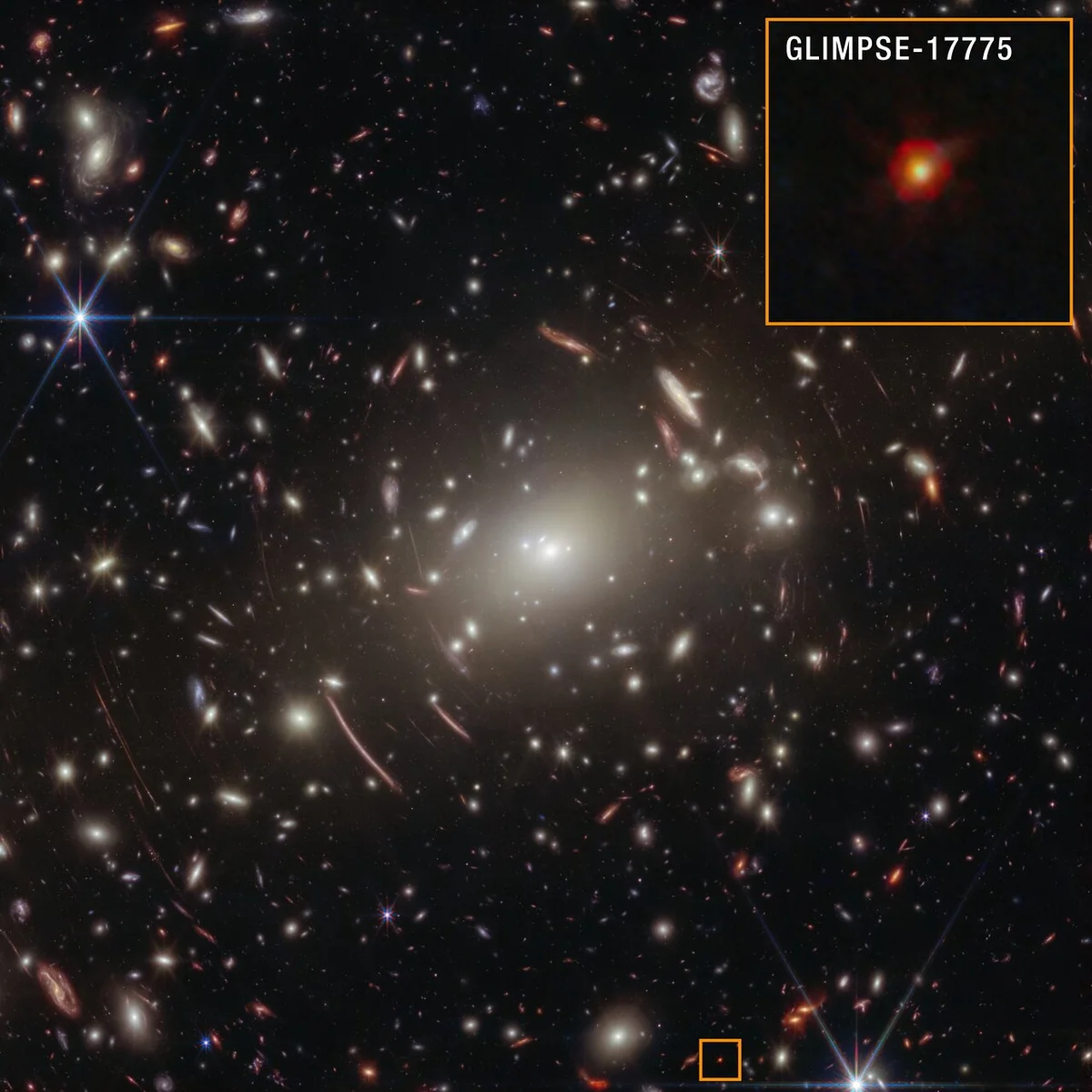
The complex puzzle surrounding the objects known as "Little Red Dots" (LRDs) has gradually been pieced together since their discovery by NASA, ESA, and CSA's James Webb Space Telescope in 2022. Now, the spectrum of a specific "Little Red Dot" is helping to connect many of the puzzle pieces.
An astronomer team led by Vasily Kokorev at the University of Texas at Austin has identified the sought-after point: GLIMPSE-17775. Through careful analysis of the spectrum captured by Webb of this point—the deepest spectrum of a Little Red Dot to date—the research team has identified several clues that all support the interpretation that GLIMPSE-17775 is a supermassive black hole enveloped by a dense cocoon of partially ionized gas. An article describing the results was published today in The Astrophysical Journal.
"I believe part of the scientific community is approaching a unified picture—that Little Red Dots can be explained by stellar models of black holes. However, in none of the previous cases of 'little red dots' did all the clues come together in the same place," said Kokorev, the lead author of the study. "With GLIMPSE-17775, we can test these models, as the spectrum of this source is so deep and impressive."
Piecing Together the Puzzle
Shortly after the commissioning of the Webb Telescope, it discovered a new, mysterious type of object in the early universe—numerous red objects that formed about 600 million years after the Big Bang. Scientists have investigated various explanations for these Little Red Dots, including the black hole scenario.
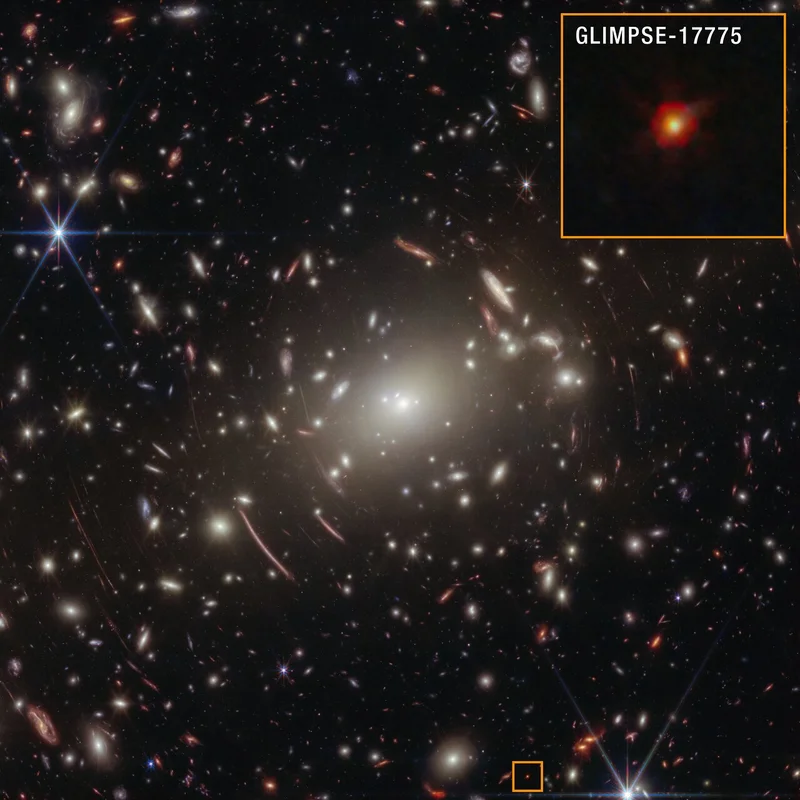
A series of fortunate circumstances led to this elaborate spectrum of a Little Red Dot. The small red spot, later known as GLIMPSE-17775, was fortuitously part of the imaging and spectroscopy work of the Webb Telescope as part of a project searching for Population III stars [1] and faint galaxies in the galaxy cluster Abell S1063. This Little Red Dot is further away than the galaxy cluster and is magnified by gravitational lensing (GLIMPSE-17775 has a cosmological redshift of 3.5, meaning it existed about 1.8 billion years after the Big Bang).
"The source was discovered as part of the GLIMPSE program, which was designed to track down the faintest sources in the early universe," said Hakim Atek from the Institut d’Astrophysique de Paris in France, a co-author of the study and lead researcher of the GLIMPSE program. "Moreover, the magnification due to gravitational lensing also allows for a more detailed characterization of brighter objects, including LRDs like GLIMPSE-17775."
While the Webb Telescope captured a 30-hour spectrum of the small red point, this corresponded to an observational time of 80 hours with the telescope due to the gravitational lensing effect. This combination of Webb's infrared sensitivity and the natural "magnifying glass" of the gravitational lensing effect enhanced the detail accuracy that could be obtained for GLIMPSE-17775. The result was over 40 spectral lines [2] of this small red source—the most detailed spectrum of an LRD to date.
"When we first saw the spectrum, it was as if all the puzzle pieces were scattered on the floor," said Kokorev. "We picked up each puzzle piece, measured the lines, and began to assemble the various parts into a mosaic. At first, some pieces might not have looked like much, but then a few came together, and we realized there was something there."
The spectroscopic data collected by Webb contains numerous hints supporting the interpretation that the small red point GLIMPSE-17775 is a black hole star: a rapidly accreting or growing black hole enveloped by a dense gas cocoon that transforms the light emitted from near the black hole and generates the features observed in the spectrum.
Chains of Evidence
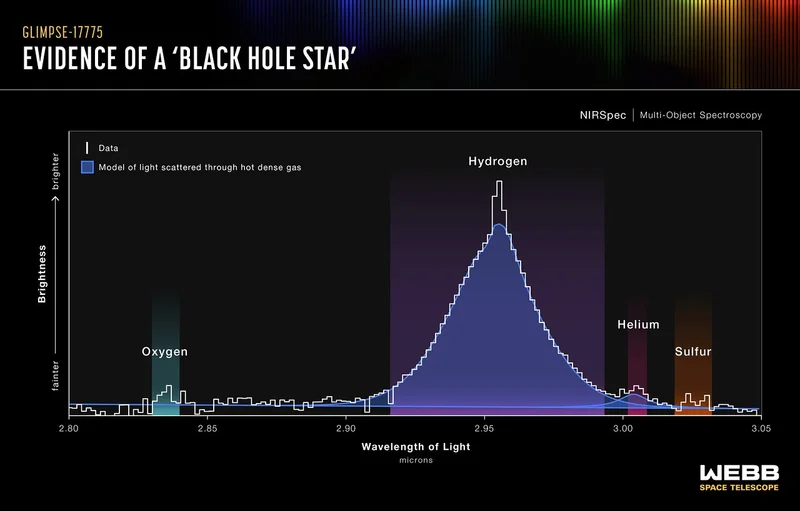
Among the over 40 spectral lines that the team discovered in the spectrum of GLIMPSE-17775 were various independent indicators that all align with the black hole scenario. For instance, the team found that many of the spectral lines (such as hydrogen, oxygen, and helium) did not fit a simple model of a rotating gas cloud. Instead, the best-fitting model includes a broadening effect known as electron scattering: a clear indication that a dense, stratified gas cocoon envelops this source.
The strength and ratio of certain spectral lines to one another, particularly the 16 iron lines that form the area referred to by astronomers as the "iron forest," as well as certain oxygen lines, indicate a high-energy source, such as a rapidly accumulating black hole. Additionally, astronomers observed the fluorescence and absorption of helium in the spectrum, each suggesting a dense medium surrounding a strong source.
The black hole scenario not only fits GLIMPSE-17775; it also explains why most Little Red Dots shine faintly in the X-ray range, as any emission of this kind is likely absorbed by the dense gas cocoon.
A missing puzzle piece for GLIMPSE-17775 is the part of the spectrum that would reveal a so-called Balmer break—a strong drop in emitted light, which is a characteristic feature of "Little Red Dots." To gain a more comprehensive understanding of this small red point, the team incorporated additional data from two observational programs using the NASA/ESA Hubble Space Telescope: the Frontier Fields and BUFFALO (Beyond Ultra-deep Frontier Fields And Legacy Observations) programs.
The data from Webb and Hubble together help explain why the Balmer break is weaker than in other Little Red Dots: GLIMPSE-17775 is surrounded by a massive host galaxy. Although the host galaxy of such an LRD has been unusual at this scale, it does not contradict the model of a dense gas cocoon. The model of "Little Red Dots" with black holes and stars attributes the excess blue light to stars in the host galaxy.
When Webb first discovered small red dots, some researchers thought these objects had "upended cosmology," as they were unsure how galaxies in the early universe could grow so large so quickly to account for all the light emitted by their stars. However, the team believes that the puzzle piece GLIMPSE-17775 fits well into the existing framework of the universe's developmental history, as the masses of the black holes do not need to be so high to explain the broad emission lines.
"Everything fits together, nothing is broken, and I think that makes the puzzle of our universe even more exciting," said Kokorev. "I look forward to diving deeper into the matter and finding out what drives the central energy sources of these LRDs. While we suspect a black hole, there are also other interesting theories, which is very exciting. Perhaps in one or two years, we will have the final answer to what drives these sources."
Notes
[1] Astronomers know that the first stars, officially referred to as Population III stars, must have consisted almost entirely of hydrogen and helium—the elements that formed as a direct result of the Big Bang. They likely contained none of the heavier elements such as carbon, nitrogen, oxygen, and iron found in stars that shine today. In other words: Population III stars were metal-free (astronomers refer to any element heavier than helium as metal).
[2] In a spectrum, light emitted or absorbed by an atom or molecule at a specific frequency is analyzed. Each ion, atom, and molecule emits and absorbs light at specific wavelengths, making it possible to determine the composition of a star or other celestial body. Emission lines create bright features, absorption lines dark features, and each line represents light emitted or absorbed by one or more substances.
Background Information
Webb is the largest and most powerful telescope ever launched into space. As part of an international cooperation agreement, ESA provided the launch service for the telescope using the Ariane 5 launch vehicle. In collaboration with its partners, ESA was responsible for the development and qualification of the adaptations of Ariane 5 for the Webb mission, as well as for securing the launch service through Arianespace. ESA also provided the main spectrograph NIRSpec and 50% of the mid-infrared instrument MIRI, which was developed and built by a consortium of publicly funded European institutes (the MIRI European Consortium) in collaboration with JPL and the University of Arizona.
Webb is an international partnership between NASA, ESA, and the Canadian Space Agency (CSA).