Stardust from a Dead Star: The Seed of Our Solar System's Formation
A meteorite that fell in Mexico in 1969 reveals that dust from a star that died before the Sun may have acted as a "seed" for the early solids of the Solar System, solving a longstanding puzzle in cosmochemistry.
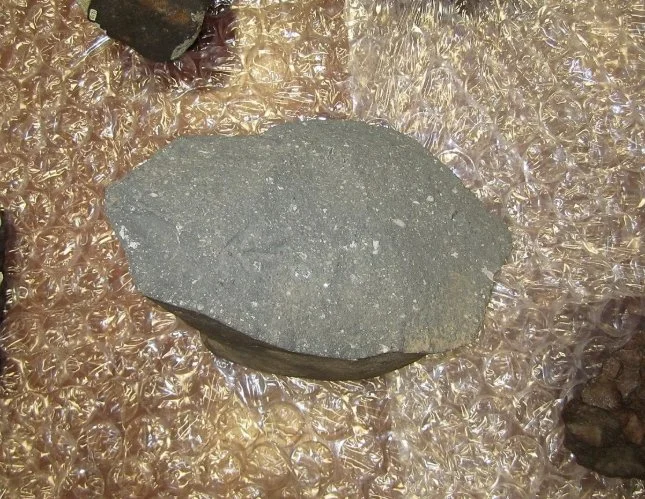
In February 1969, just months before the historic Apollo 11 mission, a fireball streaked across the sky over Chihuahua, Mexico, scattering more than two tons of rocks across the northern region. This event marked the fall of the Allende meteorite, the largest primitive meteorite ever recovered on Earth. The term "primitive" refers to its preservation in a nearly unaltered state since the formation of the Solar System approximately 4.5 billion years ago. As a result, it serves as a remarkable fossil of the solar nebula, continuing to yield new insights more than fifty years later.
The Oldest Inclusions of the Solar System
Among the oldest components found within Allende are known as calcium-aluminum inclusions (CAIs). These inclusions represent the first solids that condensed from the hot gas of the early Solar System, marking the transition from vapor to solid rock. Everything that followed—asteroids, moons, and even the ground beneath our feet—originated after these initial formations.
Even Older Grains: Dust from a Dying Star
Since the 1980s, researchers have recognized that primitive meteorites contain even older grains, such as nano-diamonds and similar minerals. These materials possess compositions so distinct from anything known in our Solar System that they are believed to have formed around another star that perished before the Sun ignited. This dust is genuine stellar debris, predating all other material in our Solar System.
The Discovery: Stellar Dust as a "Nucleation Seed"
A team comprising Ren Marquez and Francois Tissot from Caltech, along with Bruce Charlier from Victoria University of Wellington, has now located these grains within the CAIs themselves. They propose that these grains acted as nucleation seeds, providing surfaces around which the earliest solids of the Solar System could crystallize.
Tissot explains that nucleation is a challenging process without a surface for growth. Without something to disrupt the uniformity of a gas mixture, minerals would take an exceedingly long time to condense as the Solar System cooled. Thus, the stellar dust addresses a problem that had puzzled cosmochemists for years.
The emerging picture is one of a star that lived and died, dispersing its dust into the cosmos. Part of this dust entered the cloud that would eventually give rise to the Sun, surviving the intense conditions of its formation, and becoming the seed around which the first solid matter of our planetary system coalesced.
An Unexpected Echo on Earth
Interestingly, the techniques developed by Marquez to analyze infinitesimal samples are now being applied to blood and tissues in a project aimed at early diagnosis of osteoporosis. This serves as a compelling example of how the study of the night sky can sometimes have tangible impacts on daily life here on Earth.