Reassessing the Origins of an Ancient Silver Globe
An investigation into the origins of the Kugel Globe reveals unexpected influences and challenges the assumption of its Greek heritage.
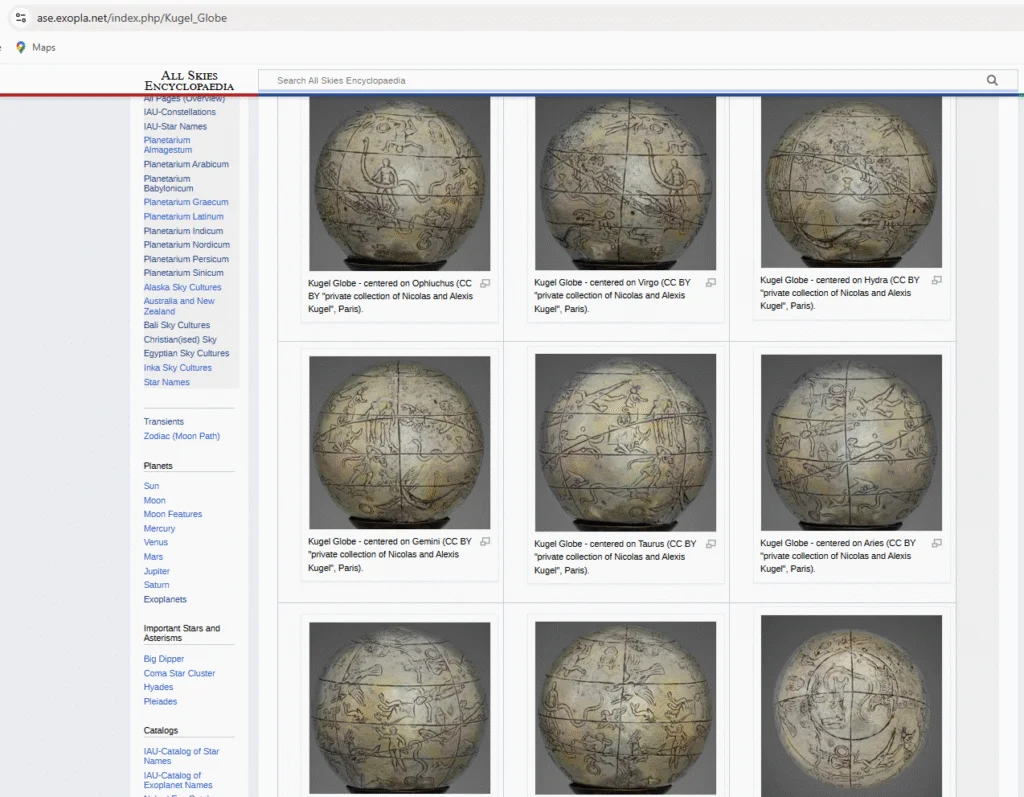
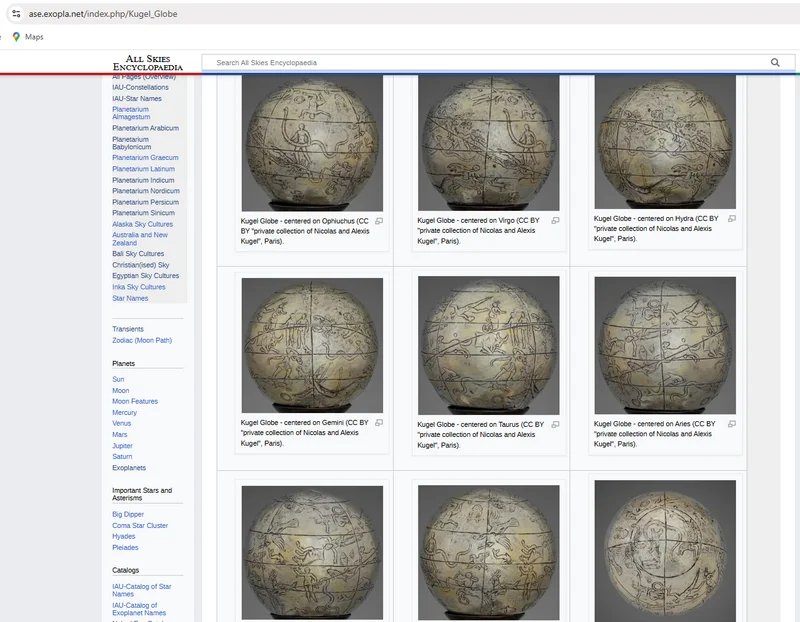
Three notable globes, often attributed to ancient Greece, have been preserved through history: the 60 cm Farnese Globe, a marble globe depicted on a statue of the Titan Atlas, and a smaller bronze globe that has been known for some time, now housed in the Römisch-Germanischen Museum in Mainz. Additionally, there exists a small silver globe currently owned by a private collector in Paris, Mr. Kugel, who generously provided high-resolution images for publication in the All Skies Encyclopaedia (ASE).
The Kugel Globe was discovered around 2000 in the Paris art market, where it was offered alongside other silver artifacts. The initial scholarly article by Cuvigny in 2004 dates the globe to approximately the 2nd or 1st century BCE, suggesting it likely originates from Anatolia. Since then, it has commonly been categorized among the "three Greek globes" in academic literature (see Dekker 2013).
However, several peculiarities in the style of inscriptions and the depicted objects have raised questions about this classification (Hoffmann 2025). Notably, the constellation Corona Australis is illustrated on the globe, although it is only documented in texts from the 1st century CE, which would require a reassessment of the globe's dating to one or two centuries earlier. Furthermore, the representation of the constellation Cetus as a regular sea creature (whale) rather than the traditional Greek sea monster is also curious, as discussed by Hoffmann, Vickers, and Geymeier (2022).
New Findings
My international team has identified additional distinctive features that cast doubt on the assumption that the Kugel Globe originates from Greek culture:
- The Great and Little Bears are depicted as tigers rather than bears.
- The figure representing the Virgo constellation lacks the usual ear of corn and instead wears an Indian sari.
- Her hairstyle is Chinese, specifically the "Maiden Bun," which is only documented from the 4th century CE onward.
These observations strongly suggest that the small silver globe owned by Nicolas and Alexis Kugel in Paris likely originates from India and exhibits numerous foreign influences, including Greek, Chinese, and potentially Persian elements.
We have published these preliminary findings in a brief report co-authored by approximately 25 experts and hope that more knowledgeable colleagues will help to accurately contextualize the Kugel Globe. Clearly, there remains a significant amount of research to be conducted!
Hoffmann, AlAjaji, Shylaja, Yang et al. (2025).
References
Hélène Cuvigny, “Une sphère céleste antique en argent ciselé,” in Harald Harrauer and Rosario Pintaudi (ed.) Gedenkschrift Ulrike Horak (Florence, 2004) (= Papyrologica Florentina 34) 345-381.
Dekker, Elly (2013). Illustrating the Phaenomena, Oxford University Press.
Hoffmann (2025), Some Results on the Ancient Globes, Globe Studies – The Journal of the International Coronelli Society, 69, 4169.
Hoffmann, S.M., Vickers, D., and Geymeier, M. (2022). Constellation Cetus: Whale or Monster?, in Hoffmann and Wolfschmidt (eds.). Astronomy in Culture – Cultures of Astronomy, tredition Hamburg/ OpenScienceTechnology Berlin, 302-340.
Hoffmann, AlAjaji, Shylaja, Yang et al. (2025). The IAU Working Group on Star Names (WGSN): Research Finds in 2025. Journal of Astronomical History and Heritage, 28(4), 1026–1038.