Prepare for the Spectacular Total Lunar Eclipse: A Night of Red Magic Awaits
A total lunar eclipse on September 7, 2025, will transform the Moon into a stunning blood-red hue. Here’s how to prepare and where to observe this rare celestial event.
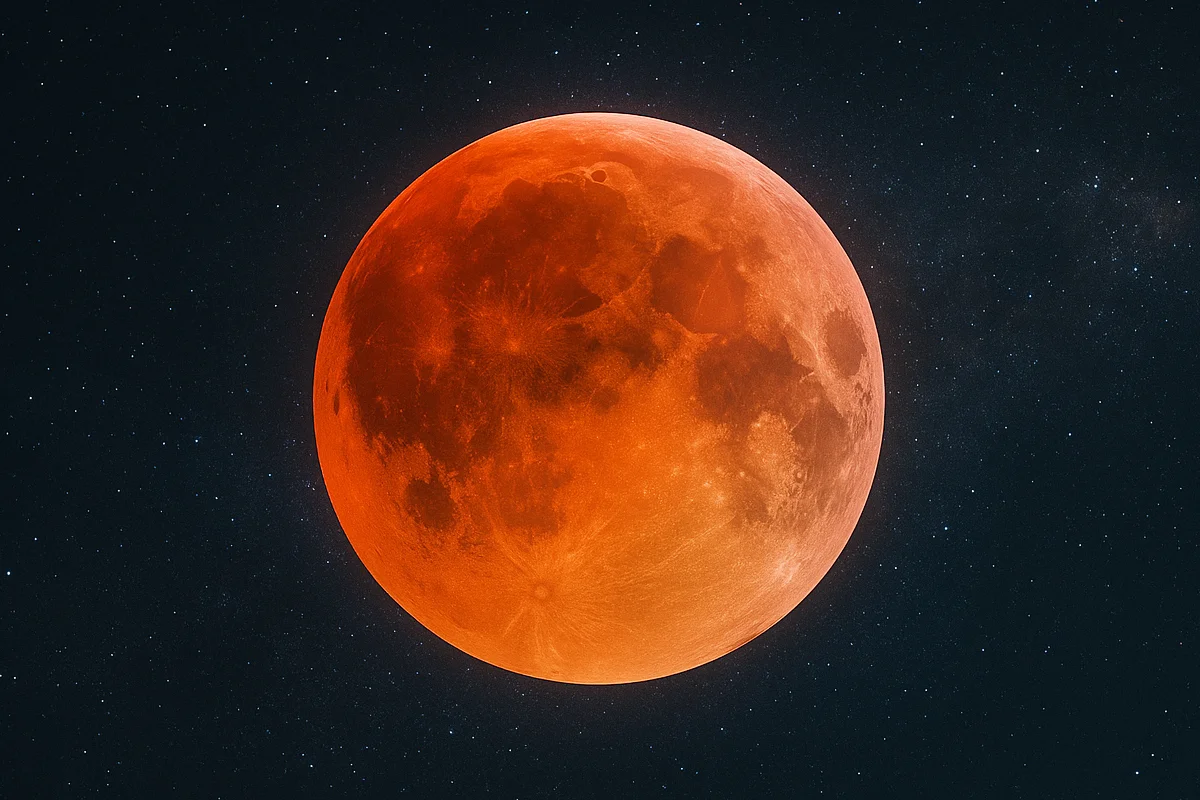
A celestial event is on the horizon, set to transform the night sky. In just a few days, the Moon will gradually slip into the Earth’s shadow, ultimately re-emerging with a striking blood-red hue. This rare phenomenon promises to be a captivating spectacle, visible from France for those who know when and where to look.
The Historical Significance of Lunar Eclipses
Lunar eclipses have long fascinated humanity, serving as more than mere astronomical events; they have inspired powerful myths and collective fears. In ancient China, it was believed that celestial dragons devoured the Moon, prompting people to bang drums and pots to scare the creature away. The Maya civilization, with its sophisticated calendars, could predict eclipses with remarkable accuracy, viewing them as pivotal moments when the spiritual world intersected with the physical. In 1504, Christopher Columbus cleverly used a lunar eclipse to manipulate the indigenous people of Jamaica, threatening them with divine retribution for refusing to aid him. Even in recent history, during the total eclipse of July 2018, superstitions led some Indian villages to empty in fear of misfortunes.
These stories underscore that a lunar eclipse is never an ordinary occurrence; it represents a moment of transition, a pause in the natural order, as if the universe holds its breath. Even in our modern understanding of the science behind these events, witnessing a blood-red Moon enveloped in shadow remains a mystical and profoundly human experience.
A Night of Red: The Total Lunar Eclipse
Get ready for a breathtaking sight! On September 7, 2025, a total lunar eclipse will cast the Moon into the Earth’s shadow. If conditions are favorable, it will glow a striking blood-red.
This celestial performance is both mystical and spectacular, viewable to the naked eye, provided observers know where to look, the timing, and how to prepare.
Observing the Eclipse on September 7, 2025
This eclipse will be visible across a wide swath of the globe, including mainland France, although it will begin while the Moon is still below the horizon.
Key timings for Paris (local time CEST):
| Phase of Eclipse | Time (CEST) | Visibility | |-----------------------------|-------------|-------------------------------| | Penumbral phase begins | 17:28 | Not visible (Moon below horizon) | | Partial shadow begins | 18:27 | Not visible | | Totality begins | 19:30 | Moon just rising | | Maximum eclipse | 20:11 | ✨ Visible on the horizon ✨ | | Totality ends | 20:52 | Clearly visible | | Shadow ends | 21:51 | Fully visible |
Did you know? Unlike solar eclipses, lunar eclipses are completely safe for the eyes. No filters are needed; you can enjoy the view for as long as you wish.
Why Does the Moon Turn Red During an Eclipse?
Contrary to popular belief, the Moon doesn’t vanish entirely during a total lunar eclipse; it bathes in the Earth’s shadow but remains visible, changing color instead. Rather than turning black, it takes on a reddish hue, ranging from copper to deep burgundy. This effect is due to a phenomenon known as Rayleigh scattering. As sunlight grazes the Earth’s atmosphere, only the red wavelengths manage to reach the Moon. Essentially, our planet acts as a natural filter, allowing only the warmer light wavelengths to pass through. For a brief period, it’s as if the Moon is draped in every sunset occurring on Earth simultaneously—a poetic yet scientific marvel.
Weather Considerations for the Eclipse
While the Moon will be the star of the evening, clear skies are essential for optimal viewing.
- One day before: Keep an eye on specialized weather sites (Windy, MétéoCiel, AccuWeather).
- Hourly updates: Aim for cloud coverage < 30% between 19:30 and 21:00.
- Best spot: Find a high location, away from urban light pollution.
Tip: Apps like Clear Outside, Stellarium, or Sky Live can provide minute-by-minute updates on sky conditions in your area.
Photography Checklist: Smartphone or Telescope?
Using a Smartphone
- Night mode activated
- Stabilization (tripod or lean against a wall)
- Manual settings:
- ISO 200-400
- Shutter speed: 1/4 to 1 second
- Moderate zoom to avoid pixelation
Using a Camera or Telescope
- DSLR or mirrorless camera with telephoto lens (minimum 200 mm)
- Long exposure, remote shutter or delayed trigger
- Lunar filter if brightness is excessive
- Manual focus set to infinity
Comfort and Safety Guidelines
- Dress warmly (September evenings can be chilly).
- Use a red lamp to preserve night vision.
- Scout a clear location (park, balcony, hill) in advance.
- Avoid overly bright areas (light pollution makes the Moon less visible).
Anecdote: During his 1504 voyage, Columbus leveraged a predicted lunar eclipse to impress the local Jamaicans and secure supplies, claiming that his god would make the Moon disappear—a prophecy that came true before their eyes!
Quick Summary: Who Can See What, When, and How?
| City | Visible Times | Observation Tips | |------------|-----------------|----------------------------------| | Paris | 20:00 – 21:30 | Clear horizon towards the east | | Lyon | 19:50 – 21:30 | High balcony or hill | | Toulouse | 19:45 – 21:45 | Clear sky towards rising Moon | | Marseille | 19:40 – 21:45 | Perfect view from 20:00 |
A Red Moon… and a Golden Memory
If the weather cooperates, the evening of September 7 will offer a suspended moment in time. A Moon engulfed in shadow, glowing red, silent, and almost supernatural.
This spectacle is accessible to everyone, requiring no expensive equipment, but a bit of preparation. Get your eyes, cameras, and childlike wonder ready: this night could leave you in awe.
Will you be ready?
Sources
- NASA – “Eclipse 2025 Data”
- TimeandDate.com – “September 2025 Lunar Eclipse”
- Observatoire de Paris – “Calendrier des éclipses”
- Sky & Telescope – “Lunar Photography Guide”