Perseverance Captures Stunning Eclipse of the Sun on Mars
NASA's Perseverance rover captures a stunning solar eclipse on Mars, providing valuable insights into the moon Phobos and the Martian surface.
Perseverance Captures Stunning Eclipse of the Sun on Mars
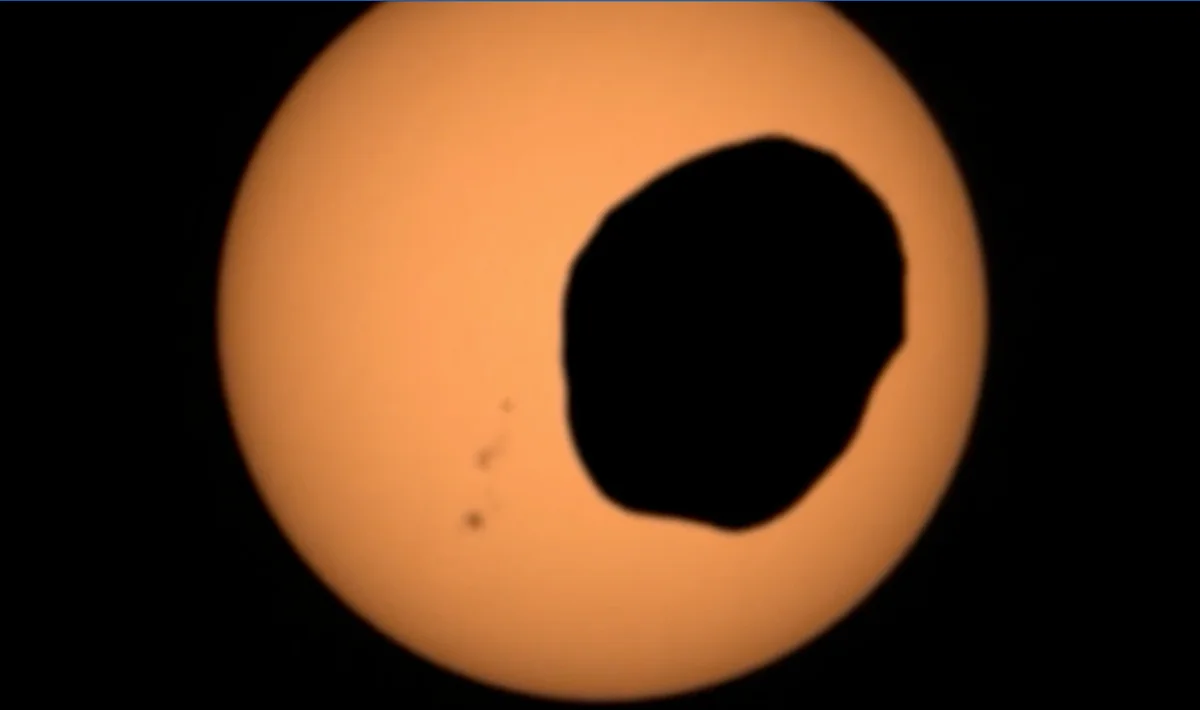
The NASA Perseverance rover has recently recorded a breathtaking video of Phobos, Mars' potato-shaped moon, as it transited across the Sun, creating a solar eclipse. This remarkable event, captured on April 2 during the 397th Martian day (or sol) of the mission, lasted just over 40 seconds—significantly shorter than typical solar eclipses involving Earth's Moon—since Phobos is about 157 times smaller than our Moon. These observations are crucial for scientists aiming to deepen their understanding of Phobos' orbit and its gravitational influence on the Martian surface, which ultimately shapes the crust and mantle of the Red Planet.
Historical Context of Solar Eclipses on Mars
The eclipse footage adds to a rich legacy of NASA spacecraft documenting solar eclipses on Mars. In 2004, the twin rovers Spirit and Opportunity captured the first time-lapse images of Phobos during a solar eclipse, while Curiosity continued this tradition with videos taken by its Mastcam system. However, Perseverance has provided the most detailed and high-frame-rate video of a Phobos solar eclipse to date, thanks to its advanced Mastcam-Z camera system, which is an upgrade from Curiosity's Mastcam. The color fidelity in this latest footage also represents a significant advancement in capturing solar eclipses.
Solar Filter Technology
The Mastcam-Z is equipped with a solar filter that functions like a pair of sunglasses, reducing light intensity for clearer observations. Mark Lemmon, a planetary astronomer at the Space Science Institute in Boulder, Colorado, who has overseen much of the Phobos observations from the rover, noted, “You can see the details in the shape of Phobos' shadow, such as ridges and bumps on the lunar landscape. You can also see sunspots. And it’s extraordinary that you can see this eclipse just as the rover did from Mars._”
Understanding Phobos' Orbit
As Phobos orbits Mars, its gravitational pull exerts subtle tidal forces within the Red Planet, slightly deforming the rock in its crust and mantle. These forces also gradually alter Phobos' orbit. Consequently, geophysicists can utilize these changes to gain insights into the flexibility of Mars' interior, revealing more about the materials within its crust and mantle. Scientists are already aware that Phobos is on a doomed path, gradually spiraling inward toward Mars and expected to collide with the planet in about ten million years. The eclipse observations from the Martian surface over the past two decades have allowed researchers to refine their understanding of this slow descent into destruction that Phobos faces.
References:
- NASA/Jet Propulsion Laboratory