Partial Solar Eclipse on August 12, 2026: A Comprehensive Guide for France
On August 12, 2026, France will experience a spectacular partial solar eclipse, with varying obscuration levels across the country. Learn what to expect and how to safely observe this astronomical event.
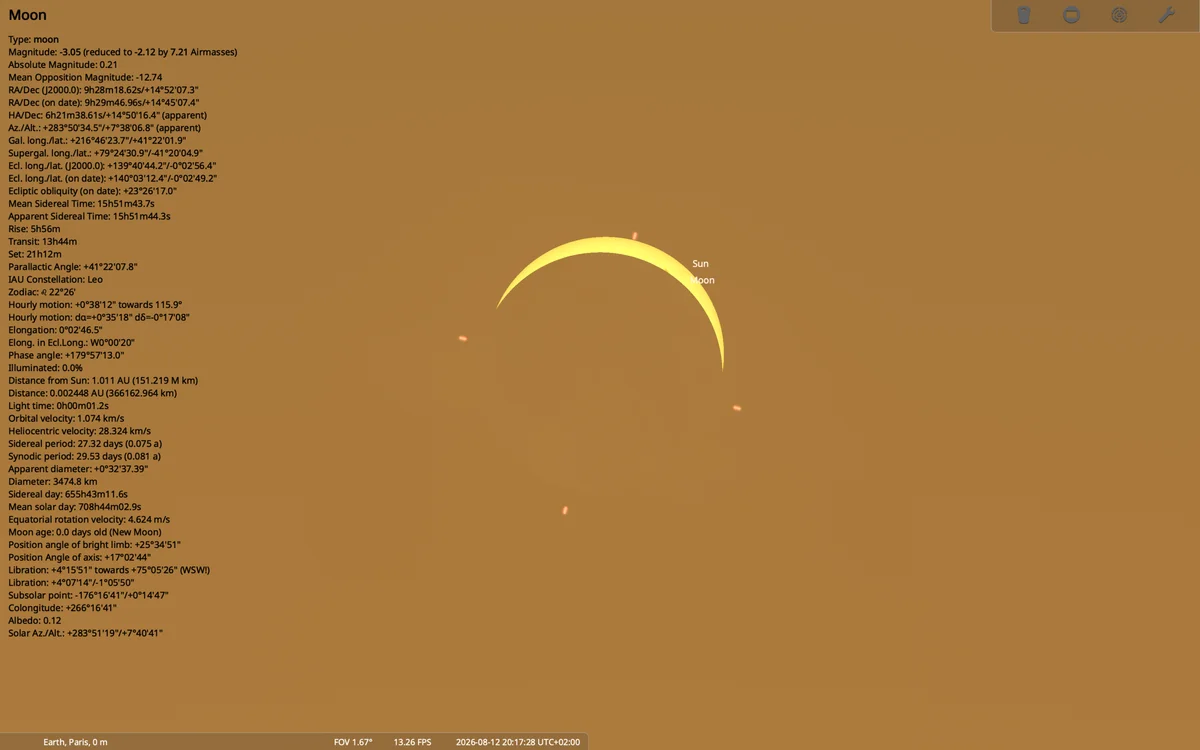
On August 12, 2026, France will witness one of the most remarkable partial solar eclipses of the century. As the day winds down, the Moon will obscure up to 99.5% of the solar disk in the Southwest, casting an unusual twilight light in the height of summer. People across the country will gaze at the same sky, but their viewing experiences will differ significantly based on their geographical location.
99.5 % Maximum obscuration in Biarritz
92.2 % Obscuration in Paris
20h14-20h27 Maximum time varies by region
90.3 % Minimum obscuration in Lille
What to Expect from France
While metropolitan France will not fall within the path of totality, the obscuration will still be exceptional, ranging from 90.3% in Lille to about 99.5% in Biarritz. The degree of solar coverage will be higher in the south, which is geographically closer to the trajectory passing through Spain.
In Paris, the peak obscuration will occur around 20h17, with 92.1% of the Sun covered. Toulouse will experience its maximum at approximately 20h26 with 97.8% obscuration, while Biarritz will see 99.4% at 20h27. These figures paint a vivid picture: the sky will darken significantly in the Southwest, creating a slender crescent of sunlight that produces an eerie twilight during summer.
Obscuration Percentages by Region
The percentages of obscuration vary widely across cities. Toulouse will reach 97.8% (maximum at 20h26), Bordeaux 97.5% (around 20h28), Marseille 96.3% (approximately 20h24), Paris 92.2% (around 20h17), and Lille 90.3% (at 20h13). The entire Atlantic coast is particularly well-positioned, with Brest experiencing a 96% obscuration and similar figures in Lorient.
The Difference Between 99% and 100% Obscuration
The distinction is stark. Even at 99.5% obscuration, part of the solar disk remains visible, and ambient light persists. In a total eclipse (100%), darkness descends abruptly, temperatures drop, and the solar corona becomes visible. This is the literal difference between day and night.
A Twilight Eclipse
This eclipse will be classified as a twilight eclipse: the maximum will occur between 19h30 and 20h30 (summer time), when the Sun is low on the western horizon. This contrasts fundamentally with the eclipse of 1999, which took place midday. In Toulouse, the Sun will be just over 5° above the horizon at its peak, while Paris will see only 7.6°.
Given that the eclipse occurs during sunset, it is advisable to be in an open area facing west. Any elevation or building could obstruct the view at the critical moment.
Exact Timing of the Solar Eclipse on August 12, 2026
In France, the partial phase will commence around 19h18 and end around 21h16, with variations depending on the region. The maximum obscuration will be observed between 20h14 and 20h27, occurring earlier in the North and Northeast, and a few minutes later towards the Atlantic, Southwest, and the Pyrenees.
The Moon will start to cover the Sun at the first apparent contact around 19h15 (French time), gradually obscuring it until the peak around 20h15. In Nantes, the eclipse will begin at approximately 19h25, reach its maximum around 20h20, and conclude shortly after 21h, as the Sun nears the horizon. All times are according to French summer time (UTC+2).
The Path of Totality: Iceland and Northern Spain
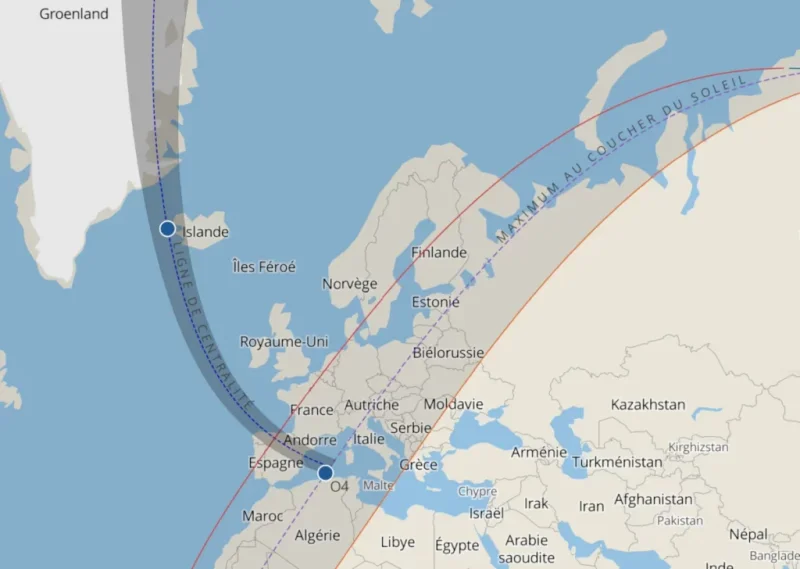
The path of totality will traverse the Arctic Ocean, Greenland, Iceland, the Atlantic Ocean, and will eventually reach Portugal and northern Spain, extending to the island of Mallorca. The maximum duration of totality will be 2 minutes and 18 seconds. For most observers within the path, the Sun will be completely eclipsed for less than two minutes.
Where to Go for Totality
For those seeking the complete experience, the path of totality in Spain spans an area from Bilbao to Madrid, including Zaragoza, Burgos, and La Coruña. Totality in Ferrol will last 1 minute and 33 seconds, with the Sun only 12° above the horizon. This will be the first total solar eclipse visible in Iceland since June 30, 1954, and the only one in the 21st century for the country. According to climate forecasts, the best chances for clear skies are expected in Portugal and Spain.
Weather Uncertainty
The success of the observation will heavily depend on the weather. Long-term climate forecasts indicate that northern France (Paris, Lille) faces a high risk of cloud cover (55 to 70%), while the South (Toulouse, Marseille, Montpellier) offers better prospects for clear skies. It is strongly recommended to monitor weather reports in the days leading up to the event.
Safe Observation of the Solar Eclipse
Eye protection is of utmost priority. As long as any part of the solar disk remains visible, viewing it with the naked eye can cause solar retinopathy: a painless burn to the retina at the moment, which can lead to permanent black spots in the field of vision.
Certified Glasses are Mandatory
Glasses must comply with the ISO 12312-2:2015 standard, suitable for direct solar observation without magnification. They reduce solar brightness by 99.999% and block harmful infrared and ultraviolet radiation entirely. Instructions for use in French, manufacturing date, batch number, origin, and manufacturer’s contact information must be printed on the back.
Ordinary sunglasses, no matter how dark, are entirely insufficient. Special eclipse glasses or certified solar filters must be used, which are thousands of times darker. It is also critical not to look at the Sun through a camera lens, telescope, or binoculars while wearing eclipse glasses, as concentrated solar rays could damage the filter and cause serious eye injuries.
Indirect Observation Methods
For those without certified glasses, indirect methods are available. The pinhole technique allows you to project the image of the Sun onto a surface. If you're near trees with leaves, observe the shadows cast on the ground: they will form small crescent shapes of sunlight, one of the most surprising visual effects of the eclipse.
Photographing the Eclipse: Practical Tips
Capturing this phenomenon requires appropriate equipment: a solar filter on the lens, a tripod for stabilizing shots, and manual settings to manage low light in the evening. Smartphone filters exist and allow for photography without damaging the sensor. The low position of the Sun on the horizon provides unique photographic opportunities, especially in Spain, where the eclipse will be visible at sunset, allowing for the “diamond ring” effect just as it touches the horizon.
A Historic Astronomical Event for France
This will be the most significant astronomical event in Western Europe since the total eclipse of August 11, 1999, marking a quarter-century wait for those who remember those few minutes of total darkness. The last total eclipse visible in metropolitan France occurred on that date, with the next not expected until September 3, 2081. For the vast majority of people alive today, this is a once-in-a-lifetime opportunity.
This eclipse is part of the Saros 126 series and is the 16th total eclipse of the 21st century. The next total eclipse visible in Spain will occur less than a year later, on August 2, 2027. To prepare for this observation and discover other celestial events of the year, check our astronomical calendar.
Prepare for Your Observation Now
ISO 12312-2 certified glasses will likely be in short supply as the date of August 12, 2026, approaches. It is advisable to obtain them now from opticians, pharmacies, or specialized retailers. Identify a viewing location with a perfectly clear western horizon, free from buildings or elevation.
The Southwest offers the best obscuration conditions, but weather remains the decisive factor. The Paris Observatory has developed the ÉclipSEOP application, which provides precise timings and obscuration percentages for any location in France.
Sources
- Société astronomique de France — official information on the eclipse of August 12, 2026
- Observatoire de Paris — ÉclipSEOP application and scientific data
- NASA Science — eclipse path and mapping
- Cité de l'espace — observation guide and scientific context
- National Solar Observatory — official mapping and NASA data