Solar Storms and Dust Storms: An Unexpected Connection on Mars
A study presented at NAM 2026 suggests that solar storms, when coinciding with major Martian dust storms, can heat the planet's lower atmosphere, leading to new questions about its meteorology.
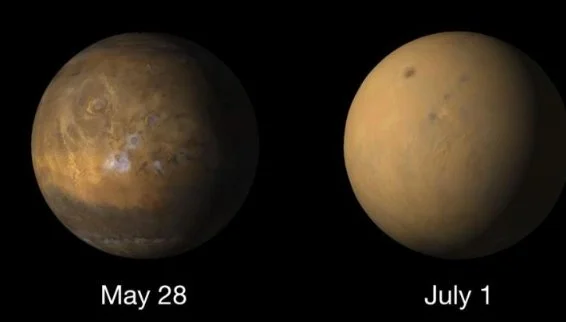
New Research Presented at NAM 2026 Suggests Solar Storms May Heat Mars' Lower Atmosphere During Dust Storms
Recent findings presented at the National Astronomy Meeting (NAM 2026) by the Royal Astronomical Society indicate that solar storms may have a significant impact on Martian weather, particularly when they coincide with large global dust storms. This revelation raises intriguing questions about the complexities of the Martian atmosphere and meteorology.
Solar storms could potentially influence the weather conditions on Mars during the occurrence of substantial dust storms. This assertion is based on a pioneering study that uncovered compelling evidence of rising temperatures in the Martian lower atmosphere when these two phenomena coincided. The implications suggest that Mars may possess a more intricate atmospheric environment and meteorological system than previously understood.
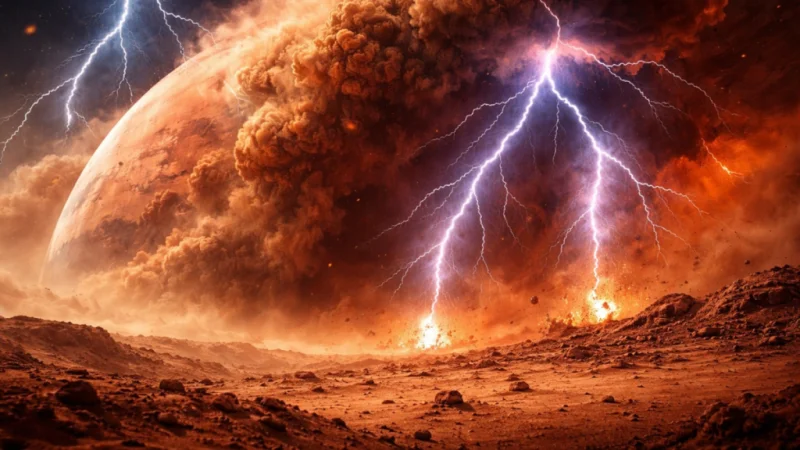
Analyzing Five Events: One Surprising Outcome
A team of astronomers from Lancaster and Leicester Universities, in collaboration with the Instituto de Astrofisica de Andalucia-CSIC in Granada, Spain, investigated five solar energetic particle events on Mars to determine if prolonged episodes could elevate the temperatures of the lower Martian atmosphere, where the planet's weather is generated. While four of the events showed no significant effects, the fifth, which occurred in June 2018, unexpectedly coincided with the expansion of a global dust storm—an event that ultimately silenced NASA's Opportunity rover.
Lana Williams, a researcher at Lancaster University, noted that dust storms were not initially part of their investigation. Thus, discovering one occurring simultaneously with the temperature increase was an unexpected finding. This suggests that the atmosphere and weather on Mars may react to multiple overlapping events rather than to independent heating sources.
Beyond Simple Heating from Dust
Dust storms naturally warm certain regions of the Martian atmosphere by absorbing sunlight. However, the researchers indicated that the heating pattern observed was anomalous compared to what would be expected from a dust storm alone.
Missions That Enabled the Study
Previous observations have shown that solar storms can produce auroras, increase surface radiation levels on Mars, and accelerate the loss of the planet's atmosphere into space. The MAVEN spacecraft, operational from 2014 until the loss of signal in 2025, orbited Mars studying the planet's upper atmosphere and its interaction with solar activity and solar wind. Meanwhile, the ExoMars Trace Gas Orbiter, a joint mission of ESA and the Russian agency Roscosmos, has been orbiting Mars since October 19, 2016, conducting scientific observations since 2018.
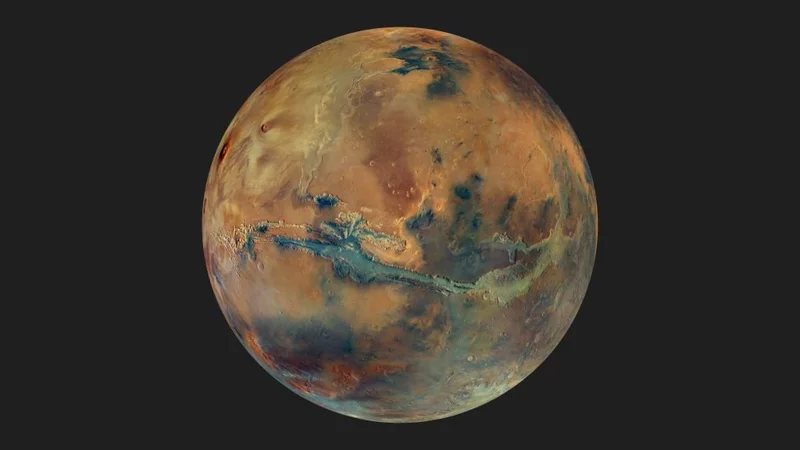
A Result Yet to Be Confirmed
The researchers emphasize the preliminary nature of their findings: this is a singular observation rather than a statistically confirmed effect. Further analysis of future solar energetic particle events will be necessary to determine whether the phenomenon observed in 2018 is an isolated incident or indicative of a genuine interaction between space weather and Martian climate. If validated, this discovery could have significant practical implications, especially considering that the lower atmosphere of Mars is where future astronauts will operate. Understanding how solar storms and dust storms may interact is crucial for the careful planning of human missions to the planet.