NASA's Psyche Spacecraft Completes Close Flyby of Mars, Capturing Stunning Time-lapse
NASA's Psyche spacecraft has successfully flown by Mars, capturing a stunning time-lapse of the planet while en route to a metallic asteroid, enhancing its mission objectives.
On May 15, 2026, NASA's Psyche spacecraft successfully executed a close flyby of Mars, coming within approximately 4,600 kilometers (2,800 miles) of the Martian surface while traveling at speeds exceeding 19,800 kilometers per hour. This flyby was not the mission's final destination but rather a critical waypoint as Psyche makes its way to the eponymous metallic asteroid located in the main asteroid belt between Mars and Jupiter, which it is set to reach in the summer of 2029.
The flyby served a dual purpose. Firstly, it allowed the spacecraft to gain gravitational assistance, increasing its velocity by about 1,600 kilometers per hour and slightly altering its orbital path around the Sun. Secondly, it provided the scientific team with an opportunity to calibrate the onboard instruments using Mars as a testing ground in preparation for the upcoming encounter with the metallic asteroid.
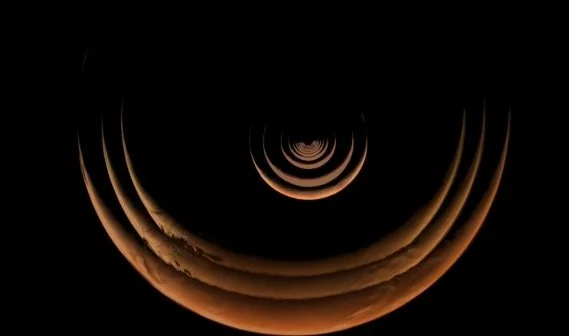
A Psychedelic Time-lapse
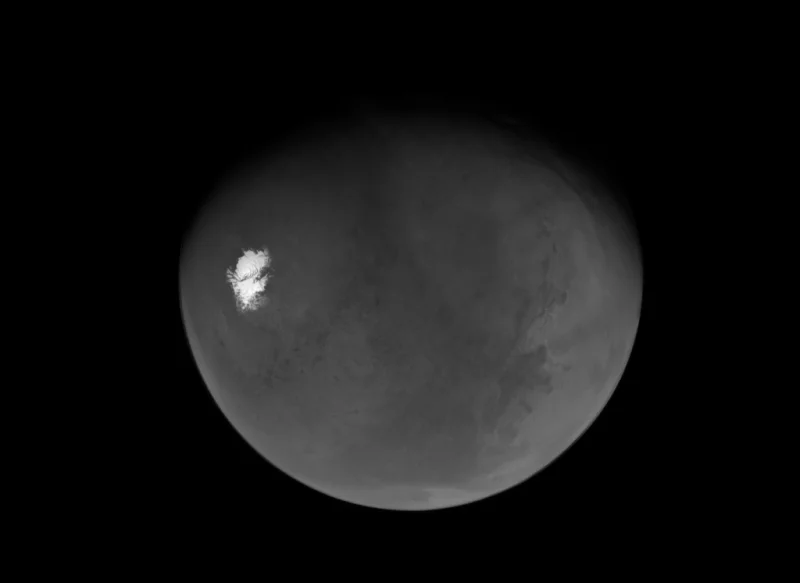
During May, the multispectral imager aboard the spacecraft captured an extensive series of images. NASA compiled these images into a time-lapse video that showcases Mars transitioning from a slender crescent in the night sky to a crater-filled landscape illuminated by sunlight, before fading back into darkness. The result is a vibrant and almost dreamlike mosaic created by combining various multispectral acquisitions.
Among the details captured are the southern polar ice cap of Mars, which is approximately 700 kilometers wide and rich in water ice, as well as the famous Huygens crater, noted for its double-ringed structure. The images also facilitated a better observation of the so-called "bow shock" of Mars, the region where the planet's magnetic field deflects solar wind particles, similar to how a ship's bow channels waves.
Successful Instrument Testing Around Mars
In addition to the camera, the other scientific instruments on board also passed their tests successfully. The gamma-ray and neutron spectrometer, which will be used to identify chemical elements on the surface of the Psyche asteroid, recorded an increased counting rate that aligned with predictions during the closest approach.
The magnetometer, operational since the spacecraft's launch in 2023, continued to gather valuable data to test the mission's central hypothesis: that the Psyche asteroid is actually the exposed metallic core of an ancient planetesimal, a remnant from the formation of rocky planets.
Onward to the Psyche Asteroid
Launched in 2023 aboard a SpaceX Falcon Heavy rocket, the Psyche spacecraft is approximately the size of a single tennis court and is powered by solar energy. The navigation team confirmed that the trajectory achieved after the Mars flyby is precisely what is needed for the rendezvous with the asteroid in 2029. Given the stunning visuals captured of Mars, scientists are optimistic that the arrival at the final destination will yield even more extraordinary discoveries.