NGC 2392: A Dying Star Observed by the JWST
The James Webb Space Telescope has observed the planetary nebula NGC 2392, a dying star in the constellation Gemini, known by various names including the Clown Nebula. Discover its stunning features and colors.
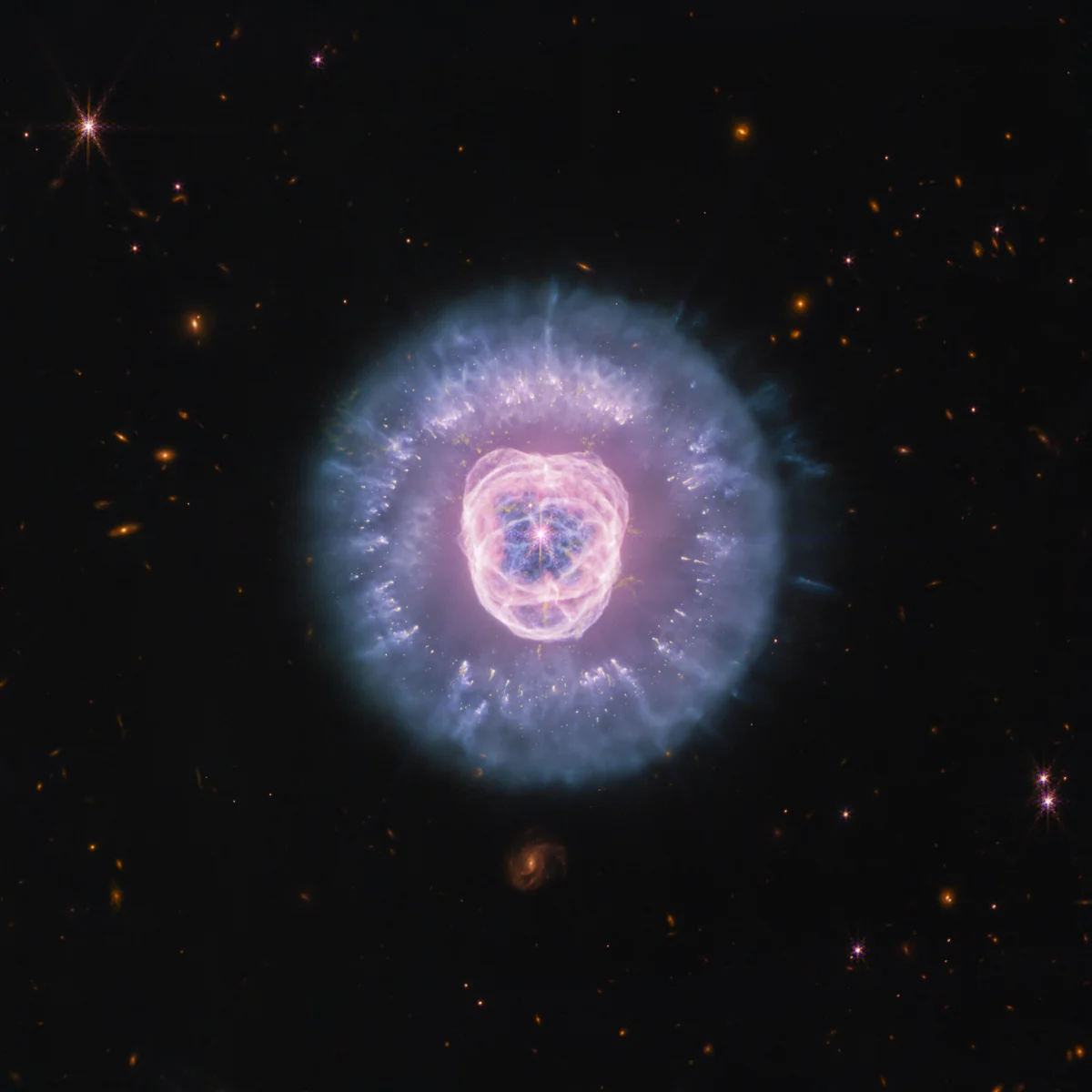
The James Webb Space Telescope (JWST) has recently turned its gaze towards the planetary nebula NGC 2392, a dying star located in the constellation Gemini. This celestial object, also known as the Clown Nebula, the Eskimo Nebula, or the Lion Nebula, continues to captivate astronomers with its stunning features.
One reason NGC 2392 may look different from its classic clown-like appearance is due to the color palette used to represent the infrared radiation captured by the JWST's MIRI and NIRCam instruments. Infrared radiation, which falls below the red spectrum, is not visible to the human eye. To make this data comprehensible, it is translated into visible colors.
The JWST team has assigned specific colors to various wavelengths: radiation at 1.15 µm is depicted in blue, 1.87 µm in cyan, 2.12 µm in yellow, 3.35 µm in orange, and 10 µm in red. Consequently, the nebula takes on a general hue of purple and blue, even though its true color, as perceived by the human eye, leans towards red. This red corresponds to a wavelength of approximately 0.7 µm, while the JWST observes much further into the spectrum, leading to a necessary visual transformation.
Despite these adjustments, the resemblance between the traditional depiction of NGC 2392 and the new images from Webb is striking. In both representations, the layers of gas expelled by the dying star at the center maintain a similar profile. Dust condensations that obscure the warm radiation from the contracting star are also visible, creating rays that emanate from the center. However, a noticeable difference is the background; the image captured by the Hubble Space Telescope in 2000 presents a black sky, while the JWST image is adorned with distant galaxies, showcasing its capability to observe the universe in greater detail.
As for NGC 2392, which shines brightly at a distance of 6,000 light-years in Gemini, the debate continues regarding its common name: should it be referred to as the Clown Nebula, the Eskimo Nebula, or the Lion Nebula? The choice remains a topic of discussion among astronomers and enthusiasts alike.